Gold Trading Alert: A double whammy of a falling US dollar and Treasury bonds sends gold prices plummeting to a two-month low! Is the battle to defend $4,000 underway?
2026-10-08 07:24:18
On Wednesday (October 7), the global gold market experienced a heavy sell-off. Spot gold fell 1.3% to close at $4,109.78 per ounce, after hitting a low of $4,066.30 during the session, its lowest level since August 5. December-delivery US gold futures fell 1.1% to settle at $4,140.70 per ounce. Meanwhile, silver fell 3%, platinum fell nearly 4%, and palladium fell to its lowest level in over a year. The precious metals sector was almost entirely under pressure, and market sentiment suddenly cooled. On the surface, this was a price correction triggered by a stronger dollar and high US Treasury yields; at a deeper level, it represents a repricing of the market's expectation that interest rates will remain high for a longer period. Gold, as a non-interest-bearing asset, temporarily lost its luster in the face of the dollar and US Treasury bonds. However, on the other hand, the People's Bank of China has increased its gold reserves for 23 consecutive months, geopolitical conflicts continue to escalate, and high oil prices continue to cast a shadow of inflation. Amidst a fierce tug-of-war between bulls and bears, the $4,000 mark has become the most crucial point of observation for the gold market. In early Asian trading on Thursday (October 7), spot gold fluctuated narrowly, currently trading around $4,110 per ounce. 
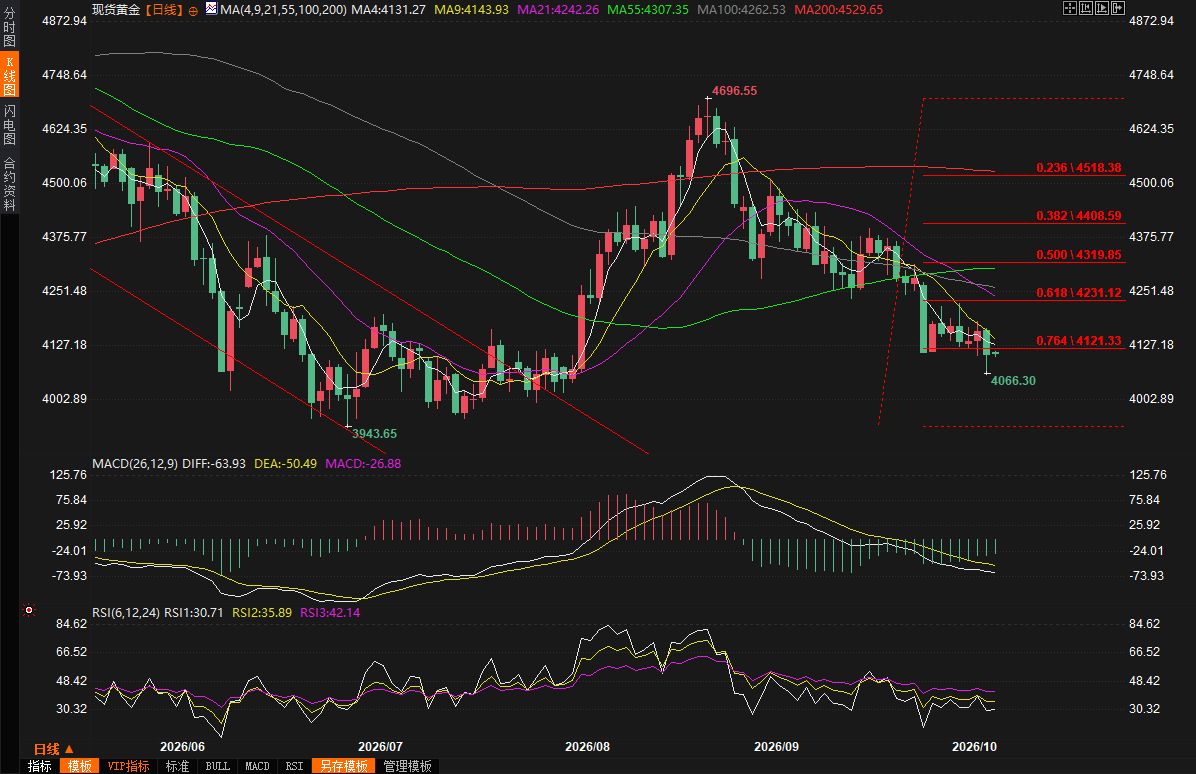 (Spot gold daily chart, source: FX678) At 07:19 Beijing time, spot gold is currently trading at $4110.81 per ounce.
The double whammy of a falling dollar and US Treasury bonds has caused the opportunity cost of interest-free gold to soar.
The most direct drivers of this round of gold price declines came from the US dollar and US Treasury yields. On Wednesday, the US dollar index rose approximately 0.4%, closing at 102.25, having reached a high of 102.50 during the session, approaching Monday's 18-month high of 102.53. The euro fell 0.53% against the dollar to $1.1198, nearing a 17-month low. Renewed concerns about French fiscal policy caused the yield on French 10-year bonds to surge 11.9 basis points to 4.8696%, the largest single-day increase in two weeks; the yield on German 10-year bonds remained unchanged at 3.4805%. Yields from heavily indebted European countries significantly underperformed safe-haven assets like Germany, further boosting demand for the US dollar as a safe haven. A stronger dollar makes dollar-denominated gold more expensive for holders of other currencies. Meanwhile, high US Treasury yields directly increase the opportunity cost of holding gold. The yield on the 10-year US Treasury note is at a more than 20-year high, having touched a 24-year high of 5.364% during the session; the yield on the 30-year Treasury note also reached a 24-year high, last quoted at 5.669%. Although the $39 billion 10-year Treasury auction performed strongly, with a winning bid rate of 5.300%, lower than the market yield at the bid close, and a bid-to-cover ratio of 2.77, higher than the average of 2.54 in the previous six auctions, primary dealers were allocated only 2.5% of the issuance, the lowest proportion since the end of the global financial crisis, driving yields back from their highs. However, overall yield levels remain historically high. More noteworthy is the "bearish steepening" of the yield curve. The spread between the two-year and 10-year Treasury yields widened from 48.1 basis points to 52.2 basis points, reaching a high of 53.7 basis points during the session, the highest since mid-August. This trend typically reflects rising inflation expectations. For gold, this means that while short-term interest rate expectations have fluctuated, long-term inflation and fiscal risks are still unfolding. In the short term, however, the combination of high yields and a strong dollar will continue to put downward pressure on gold prices.The Fed meeting minutes revealed divisions, with "higher and longer" remaining the dominant theme.
Following the release of the minutes from the Federal Reserve's September meeting, market expectations for the policy path have become more nuanced. The Fed unanimously voted to raise interest rates by 25 basis points at its September 15-16 meeting, but policymakers were clearly divided on the rationale for the hike. "Some participants" believed a rate hike was necessary to prevent broader impacts from energy and other price shocks; however, more hawkish core officials argued that a rate hike was necessary to prevent emerging demand-driven inflation. The minutes also showed that "most participants" believed it would be appropriate to raise the target range for the federal funds rate again before the end of the year; "several participants" even stated that the current policy rate was not restrictive, or only slightly restrictive. Currently, investors expect the Fed to keep the policy rate range unchanged at 3.75%-4.00% at its October 27-28 policy meeting. The CME Group's FedWatch tool shows a 19.4% probability of the Fed raising rates by at least 25 basis points later this month, down from about 38% a week ago; however, the market expects an 83% to 85% probability of a rate hike at the Fed's December 8-9 meeting. Kansas City Fed President Schmid stated that curbing inflation may require further interest rate hikes; San Francisco Fed President Daly, however, indicated that the policy path will depend on the persistence of inflationary pressures. New York Fed President Williams and Vice Chairman Jefferson, on the other hand, leaned towards patience regarding further rate hikes last week. This divergence suggests that intense debate continues within the Fed, but the core signal received by the market remains unchanged: interest rates will remain high for an extended period. Peter Grant, Vice President and Senior Metals Strategist at Zaner Metals, bluntly stated that the market's message is that interest rates will remain high for a longer time, providing support for yields and the dollar. For gold, this is undoubtedly a shackle that is difficult to shake off in the short term.Oil Market and Geopolitical Conflicts: Inflation Flames Remain Unextinguished
High energy prices are a major driver of persistent inflation. Brent crude settled at $100.20 per barrel, while U.S. crude settled at $88.28 per barrel. The International Energy Agency (IEA) agreed to accelerate the release of oil reserves, prioritizing diesel, to curb record fuel prices, with an estimated 100 million barrels of oil expected to be released into the market; France also released 10 million barrels of diesel from its strategic reserves. As a result, oil prices closed lower amid volatile trading. However, data from the U.S. Energy Information Administration showed that U.S. crude oil inventories fell by 3.2 million barrels to 424.1 million barrels in the week ending October 2, compared to analysts' expectations of a 1.7 million barrel increase. Distillate fuel inventories declined, while gasoline inventories increased. Coupled with the potential loss of approximately 11.2 million barrels of crude oil production due to the Gulf of Mexico storm, attacks on Russian oil facilities in Ukraine, and reduced refining volumes in the Middle East, the fuel market remains tight. Geopolitically, the Houthi rebels intensified their attacks on Saudi airports, with attacks on King Khalid International Airport and Abha Airport in Riyadh resulting in 3 deaths and 36 injuries. The Houthi rebels also warned all international airlines using Saudi airspace to cease operations, further escalating the conflict between Saudi Arabia and the Houthis. The crucial Bab el-Mandeb Strait faces increased threat, fueling concerns about regional oil supplies and exacerbating inflation worries. Currently, the market is more focused on inflation and central bank tightening. The allure of the US dollar and US Treasury yields has overshadowed gold's safe-haven appeal, and gold prices have failed to find significant support. Furthermore, SpaceX is seeking $40 billion in financing to purchase Nvidia chips, planning to raise approximately $10 billion in bank loans and $30 billion in investment-grade bond financing. Analysts worry that if SpaceX enters the investment-grade bond market, it could trigger a "crowding-out effect," with large-scale corporate financing competing with longer-term US Treasury bonds for investor funds. This competition for capital could indirectly disrupt the bond market and yields, thus affecting gold pricing.The People's Bank of China has increased its holdings for 23 consecutive months, with official purchases acting as a hidden support.
Amidst the sharp drop in gold prices, data released by the People's Bank of China (PBOC) has attracted particular attention. Gold reserves stood at 77.47 million ounces at the end of September, an increase of 740,000 ounces from the previous month, marking the 23rd consecutive month of increases. Grant stated that official demand for gold is the main supporting factor. He believes that gold prices may fall further, perhaps as low as $4,000, before rebounding by the end of the year and potentially reaching $4,400. The PBOC's continued increase in gold holdings reflects a long-term strategy of reserve diversification, hedging against dollar credit risk, and addressing geopolitical uncertainties. Even with the withdrawal of short-term speculative funds, official buying continues to provide significant bottom support for the market. The 23 consecutive months of increases also send a signal to the market: gold remains a worthwhile strategic asset to allocate during price corrections. This signal cannot be ignored by ordinary investors.Precious metals were under pressure across the board, with silver, platinum, and palladium faring even worse.
Gold wasn't the only precious metal to decline. Silver fell 3% on Wednesday, platinum dropped over 4%, and palladium hit a more than one-year low. This indicates that a strong dollar and high real interest rates are suppressing the entire precious metals sector. Silver possesses both financial and industrial attributes, while platinum and palladium are more influenced by expectations of demand from the automotive and industrial sectors, thus their declines are more pronounced under macroeconomic pressure. The synchronized weakness within precious metals suggests that macroeconomic forces, rather than supply and demand issues specific to gold, are currently driving prices. If the dollar and US Treasury yields remain high, the upside potential for precious metals will be limited; however, if interest rate expectations ease, silver and other commodities may experience greater resilience.Market Outlook: The Battle to Defend $4,000 – Can It Reach $4,400 by the End of the Year?
In the short term, gold faces triple pressure: a strong US dollar index, high US Treasury yields, and expectations of a December rate hike by the Federal Reserve. If the October meeting keeps interest rates unchanged, it may provide a brief respite, but internal divisions and hawkish comments revealed in the meeting minutes will still limit the rebound. If the 10-year US Treasury yield rises again, gold prices may test the psychological level of $4,000. In the medium term, supporting factors are equally evident. The People's Bank of China's 23 consecutive months of gold purchases, escalating geopolitical conflicts, French fiscal concerns and a weak euro, high oil prices, persistent inflation, and the crowding-out effect of the US fiscal deficit and large-scale financing by SpaceX on the bond market—all these factors could reignite demand for gold as a safe haven and store of value. Grant predicts that gold prices may rebound to $4,400 by the end of the year. Going forward, investors need to pay close attention to the Federal Reserve meetings on October 27-28 and December 8-9, US employment and inflation data, the International Energy Agency's reserve release progress, Houthi attacks, the French budget situation, and US Treasury auctions. $4,000 is a watershed between bull and bear markets; if it holds, a rebound is expected by the end of the year, while a drop below it could trigger a deeper correction. (Spot gold daily chart, source: FX678) At 07:19 Beijing time, spot gold is currently trading at $4110.81 per ounce.
- Risk Warning and Disclaimer
- The market involves risk, and trading may not be suitable for all investors. This article is for reference only and does not constitute personal investment advice, nor does it take into account certain users’ specific investment objectives, financial situation, or other needs. Any investment decisions made based on this information are at your own risk.