With an 80% probability of a Fed rate hike in December, how far can the gold rebound go?
2026-10-08 11:08:18
Spot gold edged higher on Thursday (October 8), boosted by a pullback in the dollar from an 18-month high. Gold prices rebounded from a two-month low hit in the previous session, reaching a high of $4,143.28 per ounce before trading around $4,130 per ounce. 
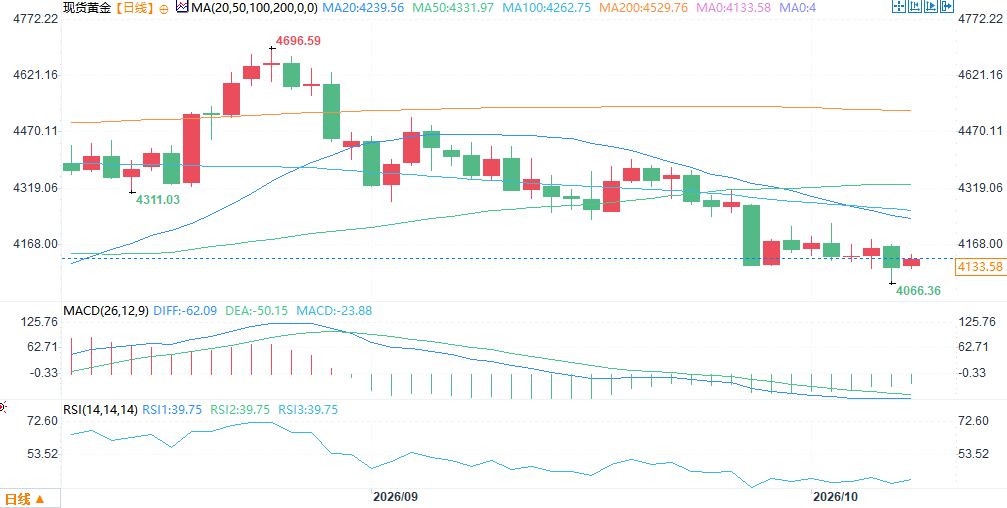 (Spot gold daily chart, source: FX678) At 11:06 Beijing time, spot gold was trading at $4132.30 per ounce.
Gold has rebounded from a two-month low, but its short-term investment rationale remains challenged.
Spot gold rose slightly on Thursday as the dollar retreated from an 18-month high, allowing gold prices to rebound from a two-month low hit in the previous session. On Wednesday, gold prices briefly fell to their lowest level since August 5, primarily pressured by a stronger dollar and rising U.S. Treasury yields. Pepperstone's head of research, Weston, stated, "The short-term investment rationale for gold remains challenging. It's still a seller's market, and we need to see a break above $4275 for the near-term upside to be more constructive." This assessment implies that although gold has rebounded from its lows, the trend has not yet reversed, and $4275 is a key confirmation level that traders will be watching closely.If long-term yields are viewed as fiscal and credit risks, gold may decouple from bond yields.
Weston also pointed out a scenario where the relationship between gold and the bond market could change. He stated, "If the market begins to interpret rising long-term yields as a reflection of sovereign credit and fiscal risk, rather than stronger economic fundamentals, gold could begin to diverge positively from bond yields, and depreciation trades could return with greater force." This scenario is a potential trigger for a more sustained recovery in gold. Currently, rising long-term yields are interpreted as a sign of a strong economy and expectations of interest rate hikes, suppressing gold; if this interpretation shifts to fiscal and credit pressures, safe-haven demand for gold could return.The Fed's September minutes showed consensus in support for raising interest rates, but with differing reasons.
Policy expectations remain a headwind. The minutes of the Fed's September meeting showed that all policymakers supported a 25-basis-point rate hike, but for different reasons. Many saw a higher rate path as a prudent insurance against persistent inflation from energy and other price shocks, while others argued it was necessary based on their core economic outlook. Most officials believed another rate hike might be appropriate before the end of the year. The market has already priced this in. According to the CME FedWatch tool, traders see only an 18% probability of a rate hike at the Fed meeting later this month, but are pricing in an 80% probability of a December rate hike, up from nearly 69% on Wednesday morning before the minutes were released.The IMF warns that energy shocks, high debt, and AI risks threaten global growth.
The broader backdrop remains clouded. The head of the International Monetary Fund warned that energy shocks, high debt levels, and AI-related risks threaten global growth. For gold, the question is whether these concerns are beginning to manifest in the bond market as fiscal pressures—a trigger for a more sustainable recovery, as identified by Weston. Escalating tensions in the Middle East have so far hurt gold through higher oil prices, inflation, and interest rate expectations, so reports of a possible renewed US strike on Iran are likely to suppress rather than support gold prices unless they trigger broader risk aversion. The reopening of trading in Shanghai after the Gold Week holiday adds to the test of Chinese physical demand.Summarize
Gold rebounded from a two-month low on Thursday as the dollar retreated from an 18-month high, but Pepperstone's Weston said the short-term investment rationale remains challenging, requiring a break above $4,275 for a more constructive move. If the market begins to view rising long-term yields as fiscal and credit risks, gold could decouple from bond yields, and depreciation trades could return. The Fed's September minutes showed consensus in support for rate hikes, but with differing reasons; the market is pricing in an 80% probability of a December rate hike. The IMF warned of energy shocks, high debt, and AI risks threatening global growth. Future focus will be on the dollar's performance, US Treasury yields, the Fed's rate hike path, developments in the Middle East, and Chinese physical demand following the Shanghai Golden Week. If gold breaks above $4,275 or the market begins to view long-term yields as fiscal pressure, gold prices could receive more sustained support; if the dollar remains strong and rate hike expectations rise, gold could continue to face downward pressure. (Spot gold daily chart, source: FX678) At 11:06 Beijing time, spot gold was trading at $4132.30 per ounce.
- Risk Warning and Disclaimer
- The market involves risk, and trading may not be suitable for all investors. This article is for reference only and does not constitute personal investment advice, nor does it take into account certain users’ specific investment objectives, financial situation, or other needs. Any investment decisions made based on this information are at your own risk.