Trump says he no longer wants the Iran deal; is the US preparing for "massive bombing"?
2026-10-08 12:10:18
Brent crude futures rose more than 1% in Asian trading on Thursday (October 8), currently trading above $102 per barrel. Amid the rise in oil prices, the latest developments in the US-Iran situation have become the focus of market attention. US President Trump stated on Wednesday that he no longer wants to reach a deal with Iran, following reports that the US military is preparing for a possible strike against Iran, possibly before the Middle East elections. 
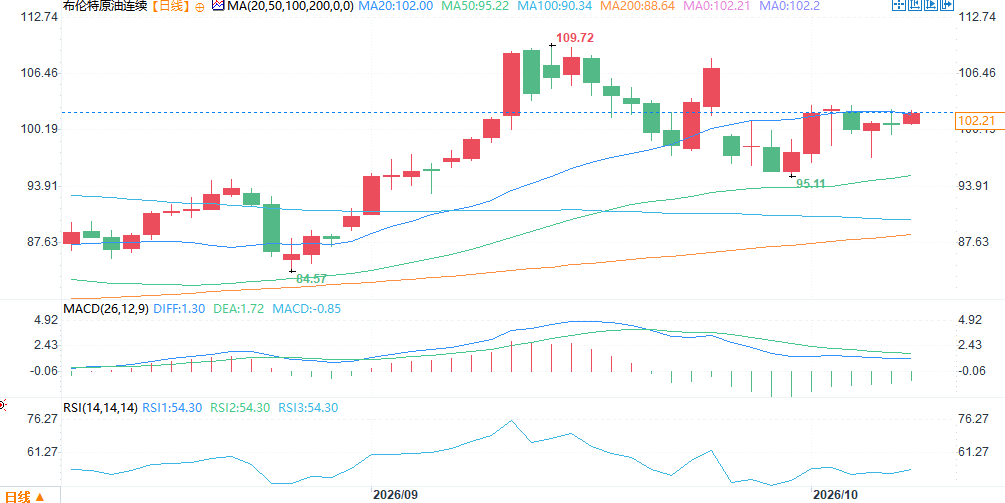 (Brent crude oil futures daily chart, source: EasyTrade) At 12:09 Beijing time, Brent crude oil futures were trading at $102.35 per barrel.
The United States is reportedly preparing to resume large-scale military operations, which may include "massive bombing."
Reports indicate that the US president and his national security team have discussed the possibility of resuming large-scale US military operations in the coming weeks. The reports suggest that a potential resumption of armed conflict could include "massive bombings" of Iranian energy, infrastructure, and nuclear targets, adding that military action could influence the outcome of the upcoming midterm elections. This report has exacerbated geopolitical uncertainty in the Middle East, supporting risk premiums in oil prices.Trump's approval ratings have plummeted to a record low, while soaring gasoline and diesel prices have sparked concerns.
Trump's approval rating has plummeted to a record low due to concerns about the high cost of living fueled by soaring gasoline and diesel prices. This political pressure could prompt Trump to take a tougher stance on Iran policy to divert domestic attention from economic problems. Ahead of the midterm elections, Trump faces competitive races in agricultural states, and record-high diesel prices are putting pressure on truck drivers and farmers, providing a political incentive for a hardline approach to Iran.Iranian officials refute Trump's claim that nobody knows who is governing Iran.
Earlier this week, Trump stated that Washington's biggest problem was that nobody knew who was managing Iran in negotiations to end the conflict. Iranian officials refuted these claims, saying "the problem is actually quite the opposite." Iranian Foreign Ministry spokesman Bagay noted "contradictory positions and mixed signals from US officials." This mutual accusation demonstrates a lack of mutual trust in the US-Iran negotiations, further undermining the prospects for an agreement.Middle Eastern exports have recovered to near pre-war levels, but oil prices remain high.
According to Kpler, Middle Eastern exports have recovered to near pre-war levels, but crude oil prices remain high. Gulf crude oil exports, excluding Iran and including those from Saudi Arabia and the UAE, are approximately 18.5 million barrels per day, roughly the pre-conflict level. Kpler's chief freight analyst stated, "Normalization no longer needs to wait for an agreement," predicting a "slower, more uneven normalization" amid the ongoing conflict, with transportation recovering through operational adaptations rather than waiting for a diplomatic trigger. This data suggests that supply recovery is being achieved through operational adjustments rather than diplomatic breakthroughs, but oil prices remain high due to attacks and geopolitical risks.Summarize
Trump has stated he is no longer keen on reaching a deal with Iran, and the US is reportedly preparing to resume large-scale military operations, potentially including a "massive bombing" of Iranian energy, infrastructure, and nuclear targets. Trump's approval rating has plummeted to a record low, and soaring gasoline and diesel prices have fueled concerns about the high cost of living, providing political motivation for a hardline stance on Iran ahead of the midterm elections. Iranian officials have refuted Trump's claim that no one knows who is governing Iran, highlighting a lack of mutual trust. Middle East exports have recovered to near pre-war levels, but oil prices remain high, with normalization achieved through operational adaptation rather than diplomatic triggers. Future developments will depend on whether the US actually resumes military operations, whether US-Iran negotiations have completely broken down, the sustainability of the Middle East export recovery, and the oil price's reaction to geopolitical risks. If military operations resume, the oil price risk premium could rise significantly; if negotiations restart, oil prices could give back some of the premium. Against the backdrop of ongoing conflict and diplomatic stagnation, the supply risk premium is unlikely to subside, and oil prices will continue to face upward pressure in the short term. (Brent crude oil futures daily chart, source: EasyTrade) At 12:09 Beijing time, Brent crude oil futures were trading at $102.35 per barrel.
- Risk Warning and Disclaimer
- The market involves risk, and trading may not be suitable for all investors. This article is for reference only and does not constitute personal investment advice, nor does it take into account certain users’ specific investment objectives, financial situation, or other needs. Any investment decisions made based on this information are at your own risk.