Declining inventories support prices, releasing reserves puts downward pressure on prices, and attacks add further chaos. Where will oil prices go from here?
2026-10-08 11:44:19
Oil prices rose on Thursday (October 8) amid continued concerns about supplies from key Middle Eastern oil-producing regions and increased shipping attacks in the Gulf and the Strait of Hormuz. Brent crude futures rose about 1.4% to above $102 a barrel; WTI crude futures rose about 1.6% to around $89.71 a barrel. Oil prices closed lower on Wednesday after the International Energy Agency agreed to accelerate the release of oil inventories and prioritize diesel supplies under a program launched in March, as governments sought to address supply disruptions caused by record fuel prices and the conflict with Iran. 
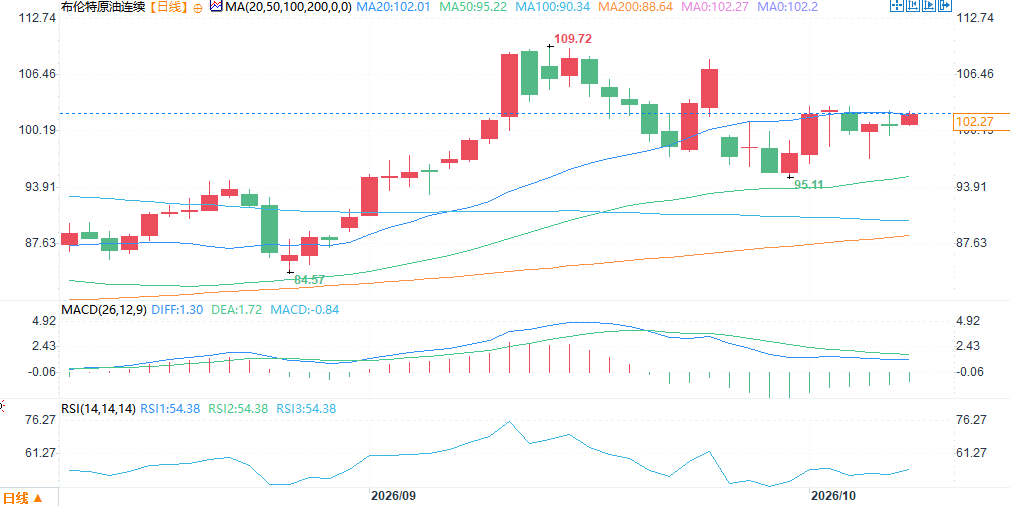 (Brent crude oil futures daily chart, source: FX678) At 11:41 Beijing time, Brent crude oil futures were trading at $102.14 per barrel.
Attacks on shipping in the Gulf and Hormuz have increased, with October seeing the highest number of attacks since the start of the conflict.
However, oil shipping threats in the Gulf and the Strait of Hormuz increased in October as the conflict between the US, Israel, and Iran entered its eighth month. The Strait of Hormuz previously carried approximately 20% of global oil and fuel shipments. Last week saw the highest number of tanker attacks through the Strait of Hormuz since the start of the conflict with Iran, as Gulf oil-producing nations increased exports. The increased attacks come as more crude oil is flowing out of the Gulf, but at a higher cost and pose greater risks to cargoes and crew. In the latest attack, the UK's Maritime Trade Action Group said on Wednesday that a tanker north of Qatar was hit by multiple projectiles, resulting in casualties.Oil-producing countries are willing to take the risks because there are no alternative routes to transport oil to international markets.
"In the past, such attacks have led to reduced shipments from the Persian Gulf," said Daniel Hines, senior commodities strategist at ANZ Bank, in a report on Thursday. "This time, producers seem willing to risk damage to their vessels because there is no alternative way to transport oil to international markets." Hines also stated that the International Energy Agency's oil releases may include barrels already included in the organization's original 400 million barrel release plan at the start of the Middle East conflict, meaning it does not appear to represent additional withdrawals from strategic reserves. He said, "Ultimately, strategic reserve releases can temporarily increase supply flows, but they don't create new capacity."US inventory data supported oil prices, with crude oil inventories falling more than expected.
Inventory data from the world's largest oil consumer and producer, the United States, supported prices as crude oil inventories fell more than expected, while diesel inventories declined slightly. The U.S. Energy Information Administration said Wednesday that crude oil inventories fell by 3.2 million barrels to 424.1 million barrels in the week ending October 2, compared with analysts' expectations of a 1.7 million barrel decrease. Distillate fuel inventories, including diesel and jet fuel, fell by 42,000 barrels to 105.14 million barrels, well below levels seen in the same period over the past five years.The IEA accelerated the release of inventory and G7 diesel, but was unable to create new production capacity.
Oil prices closed lower on Wednesday after the International Energy Agency agreed to accelerate the release of oil inventories and prioritize diesel supplies under a plan launched in March. The G7 countries, led by France, agreed to release diesel stocks under pressure from the Trump administration, though the amount was unclear. These releases are intended to address record fuel prices and supply disruptions, but Heins pointed out that these releases may simply be planned stockpiling rather than additional supply, and that strategic stockpile releases cannot create new production capacity. Market concerns about supply disruptions continue to dominate oil prices, especially given the ongoing shipping attacks in the Strait of Hormuz.Summarize
Oil prices rose on Thursday as Middle East supply concerns persisted and shipping attacks in the Gulf and the Strait of Hormuz increased. Last week saw the highest number of tanker attacks in the Strait of Hormuz since the start of the conflict, with a tanker in northern Qatar being hit and causing casualties. ANZ Bank stated that producers are willing to bear the risk of damaged vessels due to the lack of alternative routes. A larger-than-expected drop in US crude oil inventories supported prices. The IEA's accelerated release of inventories and G7 diesel releases are intended to address record fuel prices, but may simply be planned withdrawals and not create new capacity. Future developments will depend on whether the attacks on shipping in the Strait of Hormuz escalate, the evolution of the Middle East conflict, the actual impact of IEA and G7 inventory releases, US inventory data, and global diesel supply tightness. If attacks continue and supply disruptions worsen, oil prices could rise further; if the conflict eases or inventory releases are effective, prices could fall back. Given the persistent supply risk premium, oil prices still face upward pressure in the short term. (Brent crude oil futures daily chart, source: FX678) At 11:41 Beijing time, Brent crude oil futures were trading at $102.14 per barrel.
- Risk Warning and Disclaimer
- The market involves risk, and trading may not be suitable for all investors. This article is for reference only and does not constitute personal investment advice, nor does it take into account certain users’ specific investment objectives, financial situation, or other needs. Any investment decisions made based on this information are at your own risk.