A surge in US Treasury yields pushed the dollar higher, putting downward pressure on the NZD/USD exchange rate.
2026-10-08 13:46:18
The New Zealand dollar (NZD) traded in a range against the US dollar after a slight decline in the previous session. During the Asian trading session on Thursday (October 8), the pair remained in an upward range, trading around 0.5600. However, the market generally believes that the pair still faces further downward pressure, primarily driven by a stronger US dollar. The continued rebound in US Treasury yields, approaching their highest levels since 2002, has provided strong support for the US dollar and limited the NZD's upside potential. Market attention is focused on public speeches by Federal Reserve officials and subsequent interest rate decisions. Coupled with rising oil prices and inflation concerns, expectations for a Fed rate hike have intensified again. The Reserve Bank of New Zealand's rate hike path has also become another key variable influencing the NZD's performance.
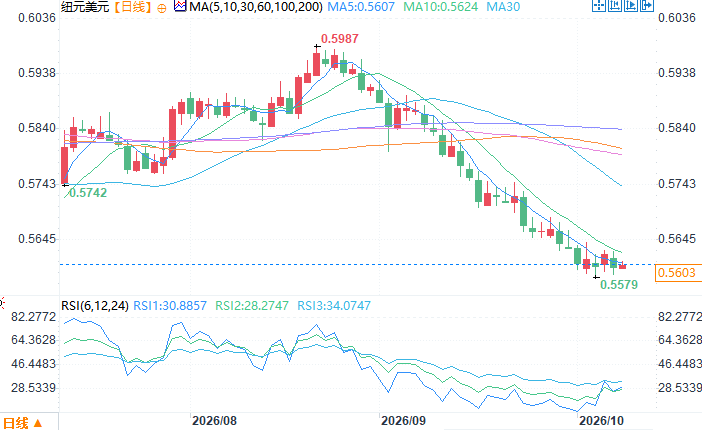 The New Zealand dollar is trading at 0.5600/01 against the US dollar at 13:43 Beijing time on October 8. Source: EasyTrade.
US Treasury yields surged; speeches by Federal Reserve officials will provide directional signals.
The yield on the 10-year US Treasury note is trading around 5.31%, while the yield on the 30-year Treasury note has reached 5.70%. The continued rise in long-term US Treasury yields directly boosts the attractiveness of dollar assets, putting general pressure on non-US currencies. Traders are closely awaiting public statements from Federal Reserve officials, with Christopher Waller and Alberto Musalem scheduled to speak. The market hopes to glean clues about the Fed's future monetary policy direction from their remarks. The recent rapid rise in international oil prices has reignited concerns about sticky inflation, increasing the market's perception that the Fed is more likely to maintain high interest rates or even continue raising them. The minutes of the Fed's last policy meeting showed that policymakers unanimously supported a rate hike in September, with the vast majority of officials agreeing that another rate hike is necessary before the end of 2026. The market generally expects the Fed to keep interest rates unchanged at its October meeting, but data from the CME FedWatch Tool shows that traders are still pricing in a 78.3% probability of a December rate hike.The US dollar reversed its divergent trend and strengthened across the board among major G10 currencies.
Scotiabank strategists point out that the US dollar has regained its dominant position among major currencies. They state that after a period of divergent performance among G10 currencies, the dollar has once again demonstrated a comprehensive strengthening trend after nearly a week. This round of broad-based dollar appreciation contrasts sharply with the mixed performance and significant divergence seen in the previous trading days, marking a clear shift in the dollar's short-term trend. Previously, G10 developed economy currencies showed mixed performance, with some currencies exhibiting independent trends based on their own fundamentals, resulting in a relatively volatile dollar index. However, with rising US Treasury yields and renewed expectations of a Fed rate hike, the dollar has gained widespread buying support, beginning to suppress non-US currencies, including the New Zealand dollar, and the main logic of the foreign exchange market has returned to the strength of the US dollar.The Reserve Bank of New Zealand's interest rate hike expectations are fully priced in; the October decision will influence the New Zealand dollar's outlook.
The Reserve Bank of New Zealand (RBNZ) has already raised its benchmark interest rate by 25 basis points, and financial markets are now pricing in further monetary tightening measures from the RBNZ. The money market has fully priced in another rate hike in December, and investors are closely watching the RBNZ's policy decision scheduled for October 28th. The RBNZ's monetary policy is a key domestic variable determining the New Zealand dollar's (NZD) exchange rate. If the RBNZ adopts a hawkish stance and continues its rate hike path, it will be able to offset some of the negative impact of a stronger US dollar and support the NZD. However, if the RBNZ signals a dovish stance, suggesting that the current rate hike cycle is likely over, then the downward pressure on the NZD against the US dollar will further increase in the context of a strong US dollar. The current temporary stabilization of the NZD/USD at the 0.5600 level is essentially the result of a battle between bullish and bearish forces. The divergence in monetary policy expectations between the two countries will dominate the medium-term trend of this currency pair.Conclusion
In summary, the New Zealand dollar is expected to maintain a volatile pattern against the US dollar in the short term, but fundamental factors are predominantly negative. Long-term US Treasury yields are approaching multi-year highs, and inflation concerns are increasing the probability of a Fed rate hike in December, leading to a broad strengthening of the US dollar among G10 currencies and putting significant downward pressure on the New Zealand dollar. The market is awaiting speeches from Fed officials for policy signals, while closely watching the Reserve Bank of New Zealand's October policy meeting to observe the extent of tightening in New Zealand's domestic monetary policy. Fluctuations in the US dollar and US Treasury yields, as well as the interplay of policy expectations between the two central banks, will continue to dominate the New Zealand dollar's exchange rate movement against the US dollar, and short-term volatility risks in the foreign exchange market should not be ignored. The New Zealand dollar is trading at 0.5600/01 against the US dollar at 13:43 Beijing time on October 8. Source: EasyTrade.
- Risk Warning and Disclaimer
- The market involves risk, and trading may not be suitable for all investors. This article is for reference only and does not constitute personal investment advice, nor does it take into account certain users’ specific investment objectives, financial situation, or other needs. Any investment decisions made based on this information are at your own risk.