Gold Trading Alert: Gold Prices Rebound from Two-Month Low, But Is the Debt Crisis the Real "King of Bombs"?
2026-10-09 07:48:16
On Thursday (October 8), the global gold market finally saw a rebound after hitting a two-month low in the previous trading day. Spot gold rose 0.58% to close at $4,133.65 per ounce; US gold futures for December delivery closed up 0.4% at $4,157 per ounce. On the surface, this appears to be a small rise, but behind it lies a complex web of factors, including high uncertainty surrounding the Federal Reserve's policy path, escalating concerns about US debt, the fluctuating relationship between the dollar and US Treasury yields, the risks of conflict in the Middle East and the Strait of Hormuz, the inflationary shadow cast by high oil prices, and the political and debt crisis in the Eurozone. Gold is at a crossroads of intense competition between bulls and bears; any shift in either side could trigger the next major price movement. On Friday (October 9) in early Asian trading, spot gold fluctuated slightly higher, currently trading around $4,142.60 per ounce.  Spot gold touched its lowest level since August 5 on Wednesday, dragged down by a stronger dollar and rising U.S. Treasury yields. While gold prices rebounded slightly on Thursday, market sentiment remained cautious. The dollar and the 10-year U.S. Treasury yield had risen for the second consecutive trading day, putting direct pressure on non-interest-bearing gold, as rising interest rates increase the opportunity cost of holding it. However, with robust demand at the U.S. 30-year Treasury auction, yields retreated from their highs, and the dollar index also fell 0.14% to 102.11. A weaker dollar typically supports dollar-denominated gold, while lower yields ease valuation pressures. This interplay of bullish and bearish factors has created a fragile balance for gold prices near two-month lows.
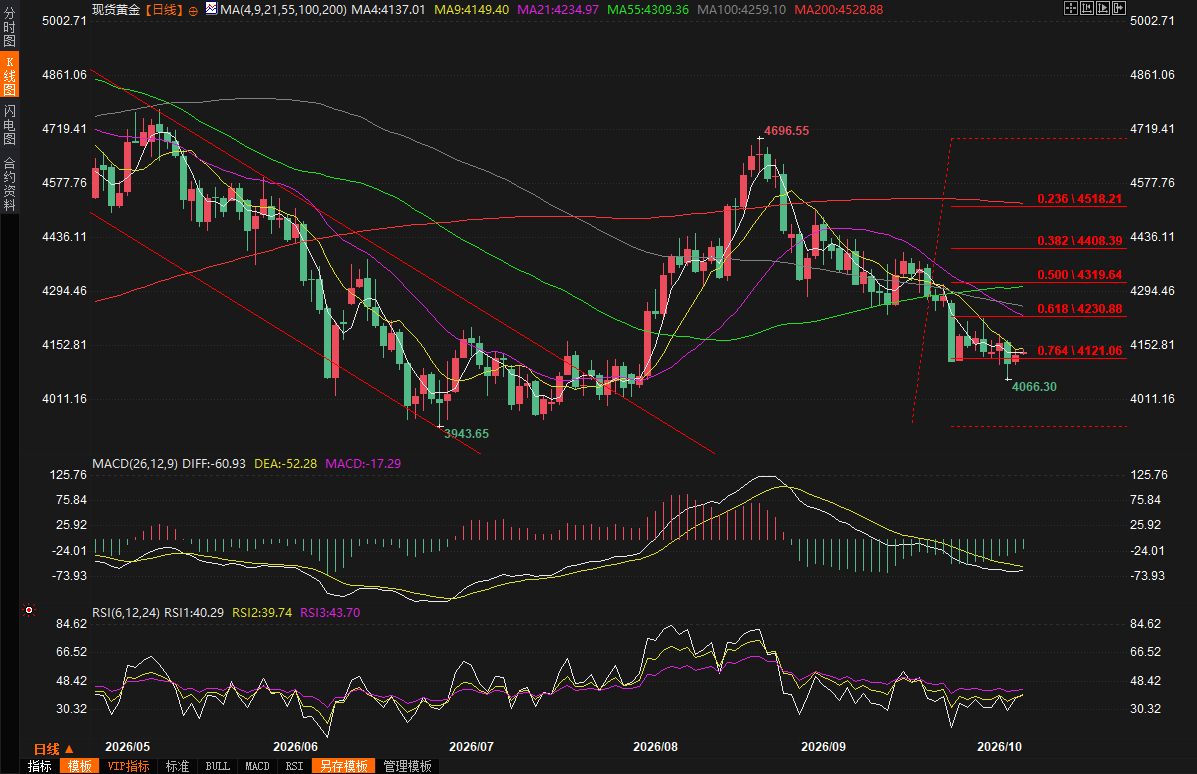 (Spot gold daily chart, source: EasyTrade) At 07:44 Beijing time, spot gold is currently trading at $4140.82 per ounce.
Spot gold touched its lowest level since August 5 on Wednesday, dragged down by a stronger dollar and rising U.S. Treasury yields. While gold prices rebounded slightly on Thursday, market sentiment remained cautious. The dollar and the 10-year U.S. Treasury yield had risen for the second consecutive trading day, putting direct pressure on non-interest-bearing gold, as rising interest rates increase the opportunity cost of holding it. However, with robust demand at the U.S. 30-year Treasury auction, yields retreated from their highs, and the dollar index also fell 0.14% to 102.11. A weaker dollar typically supports dollar-denominated gold, while lower yields ease valuation pressures. This interplay of bullish and bearish factors has created a fragile balance for gold prices near two-month lows.The Fed's Mystery: Divergent Meeting Minutes and Waller's "Flexible Rate Hikes"
The Federal Reserve is currently the biggest source of uncertainty in the gold market. Meeting minutes revealed a clear division among Fed policymakers last month regarding the rationale for raising interest rates. While "some participants" believed a rate hike was necessary to curb the impact of energy and other price shocks, the more hawkish core policymakers argued for a rate hike to prevent emerging demand-driven inflation. This means there isn't a truly predetermined policy path within the Fed. As WisdomTree commodity strategist Nitesh Shah noted, the minutes highlight the fact that policy doesn't have a fixed path, slightly increasing volatility in the gold market. Fed Governor Waller stated on Thursday that further rate hikes might be needed to push inflation down to the Fed's 2% target, but added that the pace of rate hikes has "flexibility" and leaves room for a pause in rate hikes in October. The CME Group's FedWatch tool shows traders see a 17% probability of a rate hike in October, but expect an 81% probability in December. This expectation is quite delicate for gold: if a pause in rate hikes does occur in October, gold may get a brief respite; however, if expectations of a December rate hike continue to strengthen, gold will remain under pressure. However, Jay Hatfield, CEO of Infrastructure Capital Management, believes that the 10-year US Treasury yield has peaked, possibly around 5.30% or even lower. He argues that the market's most pessimistic phase regarding Fed rate hikes has passed, and the Fed can only raise rates once more in this cycle, not the three times currently priced in by the market. If this assessment holds true, the interest rate pressures on gold may be nearing their end.Debt and Yield: The Emergence of Gold's "Opposite" Value
Beyond Federal Reserve policy, the high level of US debt is becoming an increasingly important narrative in the gold market. Nitesh Shah explicitly points out that rising yields seem to highlight growing market concerns about high debt levels. If debt continues to climb, gold, as the antithesis of fiat currency and government assets, is likely to be favored. This logic can also be found in bond market data. Demand for the US 30-year Treasury auction was robust, with a winning yield of 5.618%, lower than the expected rate at the bid deadline. The bid-to-cover ratio was 2.54 times, better than the average of 2.41 times in the previous six auctions. Indirect bidders, including foreign investors, were allocated 72.3%, also higher than the average of 69.1% in the previous six auctions. This indicates that despite the continued market sell-off, investors are still willing to buy long-term government bonds. However, the absolute level of yields remains high. The yield on the 10-year U.S. Treasury note fell 5 basis points to 5.227% on Thursday, after hitting a 24-year high on Wednesday; the yield on the 30-year Treasury note fell 5.9 basis points to 5.602%; and the yield on the two-year Treasury note dipped 1.3 basis points to 4.751%. The spread between the two-year and 10-year Treasury yields narrowed to 47.1 basis points from 51.4 basis points, after reaching a high of 54.2 basis points during the session, the widest since mid-August. The flattening yield curve reflects complex market expectations for economic growth and monetary policy prospects. For gold, high yields are a pressure, but debt concerns and fiscal risks are potential support. Once the market shifts from "interest rate trading" to "debt credit trading," gold's value as the antithesis of fiat currency and government assets will become more prominent.Geopolitical Risks and Oil Prices: The Tensions in the Strait of Hormuz
Geopolitically, the situation in the Middle East remains turbulent. Sources say that oil tankers attempting to transport critical goods through the Strait of Hormuz face increased risks of attack and intimidation after Iran again warned of blocking unauthorized shipping lanes. The Strait of Hormuz is a vital global energy transport route; any disruption to its passage would rapidly escalate oil prices and inflation expectations. On Thursday, Trump stated that the US would not launch an attack on Iran before the November midterm elections, and that the two countries were engaged in "productive" negotiations to end the six-month-long conflict. This conflict, which began in February when the US and Israel launched attacks on Iran, has caused a decline in Trump's domestic approval ratings and put significant pressure on his Republican colleagues. Recent polls show that about 60% of Americans disapprove of Trump's handling of the Iran situation, including a quarter of Republicans. Voters cited the cost of living as their biggest concern, and the conflict has driven gasoline prices sharply higher. The US and Iran have exchanged proposals in recent weeks aimed at ending the conflict and reopening the Strait of Hormuz, but Trump rejected Tehran's latest offer. Iranian state media reported on Thursday, citing the head of the country's Atomic Energy Organization, that Iran will not abandon uranium enrichment or hand over its uranium stockpile. Days earlier, US Vice President Vance stated that Iran must "substantially" reduce its uranium enrichment capacity. These reports suggest that geopolitical risks have not been resolved, and the safe-haven premium for gold remains supported. However, Trump's statement that he would not attack Iran before the midterm elections also caused a slight decline in oil prices. In terms of oil prices, Brent crude futures closed at $103.92 per barrel, up 3.7%; US crude futures closed up 3.4% at $91.17 per barrel, with both benchmarks rising by as much as $5 per barrel during the session. High oil prices will exacerbate inflation concerns, potentially forcing the Federal Reserve to maintain a hawkish stance, which is unfavorable for gold; however, inflation itself will also increase the demand for gold as an inflation hedge, so the impact of oil prices on gold is not one-way.Indirect signals from the US dollar and the euro
The foreign exchange market is also providing indirect clues for gold. The dollar fell on Thursday, the rise in eurozone government bond yields stalled, and market expectations for the Federal Reserve's interest rate path this year remained largely unchanged. A surge in oil prices briefly exacerbated inflation concerns, causing eurozone government bond yields to rise sharply again as investors continued to sell bonds from heavily indebted countries such as France and Italy. The yield on French 10-year bonds rose 2.7 basis points to 4.8873%, having earlier reached 4.9685%. France has been particularly hard hit, with investors examining the country's debt burden, budget deficit, and political outlook ahead of the 2027 presidential election. Spanish unions announced on Wednesday a nationwide strike on November 11 over housing issues, just weeks before snap elections. Christoph Schon, head of multi-asset class investment decision research at SimCorp, said there is another factor affecting the euro now: the political crisis in France, and now a similar problem in Spain. Therefore, the focus during this brief period is not on interest rate differentials or monetary policy, but on a very specific crisis facing the euro. The euro rose 0.08% against the dollar to $1.1204, after falling as low as $1.1171 earlier in the session. The dollar index fell 0.14% to 102.11. A weaker dollar typically supports gold, but expectations of a Fed rate hike still dominate the market. On the economic data front, the U.S. Labor Department reported that initial jobless claims fell by 2,000 to 197,000 last week, slightly below the 200,000 forecast by economists in a survey, continuing to indicate a stable job market. Stable employment data supports the Fed maintaining a hawkish stance, which to some extent limited gold's gains. St. Louis Fed President Musalaim also made a more hawkish statement, saying the Fed needs to raise interest rates again to bring inflation back to its 2% target level.Market Outlook: Where is Gold Heading Next?
In the short term, gold is fluctuating around $4140, with the October Fed meeting being a key turning point. If the Fed chooses to pause rate hikes, the dollar and US Treasury yields may fall, potentially leading to a more significant rebound in gold. If expectations of a December rate hike strengthen further, gold may retest two-month lows. In the medium term, rising US debt, fiscal and political risks in the Eurozone, and uncertainties surrounding the Middle East war and the Strait of Hormuz will all provide safe-haven buying opportunities for gold. In the long term, if the Fed's rate hike cycle is indeed nearing its end and real interest rates have peaked, gold's value as an asset allocation tool, the antithesis of fiat currency and government assets, will be re-emphasized. Investors need to closely monitor oil prices, inflation data, Fed officials' speeches, US Treasury auction results, and the progress of US-Iran negotiations. Overall, gold is currently not in a one-sided trend, but rather in a volatile pattern due to a high degree of interplay between bullish and bearish factors. Thursday's slight rebound was a result of the market's weighing of Fed policy uncertainty, escalating debt concerns, and rising geopolitical risks. If debt concerns continue to escalate, gold will shine as a safe haven; if expectations of a Fed rate hike rise again, gold may come under pressure and fall. (Spot gold daily chart, source: EasyTrade) At 07:44 Beijing time, spot gold is currently trading at $4140.82 per ounce.
- Risk Warning and Disclaimer
- The market involves risk, and trading may not be suitable for all investors. This article is for reference only and does not constitute personal investment advice, nor does it take into account certain users’ specific investment objectives, financial situation, or other needs. Any investment decisions made based on this information are at your own risk.