Crude Oil Trading Alert: Risks in the Strait of Hormuz and production cuts in the Gulf of Mexico continue to support oil prices; US crude oil continues to fluctuate at low levels.
2026-10-09 09:36:18
The international crude oil market oscillated between expectations of easing geopolitical tensions and the risk of supply disruptions. West Texas Intermediate (WTI) crude fell back to around $90.90 a barrel during Friday's Asian trading session, after rising nearly 2.5% in the previous session. US President Donald Trump stated that the US was having "productive discussions" with Iran and that there would be no attack on Iran before the US midterm elections. This statement briefly eased market concerns about further escalation of the military conflict, prompting some investors to take profits after a sharp rebound in oil prices.  However, the positive signals from diplomatic communications do not mean that the risks to crude oil supply have been eliminated. Trump also emphasized that despite a record amount of crude oil currently passing through the Strait of Hormuz, the US maritime blockade of Iranian ports will remain in full effect. The Strait of Hormuz remains a core variable affecting short-term oil prices. This waterway connects the Persian Gulf to the international energy transport network, handling approximately one-fifth of global oil consumption. In the past week, Iran has intensified its attacks on commercial shipping, involving nine vessels. If ship passage, insurance arrangements, or energy shipments are further disrupted, even if actual production in oil-producing countries does not immediately decrease, transport delays and increased risk premiums could push up international crude oil prices. Conversely, if substantial progress is made in US-Iran communications and shipping security improves, some of the geopolitical risk premiums previously priced into oil prices could quickly recede. Meanwhile, supply risks in the Gulf of Mexico also provide another layer of support for oil prices. Hurricane Isaias poses a serious threat to offshore oil production, forcing local producers to shut down approximately 1.3 million barrels per day of crude oil production capacity. The combination of weather-related production cuts and Middle East shipping risks creates multiple disruptions to the global supply side. It's important to note that shutting down production capacity does not necessarily equate to an equivalent scale of actual supply loss. The ultimate impact depends on the duration of the shutdown, the extent of facility damage, and the speed of production recovery. If the weather impact subsides quickly, supply pressures may ease; however, if the shutdown lasts longer, it could further tighten the short-term market balance. The impact of rising oil prices is also transmitting from the energy market to the global interest rate market. Scotiabank strategists point out that WTI crude oil rose by about $4 in a single day and regained its position above $90 per barrel, echoing the rise in US long-term Treasury yields. The yield on the 10-year US Treasury bond is approaching 5.35%, and the market faces the risk that it will rise further to multi-decade highs, levels approaching those since 2002. This reflects that investors are reassessing the impact of the energy price rebound on inflation, monetary policy, and bond valuations. Sustained increases in crude oil prices typically raise transportation, manufacturing, and energy consumption costs and may delay the decline in inflation. If inflationary pressures strengthen again, the Federal Reserve's room for interest rate cuts may be limited, and bond investors may demand higher yields to compensate for inflation and interest rate risks. However, the impact of rising oil prices on yields is not one-way: if the energy shock further dampens economic growth and triggers market risk aversion, capital flows and the economic outlook may offset some of the upward pressure driven by inflation. Therefore, the subsequent trend of US Treasury yields needs to be judged comprehensively in conjunction with inflation data, employment conditions, and Federal Reserve policy signals. The key to the current market is not just judging whether oil prices will rise or fall, but also identifying the speed of changes in risk premiums. If diplomatic progress is validated, shipping through the Strait of Hormuz remains unimpeded, and production in the Gulf of Mexico gradually recovers, oil prices may continue to digest previous gains. Conversely, if military action is implemented, commercial shipping is disrupted again, or weather-related production cuts last longer than expected, supply concerns may once again dominate the market. Due to the rapid changes in the situation, oil prices may still experience a high-volatility pattern in the short term, with rapid rises and sharp falls occurring simultaneously. From a fundamental perspective, the short-term trend of WTI is still mainly influenced by the US-Iran relationship, shipping conditions in the Strait of Hormuz, and the progress of production recovery in the Gulf of Mexico. Diplomatic easing may weaken geopolitical risk premiums, but maritime blockades and potential military action still limit the downside potential of oil prices. If supply risks continue to escalate, oil prices may retest recent highs; if the situation eases and production recovery proceeds simultaneously, a rapid retracement of risk premiums should be anticipated. From a daily chart perspective, WTI crude oil prices retreated to around $90.30 after a significant rise in the previous trading day, indicating increased divergence between bulls and bears above $90. $90 is a key psychological level to watch. If prices can stabilize above this area and subsequent buying pressure continues to strengthen, oil prices still have a chance to challenge the previous day's high and higher resistance areas. Potential resistance can be observed around $92, followed by the psychological level of $95; these are observation areas based on current pricing and not confirmed technical turning points. A decisive break below $90 could see the market further test the support area around $88. In terms of momentum, the pullback after the previous rapid rise suggests increased risk of chasing the rally in the short term, but current pricing alone is insufficient to confirm a reversal of the daily trend; further analysis of volume, moving average alignment, and subsequent closing performance is needed. From a 4-hour chart perspective, oil prices have pulled back after a rapid rise, entering a short-term directional decision-making phase. If prices stabilize around $90 and recover the local highs from the previous pullback, it may indicate that buyers still have a certain advantage, and the market is likely to resume its rebound. Conversely, if oil prices close below $90 consecutively and the rebound strength continues to weaken, they may further seek support around $88. Since complete 4-hour candlestick charts, moving averages, and Relative Strength Index (RSI) data are currently unavailable, it is impossible to reliably determine the degree of overbought/oversold conditions or confirm breakout signals. Trading should focus on the struggle around the $90 level and whether news related to the US-Iran situation drives prices to effectively break through or fall below key areas, avoiding chasing highs and lows based solely on news headlines.
 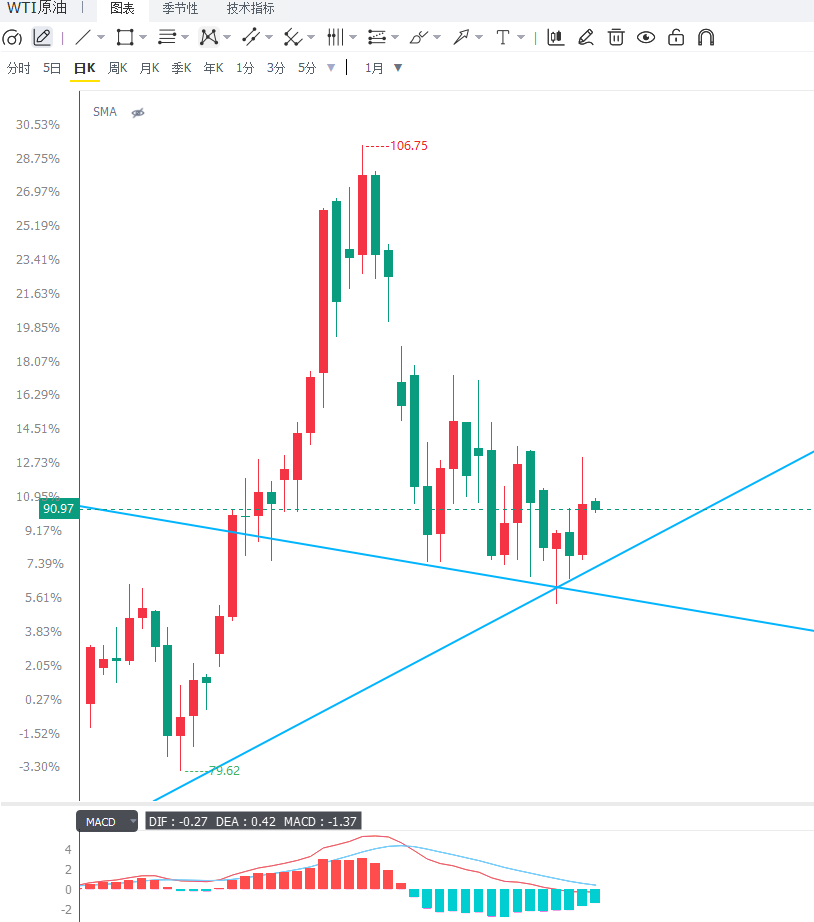 The editor summarizes that WTI crude oil is currently in a phase of tug-of-war between geopolitical risk premiums and expectations of supply recovery. Signals of dialogue between the US and Iran provided a direct trigger for a price correction, but the US maritime blockade, potential strikes on energy facilities, and weather-related production risks in the Gulf of Mexico mean that supply-side uncertainty remains high. At the same time, rising oil prices may exacerbate US inflationary pressures and affect risk appetite in global financial markets through rising Treasury yields. The key to future price movements lies in three developments: whether US-Iran communication can translate into actual easing of tensions, whether shipping in the Strait of Hormuz can remain stable, and whether production capacity shut down in the Gulf of Mexico can gradually recover. If risks ease and supply improves, oil prices may face further downward pressure; if shipping is disrupted or military risks escalate, oil prices may regain upward momentum. It is advisable to assess both the gap risk from geopolitical events and the risk of price pullbacks, focusing on price performance around $90, and using actual supply changes and technical trends as the basis for judgment.
However, the positive signals from diplomatic communications do not mean that the risks to crude oil supply have been eliminated. Trump also emphasized that despite a record amount of crude oil currently passing through the Strait of Hormuz, the US maritime blockade of Iranian ports will remain in full effect. The Strait of Hormuz remains a core variable affecting short-term oil prices. This waterway connects the Persian Gulf to the international energy transport network, handling approximately one-fifth of global oil consumption. In the past week, Iran has intensified its attacks on commercial shipping, involving nine vessels. If ship passage, insurance arrangements, or energy shipments are further disrupted, even if actual production in oil-producing countries does not immediately decrease, transport delays and increased risk premiums could push up international crude oil prices. Conversely, if substantial progress is made in US-Iran communications and shipping security improves, some of the geopolitical risk premiums previously priced into oil prices could quickly recede. Meanwhile, supply risks in the Gulf of Mexico also provide another layer of support for oil prices. Hurricane Isaias poses a serious threat to offshore oil production, forcing local producers to shut down approximately 1.3 million barrels per day of crude oil production capacity. The combination of weather-related production cuts and Middle East shipping risks creates multiple disruptions to the global supply side. It's important to note that shutting down production capacity does not necessarily equate to an equivalent scale of actual supply loss. The ultimate impact depends on the duration of the shutdown, the extent of facility damage, and the speed of production recovery. If the weather impact subsides quickly, supply pressures may ease; however, if the shutdown lasts longer, it could further tighten the short-term market balance. The impact of rising oil prices is also transmitting from the energy market to the global interest rate market. Scotiabank strategists point out that WTI crude oil rose by about $4 in a single day and regained its position above $90 per barrel, echoing the rise in US long-term Treasury yields. The yield on the 10-year US Treasury bond is approaching 5.35%, and the market faces the risk that it will rise further to multi-decade highs, levels approaching those since 2002. This reflects that investors are reassessing the impact of the energy price rebound on inflation, monetary policy, and bond valuations. Sustained increases in crude oil prices typically raise transportation, manufacturing, and energy consumption costs and may delay the decline in inflation. If inflationary pressures strengthen again, the Federal Reserve's room for interest rate cuts may be limited, and bond investors may demand higher yields to compensate for inflation and interest rate risks. However, the impact of rising oil prices on yields is not one-way: if the energy shock further dampens economic growth and triggers market risk aversion, capital flows and the economic outlook may offset some of the upward pressure driven by inflation. Therefore, the subsequent trend of US Treasury yields needs to be judged comprehensively in conjunction with inflation data, employment conditions, and Federal Reserve policy signals. The key to the current market is not just judging whether oil prices will rise or fall, but also identifying the speed of changes in risk premiums. If diplomatic progress is validated, shipping through the Strait of Hormuz remains unimpeded, and production in the Gulf of Mexico gradually recovers, oil prices may continue to digest previous gains. Conversely, if military action is implemented, commercial shipping is disrupted again, or weather-related production cuts last longer than expected, supply concerns may once again dominate the market. Due to the rapid changes in the situation, oil prices may still experience a high-volatility pattern in the short term, with rapid rises and sharp falls occurring simultaneously. From a fundamental perspective, the short-term trend of WTI is still mainly influenced by the US-Iran relationship, shipping conditions in the Strait of Hormuz, and the progress of production recovery in the Gulf of Mexico. Diplomatic easing may weaken geopolitical risk premiums, but maritime blockades and potential military action still limit the downside potential of oil prices. If supply risks continue to escalate, oil prices may retest recent highs; if the situation eases and production recovery proceeds simultaneously, a rapid retracement of risk premiums should be anticipated. From a daily chart perspective, WTI crude oil prices retreated to around $90.30 after a significant rise in the previous trading day, indicating increased divergence between bulls and bears above $90. $90 is a key psychological level to watch. If prices can stabilize above this area and subsequent buying pressure continues to strengthen, oil prices still have a chance to challenge the previous day's high and higher resistance areas. Potential resistance can be observed around $92, followed by the psychological level of $95; these are observation areas based on current pricing and not confirmed technical turning points. A decisive break below $90 could see the market further test the support area around $88. In terms of momentum, the pullback after the previous rapid rise suggests increased risk of chasing the rally in the short term, but current pricing alone is insufficient to confirm a reversal of the daily trend; further analysis of volume, moving average alignment, and subsequent closing performance is needed. From a 4-hour chart perspective, oil prices have pulled back after a rapid rise, entering a short-term directional decision-making phase. If prices stabilize around $90 and recover the local highs from the previous pullback, it may indicate that buyers still have a certain advantage, and the market is likely to resume its rebound. Conversely, if oil prices close below $90 consecutively and the rebound strength continues to weaken, they may further seek support around $88. Since complete 4-hour candlestick charts, moving averages, and Relative Strength Index (RSI) data are currently unavailable, it is impossible to reliably determine the degree of overbought/oversold conditions or confirm breakout signals. Trading should focus on the struggle around the $90 level and whether news related to the US-Iran situation drives prices to effectively break through or fall below key areas, avoiding chasing highs and lows based solely on news headlines. The editor summarizes that WTI crude oil is currently in a phase of tug-of-war between geopolitical risk premiums and expectations of supply recovery. Signals of dialogue between the US and Iran provided a direct trigger for a price correction, but the US maritime blockade, potential strikes on energy facilities, and weather-related production risks in the Gulf of Mexico mean that supply-side uncertainty remains high. At the same time, rising oil prices may exacerbate US inflationary pressures and affect risk appetite in global financial markets through rising Treasury yields. The key to future price movements lies in three developments: whether US-Iran communication can translate into actual easing of tensions, whether shipping in the Strait of Hormuz can remain stable, and whether production capacity shut down in the Gulf of Mexico can gradually recover. If risks ease and supply improves, oil prices may face further downward pressure; if shipping is disrupted or military risks escalate, oil prices may regain upward momentum. It is advisable to assess both the gap risk from geopolitical events and the risk of price pullbacks, focusing on price performance around $90, and using actual supply changes and technical trends as the basis for judgment.
- Risk Warning and Disclaimer
- The market involves risk, and trading may not be suitable for all investors. This article is for reference only and does not constitute personal investment advice, nor does it take into account certain users’ specific investment objectives, financial situation, or other needs. Any investment decisions made based on this information are at your own risk.