French fiscal uncertainty looms large, causing the euro to fall for the fifth consecutive week! Meanwhile, the dollar's strong momentum is showing signs of weakening.
2026-10-10 14:24:17
This week, the global foreign exchange market continued its divergent pattern amid a confluence of macroeconomic and political factors. The euro, pressured by both French fiscal risks and regional political uncertainty, closed lower for the fifth consecutive week, briefly touching a near 17-month low before experiencing a technical rebound, but overall selling pressure has not completely dissipated. The US dollar, supported by hawkish expectations from the Federal Reserve and high US Treasury yields, maintained relative strength, with the dollar index recording its fourth consecutive week of gains. The yen continued to be pressured by the persistently large interest rate differential between the US and Japan, while the pound sterling, benefiting from some alternative investment funds due to the weakening euro, remained relatively stable but failed to reverse its weekly decline. The repeated interplay between oil price fluctuations, geopolitical signals, and central bank policy expectations became the main theme throughout the week. 
Euro: Fiscal uncertainty and political uncertainty intertwine, selling momentum has weakened but the downward trend remains.
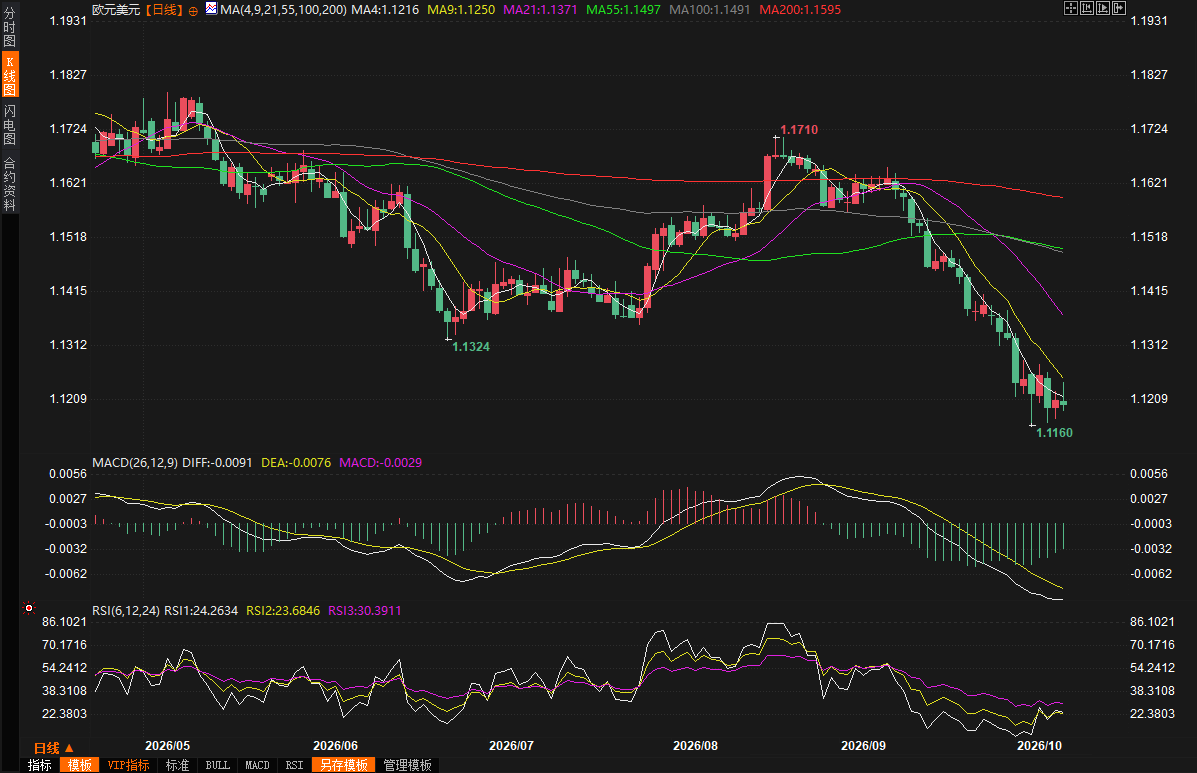
The euro's performance this week has been volatile. On Monday (October 5), the euro fell to $1.1160 against the dollar, its lowest level since May 2025. Market concerns persisted regarding France's record public debt and the political obstacles to fiscal consolidation. Meanwhile, Spain's announcement of early elections further exacerbated regional political uncertainty, dampening investor appetite for euros. Following the sell-off in French government bonds, concerns arose that fiscal risks could spread to other Eurozone countries, putting significant pressure on the euro. Mid-week, the selling momentum showed signs of weakening. The French bond market stabilized temporarily, and coupled with a decline in US Treasury yields from their highs, the euro was able to recover some ground. On Friday (October 9), during Asian trading hours, the euro rose to around $1.1211 against the dollar, but still fell about 0.1% in late New York trading, closing at $1.1201, with a weekly decline of about 0.5% and a cumulative decline of over 3% over the past five weeks. The euro approached a 16-month low against the pound, while hovering around 0.9324 against the Swiss franc. French politics has undoubtedly been the core driver of the euro's recent performance. Far-right presidential candidate Marine Le Pen's plan this week to expand fiscal spending cuts initially boosted market confidence and drove a rebound in French government bonds, but investors remain cautious about whether future fiscal discipline can be truly implemented. Brent Donnelly, head of foreign exchange trading at Spectra Markets, pointed out that many had expected a surge in French politically related trading this winter as the April 2027 election approached, and this has now materialized. He further stated that it's not entirely clear what can resolve the current situation, as any budget commitments made by the French government at this time lack sufficient credibility with regime change looming. Some market participants believe the euro is showing signs of short-term overselling. Matt Simpson, senior analyst at StoneX, said that the euro may only experience such a large move two or three times a year, and this is one of them, but bearish momentum is weakening, and caution is advised at such low levels. Risk premiums on French and Italian government bonds, which surged at the end of September, are poised to decline this week as investors await new developments before demanding higher returns to compensate for fiscal and political risks. Overall, although the euro has rebounded from its extreme lows, it is unlikely to reverse its five-week losing streak until fiscal uncertainty and political uncertainty are fundamentally alleviated.US Dollar: Its strong aura remains, but signs of weakening are emerging; a tug-of-war exists between the Fed's hawkish tone and falling yields.
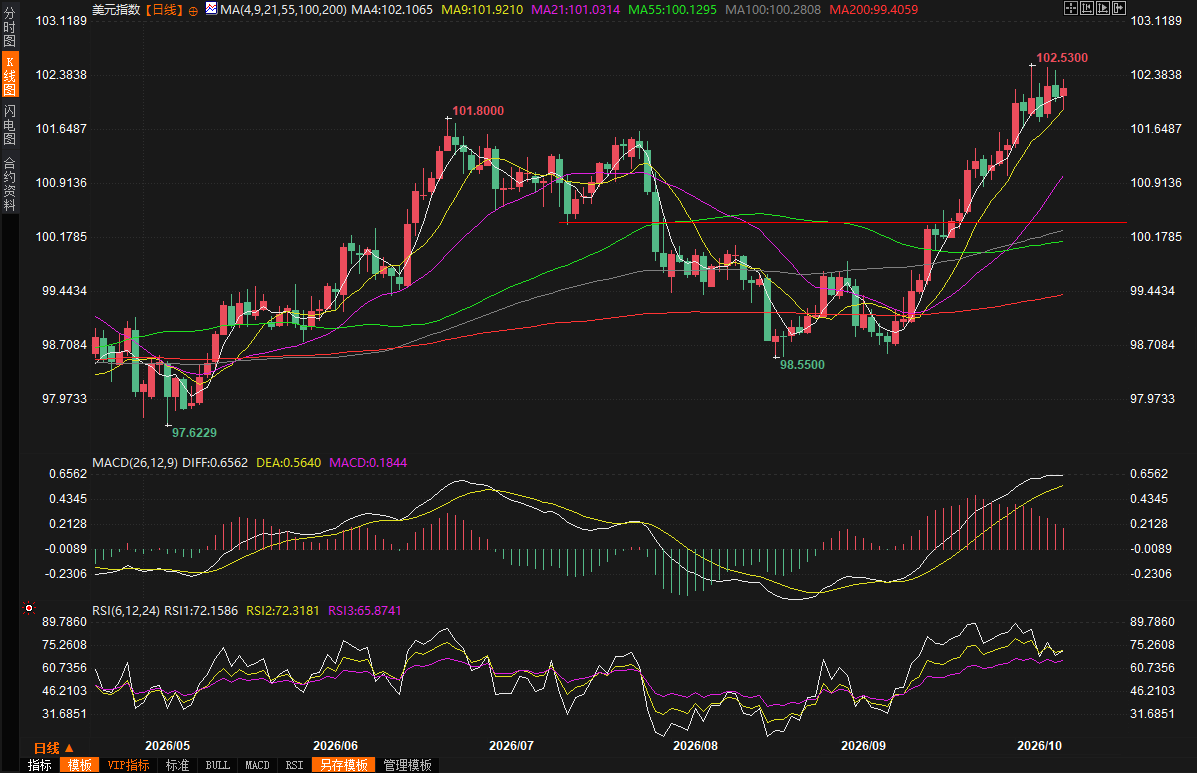
The US dollar remained strong throughout the week, rising to near an 18-month high. The dollar index reached a high of 102.53, its highest level since April 2025, and closed at around 102.23 on Friday, up about 0.3% for the week, marking its fourth consecutive week of gains and the longest winning streak since May 2025. The main driver of the dollar's rise was the climb in US Treasury yields, with the 10-year Treasury yield briefly approaching a more than 20-year high, increasing the attractiveness of dollar assets and prompting global capital flows into the US market. A broad sell-off in global bond markets also strengthened the dollar's safe-haven appeal, and market concerns about rising oil prices and a rebound in inflation further prompted investors to reassess the global interest rate path. However, the dollar's gains slowed somewhat as US Treasury yields fell in the latter half of the week. The minutes of the Federal Reserve's September meeting, released Wednesday, reinforced a hawkish tone. Westpac analysts noted that most participants still believed further tightening was appropriate, and almost all participants considered inflation risks to be skewed to the upside during the meeting. Interest rate futures continue to reflect expectations of a further rate hike in December, with the market believing there is an 85.8% probability of a Fed rate hike in December, compared to only about a 19.4% probability of a rate hike of at least 25 basis points at the policy meeting later this month. Vishnu Varathan, head of Asia-Pacific macro strategy at Mizuho Securities, believes the dollar is currently in a "fragile leading position," its strength partly stemming from the weakness of major currencies such as the euro and yen. Whether the dollar can maintain its strength remains to be seen if US economic data continues to cool. A consumer survey released by the University of Michigan on Friday showed that US consumer confidence declined further in early October, with rising living costs due to the Middle East conflict worsening households' views on the economy. Meanwhile, oil prices rebounded somewhat, with US crude futures rising about 0.6% to $92.04 per barrel and Brent crude rising about 0.58% to $104.88 per barrel, after the UK's Office for Maritime Trade Operations reported that a vessel was hit by an unidentified projectile near the UAE, providing support for oil prices. US President Trump stated earlier on Friday that the US would not launch an attack on Iran before the November 3 midterm elections, and claimed that productive talks had been held with Tehran regarding the war. This eased geopolitical tensions to some extent, calming global bond markets. Eugene Epstein, head of trading and structured products at Moneycorp, said that currently, multiple factors are intertwined, including rising oil prices and the situation in France, making it difficult to say which factor has a greater impact on the market. However, in reality, the market is relatively cautious today, with everyone waiting for speeches from Federal Reserve officials, as the dollar is currently highly sensitive to their statements.Japanese Yen and British Pound: Driven by interest rate differentials and substitution strategies, their price movements are relatively divergent.
The yen fell for the fourth consecutive week, though the decline was relatively mild, showing more stability among major currencies. The USD/JPY pair traded around 158 yen for most of the week, rising 0.25% to 158.28 yen on Friday, for a weekly gain of approximately 0.3%. Despite rising market expectations for further interest rate hikes by the Bank of Japan (BOJ), the strong dollar and the USD/JPY interest rate differential continued to weigh on the yen. BOJ board member Ayano Sato expressed support for a gradual approach to interest rate hikes this week, seen as bringing the BOJ closer to further tightening policy. Three sources familiar with the BOJ's thinking revealed that the BOJ may hint this month that core inflation has roughly reached its 2% target, paving the way for another rate hike in the coming months, providing some support for the yen. Looking ahead, the yen's performance will continue to depend on whether the BOJ releases clearer signals of interest rate hikes and whether US Treasury yields can fall further. Given the still significant USD/JPY interest rate differential, the yen is unlikely to escape its weak trend in the short term. The pound remained relatively stable this week, trading mostly around $1.32 against the dollar amid a generally strong dollar, closing at $1.3235 on Friday, but nearly flat for the week. Market concerns about high French debt levels and political uncertainty ahead of the presidential election pressured the euro, making the pound a viable alternative for some investors seeking European assets. The euro fell as low as 0.8449 pounds, its lowest level since June 2025. Meanwhile, expectations surrounding the Bank of England's monetary policy also supported the pound. Although the Bank of England has kept interest rates unchanged since the escalation of tensions in the Middle East, the market generally believes its next move will likely be further tightening. Interest rate futures indicate that the market currently expects an over 80% probability of a rate hike by the Bank of England in November, and has largely priced in the expectation of two 25-basis-point rate hikes early next year.Summary: A wait-and-see attitude is prevailing; the focus will shift to speeches by central bank officials and developments in fiscal and political affairs.
Overall, the euro struggled to shake off its downward trend under continued pressure from fiscal and political risks. Although it rebounded from a 17-month low, it still recorded its fifth consecutive weekly decline. The dollar's strength remained, but it showed signs of weakening due to falling yields and cooling economic data. The yen and pound were constrained by interest rate differentials and alternative investment logic, respectively, resulting in a clear divergence in their performance. The rebound in oil prices and Trump's comments on Iran brought a brief respite to the market earlier on Friday, but overall, a wait-and-see attitude prevailed. Going forward, the market will closely watch the speeches of Federal Reserve officials, the actual progress of French fiscal consolidation, and further clarification of the Bank of Japan's policy signals. With multiple uncertainties yet to dissipate, currency market volatility is expected to continue, and investors should remain cautious and closely monitor the evolution of data and policy developments. Looking ahead to next week, US inflation data, global bond market volatility, speeches by Federal Reserve officials, and developments in the US-Iran conflict will be key variables. The September CPI and PPI data are crucial for the interest rate decision on October 28th, and the Federal Reserve's Beige Book and officials' speeches before the blackout period will also influence market pricing of the policy path. The Eurozone will release final data on industrial production, trade, and inflation; the UK will release GDP and output figures; and Japan will release PPI and machinery orders. The Federal Reserve Chairman's "fireside chat" during the IMF and World Bank annual meetings is particularly noteworthy.- Risk Warning and Disclaimer
- The market involves risk, and trading may not be suitable for all investors. This article is for reference only and does not constitute personal investment advice, nor does it take into account certain users’ specific investment objectives, financial situation, or other needs. Any investment decisions made based on this information are at your own risk.