Despite OPEC's forecast of 400,000 barrels per day being implemented, why is Brent crude still struggling to soften?
2026-10-12 18:00:17
On Monday, October 12, OPEC Secretary General Haytham Al-Ghais announced that the organization had significantly lowered its 2026 global oil demand growth forecast to 400,000 barrels per day, a substantial contraction from the initial forecast of 1.4 million barrels per day. This adjustment reflects actual market developments throughout the year, including the suppression of consumption by high prices and actual delivery difficulties caused by disruptions to some shipping routes. Meanwhile, the ongoing risk of supply disruptions in the Middle East has kept the market cautious, with Brent crude prices trading above $105 per barrel and WTI crude remaining above $92 per barrel. The coexistence of a weakening demand outlook and supply-side uncertainty constitutes the core contradiction in the current crude oil market. 
Market Logic of Downward Demand Forecasts
The Organization of the Petroleum Exporting Countries (OPEC) has lowered its demand growth forecast by 1 million barrels per day (bpd) to 400,000 bpd from 1.4 million bpd. Al-Gais pointed out that the adjustment is based on the market's progress throughout the year, with some anticipated demand being postponed to 2027. High price levels continue to suppress price-sensitive consumption, particularly in industrial oil and some transportation fuels, where actual deliveries are lower than initially assumed. Uncertainty surrounding shipping routes has further amplified the discrepancy between demand-side statistics and actual consumption, resulting in a significantly lower-than-expected cumulative consumption growth for the year. The organization also raised its 2027 demand growth forecast, believing that the currently postponed consumption will be released as supply conditions improve. This assessment suggests that short-term demand weakness stems more from a temporary contraction due to external shocks than from a structural peak in demand.Supply disruption risk dominates price movements
Despite downward revisions to demand forecasts, supply-side risks remain a key factor keeping prices high. Continued attacks on oil tankers near the Strait of Hormuz and the Houthi attack on Riyadh airport over the weekend further escalated regional tensions. Disruptions to some alternative routes and pipelines are also under pressure, limiting actual export volumes. Reduced demand alone is insufficient to alter market equilibrium; when supply struggles to reach consumption destinations, prices are significantly more sensitive to supply risks than to demand figures. Market observations indicate that downward revisions to demand forecasts alone cannot provide sufficient justification for price declines until supply disruption risks are substantially mitigated. The combined effect of disrupted physical flows and limited inventory buffers has allowed high price levels to persist.Equilibrium under supply-demand mismatch
The current market presents a situation where anticipated contraction in demand coexists with actual constraints on the supply side. OPEC projects demand growth of only 400,000 barrels per day in 2026, but uncertainties in the supply path make it difficult for effective supply to expand in tandem. The expectation of a demand rebound in 2027 reflects the organization's assessment of consumption recovery after the gradual easing of the conflict's impact. In the short term, supply risks remain dominant, and price movements reflect more the uncertainty of physical delivery than simple changes in demand figures. Regarding long-term investment demand, OPEC has previously emphasized that continued capital investment is needed to meet future energy demand and avoid further damage to supply capacity. The market is focused on whether there is substantial improvement in supply disruptions and the pace at which the delayed demand will materialize in 2027.Current observation of technical indicators
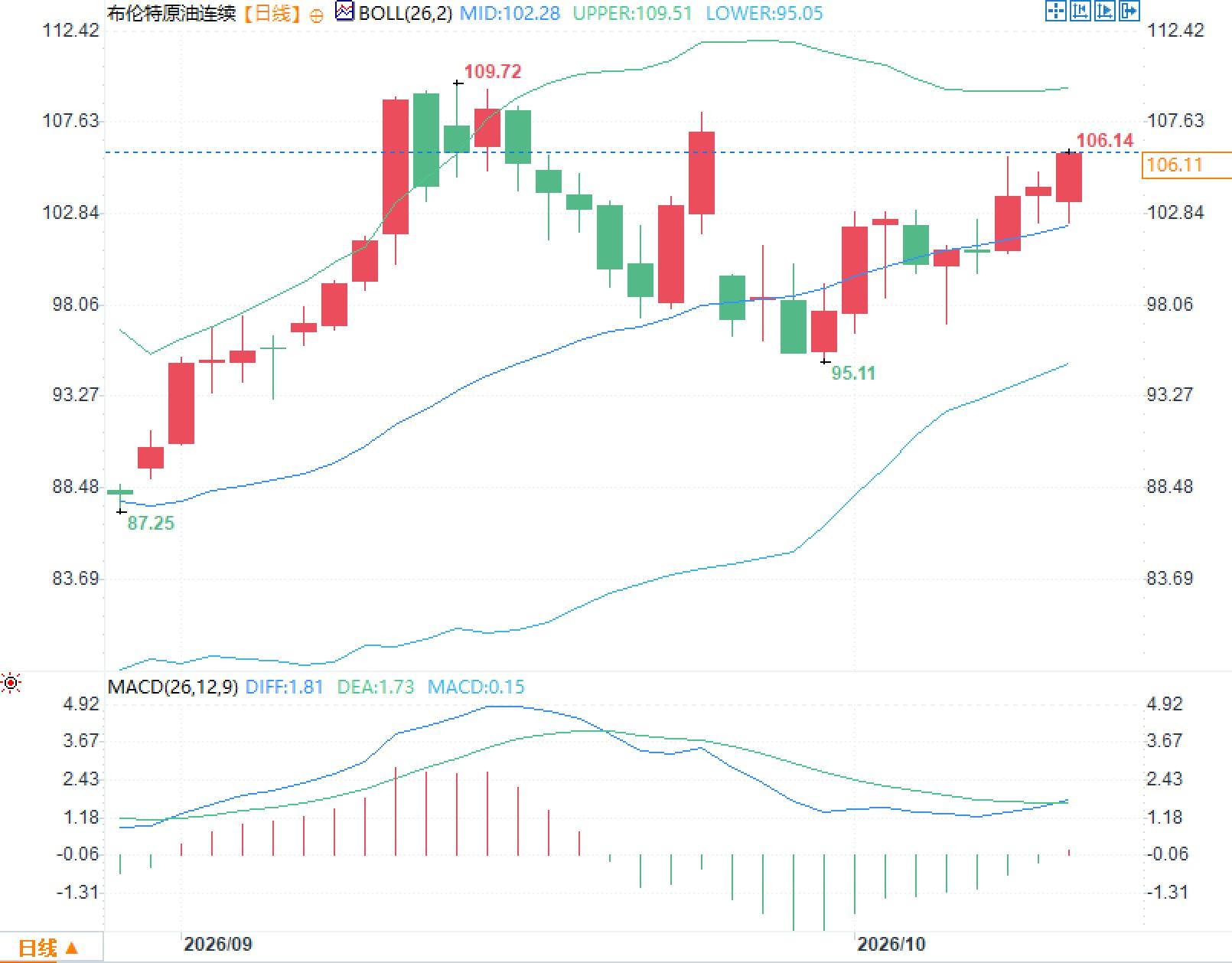
The Brent crude oil daily chart shows the Bollinger Bands with the middle band at 102.28, the upper band at 109.51, and the lower band at 95.05. The price has recently been fluctuating around 106. Regarding the MACD indicator, the DIFF is 1.81, the DEA is 1.73, and the MACD histogram is 0.15. The price is trading above the middle band, and while the histogram remains positive, the magnitude is limited.Frequently Asked Questions
Question 1: Why did OPEC significantly lower its 2026 demand growth forecast? Answer: The downward revision reflects actual market developments throughout the year, including high prices suppressing consumption and delivery difficulties caused by shipping disruptions, with some demand being postponed to 2027. Question 2: Why are prices still high despite the weakening demand forecast? Answer: The risk of supply disruptions in the Middle East persists. Tanker attacks and blocked alternative routes limit actual supply, and supply factors are currently dominating price performance. Question 3: What does the expected rebound in demand in 2027 mean? Answer: The organization expects currently postponed consumption to materialize after supply conditions improve, reflecting an assessment of demand recovery after the temporary shock, rather than short-term price guidance.- Risk Warning and Disclaimer
- The market involves risk, and trading may not be suitable for all investors. This article is for reference only and does not constitute personal investment advice, nor does it take into account certain users’ specific investment objectives, financial situation, or other needs. Any investment decisions made based on this information are at your own risk.