The USD/CHF exchange rate reveals three underlying divergences: Why are oil prices, interest rate differentials, and technical momentum no longer moving in sync?
2026-10-12 18:54:19
On Monday, October 12, the USD/CHF pair was trading around 0.8330, having given back some of the gains accumulated by the Swiss franc in the previous two trading days. Global energy supply risks have resurfaced, with Brent crude trading above $105 per barrel. Meanwhile, a Japanese holiday and the closure of some US financial markets have weakened market liquidity, further complicating the interplay between safe-haven demand, energy inflation, and monetary policy spreads. 
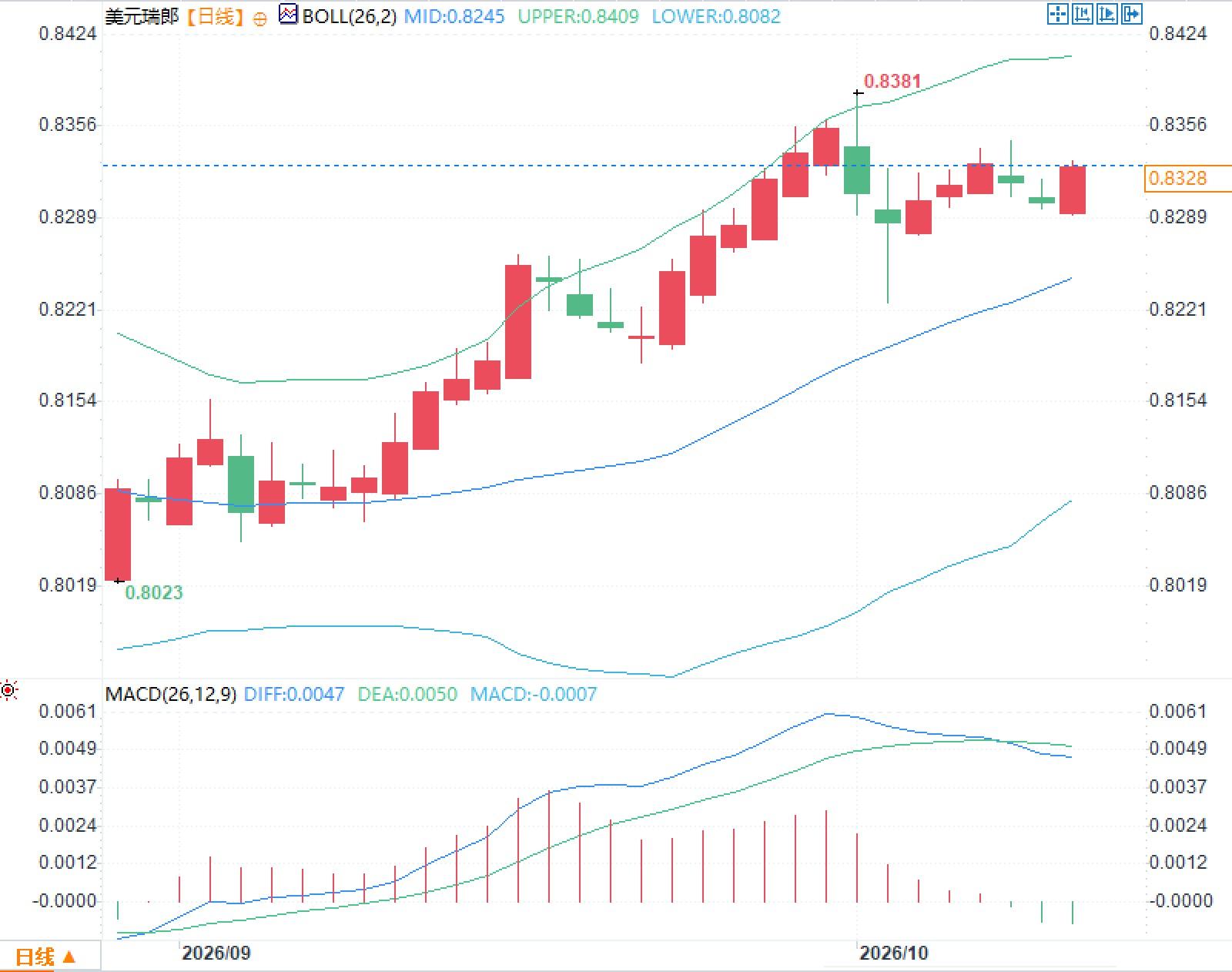 The MACD indicator shows DIFF at 0.0047, DEA at 0.0050, and the MACD histogram at -0.0007. Both lines are still above the zero line, but DIFF is now below DEA, and the histogram has turned negative, indicating that short-term price momentum has weakened relative to its signal smoothing value.
I. Escalating geopolitical risks create competition between the US dollar and the Swiss franc for their safe-haven appeal.
On October 11, King Khalid International Airport in Riyadh, the capital of Saudi Arabia, was attacked again. These successive incidents not only disrupted air transport but also increased market attention to regional energy infrastructure and shipping security. Meanwhile, the credibility of the ceasefire agreement between Russia and Ukraine regarding energy facilities has been questioned. Despite announcements of a ceasefire, attacks on Ukrainian energy infrastructure continue to be reported, indicating that diplomatic statements have not yet fully translated into verifiable implementation results. For the USD/CHF exchange rate, geopolitical risks do not have a one-way transmission relationship. Risk events may increase demand for US dollar cash and short-term liquidity. The Swiss franc, on the other hand, possesses safe-haven characteristics due to the Swiss financial system and the state of external assets. When both currencies simultaneously absorb safe-haven funds, the exchange rate change is not determined by the risk event itself, but by the relative strength of different funding needs. It is particularly important to distinguish between short-term liquidity needs and medium- to long-term asset allocation. The former may be affected by US dollar funding costs, margin requirements, and market depth, while the latter involves more real interest rates, asset safety, and exchange rate hedging costs. During holiday periods, quote depth may deviate from actual trading intentions.II. Crude oil risk premium and policy spread are forming a dual pricing mechanism.
The crude oil market currently faces two distinct types of variables: the potential supply disruption risk in the Middle East and the adjustment in supply expectations due to news of a ceasefire at Russian-Ukrainian energy facilities. Brent crude fluctuated around $105 per barrel on October 12, reflecting the market's continued assessment of energy transportation security and potential supply changes. Geopolitical risk premiums do not equate to actual supply gaps. The former reflects compensation for future uncertainty, while the latter needs verification through production, transportation, inventory, and delivery data. Judging a substantial change in energy supply and demand solely based on conflict news easily confuses risk pricing with fundamental changes. Switzerland relies on imported energy; oil price changes can affect the domestic price system through fuel, transportation, and production costs, but these effects are constrained by exchange rates, corporate profit absorption capacity, and the speed of cost transmission, and cannot be directly extrapolated to a depreciation of the Swiss franc. The latest official data shows that Switzerland's consumer price index rose 1.0% year-on-year in September, remaining flat month-on-month. The Swiss National Bank maintained its policy rate at 0% on September 24 and continues to retain policy space to participate in the foreign exchange market if necessary. In contrast, the Federal Reserve raised the target range for the federal funds rate by 25 basis points to 3.75%-4.00% on September 16. The U.S. Consumer Price Index (CPI) rose 3.4% year-on-year in August, with September data scheduled for release on October 14. This means that a significant nominal policy rate differential still exists between the U.S. dollar and the Swiss franc, but this nominal differential is not directly equivalent to real holding returns. Forward exchange rate pricing, cross-currency funding basis, hedging costs, and changes in interest rate expectations all affect the real economic value of the rate differential. Therefore, macro pricing of the USD/CHF exchange rate requires simultaneous observation of energy inflation, real interest rate expectations in both countries, and cross-border financing costs, and cannot be simply attributed to the higher interest rate having an absolute advantage.III. Technological Structure Reveals the Redistribution of Kinetic Energy
Observing the USD/CHF daily chart, after a previous round of continuous price increases, recent candlestick bodies have shortened, and the number of alternating bullish and bearish candles has increased, indicating a weakening of the continuity of the one-sided price advance. The price remains above the Bollinger Band's middle band, with the upper band continuing its upward trend, while the middle band shows a relatively smooth change. The MACD indicator shows DIFF at 0.0047, DEA at 0.0050, and the MACD histogram at -0.0007. Both lines are still above the zero line, but DIFF is now below DEA, and the histogram has turned negative, indicating that short-term price momentum has weakened relative to its signal smoothing value.IV. Frequently Asked Questions
Question 1: Why does the Swiss franc not necessarily strengthen in tandem with escalating risk events? Answer: Both the US dollar and the Swiss franc possess safe-haven attributes, but their transmission channels differ. The US dollar is influenced by cross-border financing and settlement needs, as well as US Treasury yields; the Swiss franc is linked to asset protection needs and its domestic monetary environment. The USD/CHF exchange rate reflects the relative strength of the two currencies and cannot be explained by a single risk sentiment. Holiday liquidity is often thin, which may amplify short-term volatility. Question 2: Why do oil prices affect this currency pair? Answer: Energy prices affect both Swiss import costs and US inflation expectations and the pricing of Federal Reserve policies. The key is to distinguish between risk premiums and actual supply losses: the former compensates for potential disruption risks, while the latter signifies a real supply contraction. Ultimately, the exchange rate reaction also depends on trade structure, inflation transmission, and policy differences.- Risk Warning and Disclaimer
- The market involves risk, and trading may not be suitable for all investors. This article is for reference only and does not constitute personal investment advice, nor does it take into account certain users’ specific investment objectives, financial situation, or other needs. Any investment decisions made based on this information are at your own risk.