The pound/dollar pair is fluctuating around 1.32. Will Wednesday's inflation data break the deadlock?
2026-10-12 20:26:19
On Monday, October 12th, the pound sterling gave back its earlier gains against the dollar, currently trading around 1.3230, essentially unchanged for the day. The dollar index rose to around 102.42, up about 0.2%, as the market remained cautious ahead of Wednesday's release of the US September Consumer Price Index. In the UK, August GDP data will be released on Thursday, with the market widely expecting a 0.1% contraction in the economy, following a 0.4% increase in July. 
 Over the past month, the pound has gradually declined against the dollar from above 1.33 in late September and is currently trading in a relatively low range for the year, with 52-week highs and lows around 1.3868 and 1.3010 respectively. Trading activity is concentrated in the pre-data release wait-and-see phase, with volatility remaining at a neutral level.
Market performance and technical indicator observation
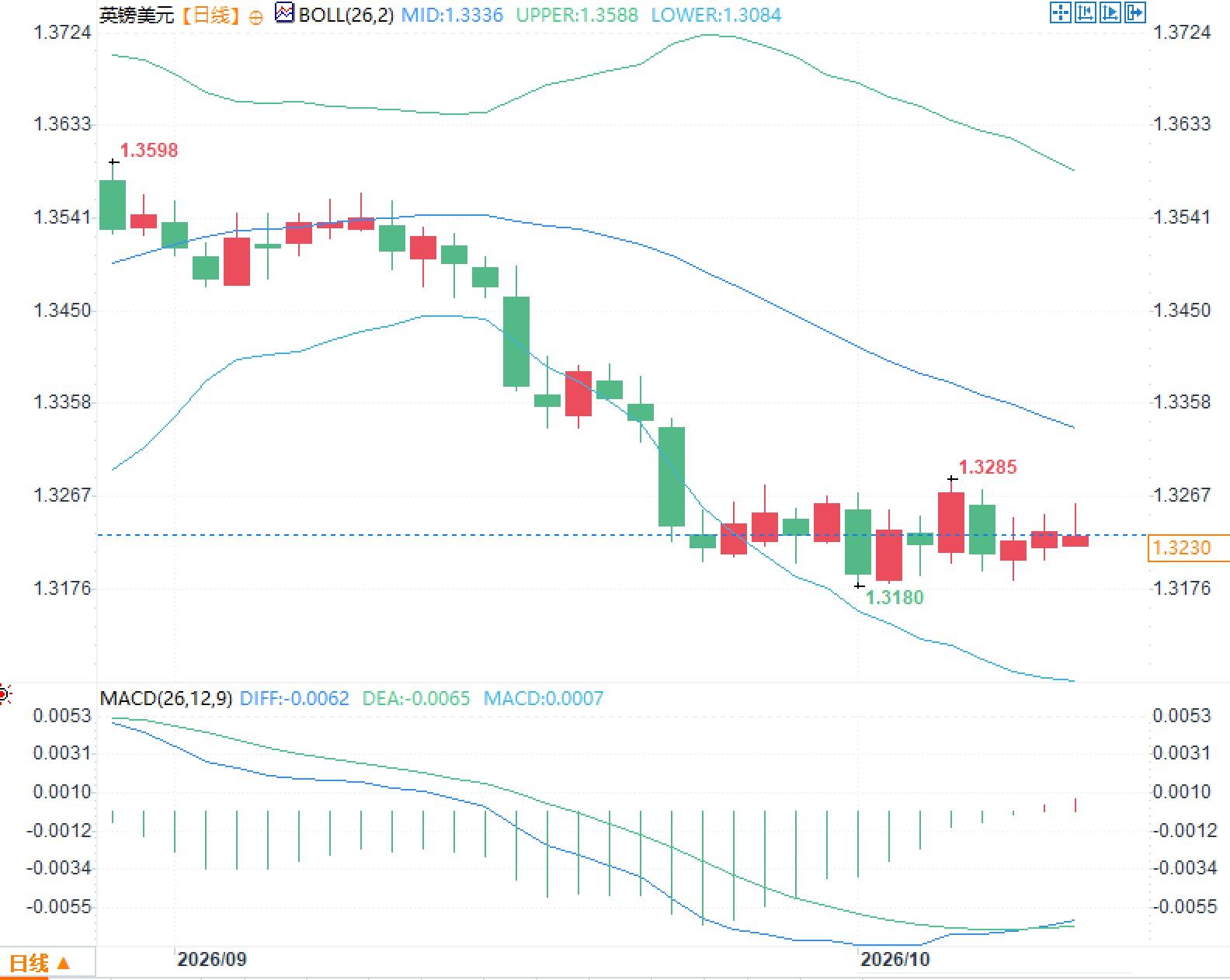
From the daily chart, the price is trading below the Bollinger Band middle line at 1.3336, with the upper band at 1.3588 and the lower band at 1.3084. Recently, the price has rebounded after testing the 1.3180 area multiple times, reaching a high of around 1.3285. The MACD indicator shows a DIFF value of -0.0062, a DEA value of -0.0065, and the histogram close to the zero line at 0.0007. Over the past month, the pound has gradually declined against the dollar from above 1.33 in late September and is currently trading in a relatively low range for the year, with 52-week highs and lows around 1.3868 and 1.3010 respectively. Trading activity is concentrated in the pre-data release wait-and-see phase, with volatility remaining at a neutral level.US Inflation Data and the Federal Reserve's Focus
The U.S. Consumer Price Index (CPI) for September will be released on Wednesday. The market expects overall inflation to rise to 3.7% year-on-year, up from 3.4% in August; core inflation is expected to be 2.5% year-on-year, slightly higher than the previous 2.4%; and the monthly overall increase is expected to be 0.6%, higher than the previous 0.4%. Federal Reserve officials have recently emphasized that inflation remains above target. The President of the St. Louis Fed stated that current policy rates are still too loose and further tightening is needed to control inflation risks; Governor Barr pointed out that energy prices and investment activity have caused inflation to deviate from the target, and further adjustments may be necessary; Vice Chairman Jefferson also stated that upside risks to inflation remain. The dollar index rose slightly ahead of the data release, reflecting market expectations that inflation readings may remain high. Overall, inflation data will be an important reference for assessing the Fed's future policy path, and current interest rate expectations have already partially priced in the possibility of further adjustments.UK Economic Data Forecast and Fundamental Background
The UK's August GDP data will be released on Thursday, with the market widely expecting a 0.1% month-on-month contraction, following a 0.4% increase in July. Manufacturing and industrial output data will also be released at the same time. The Bank of England kept interest rates unchanged at 3.75% at its September meeting, with some members voting in favor of an increase and warning that energy prices could push inflation above 4% by early next year. Internal analysis by the Bank of England shows that rising energy prices affect prices through both direct and indirect channels, with significant increases in household energy bills and petrol prices. Member Green recently stated that wage growth next year is expected to be around 3.5%, higher than the level that helps inflation return to the target; Member Mann pointed out that inflation is already somewhat embedded in the economic system. After growing by 0.4% in the second quarter, the UK economy faces slowing momentum in the third quarter, and the performance of the service and production sectors will determine the August data results. Market attention is focused on whether growth has slowed as expected and its impact on the Bank of England's policy assessment.Correlation Analysis of Energy Price Fluctuations and the US Dollar
In the energy market, crude oil prices fell in early trading before rebounding. Analysts pointed out that news of a diesel supply agreement initially eased supply concerns, with Russia set to immediately export approximately 300,000 tons of diesel, followed by an additional 500,000 tons in November and another 1 million tons in December, while related sanctions were temporarily adjusted. Brent crude rebounded after its initial decline, remaining above $100 per barrel, reflecting the continued potential pressure on supply from conflicts in the Middle East. Energy prices influence major currencies through terms of trade and inflation expectations. While current supply risks have eased, prices remain relatively high, exerting a two-way influence on the US dollar. Regarding the pound, rising energy prices exert pressure on UK prices through import inflation, indirectly affecting the pound's performance. Overall, energy market volatility remains a significant variable in the current foreign exchange market.Frequently Asked Questions
Question 1: Why is the US September CPI data receiving such close market attention? Answer: Forecasts indicate that overall inflation may rise to 3.7% year-on-year, core inflation to 2.5%, and the monthly increase to accelerate to 0.6%. Federal Reserve officials have repeatedly emphasized recently that inflation remains high, and the data results will influence the assessment of the policy path. Question 2: What are the market expectations for the UK's August GDP data? Answer: The market generally expects a 0.1% month-on-month contraction in August, following a 0.4% increase in July. Attention will also be focused on manufacturing and industrial output performance, as the data will reflect changes in economic momentum in the third quarter. Question 3: How do energy price fluctuations relate to the performance of the US dollar? Answer: Crude oil prices fell in the morning but rebounded later, and the US dollar index rose in tandem. Energy prices influence the dollar through inflation expectations and trade channels; easing supply risks and price rebounds create a two-way effect.- Risk Warning and Disclaimer
- The market involves risk, and trading may not be suitable for all investors. This article is for reference only and does not constitute personal investment advice, nor does it take into account certain users’ specific investment objectives, financial situation, or other needs. Any investment decisions made based on this information are at your own risk.