Can the two major external supports withstand the CPI test? Will the US dollar encounter resistance at its high level?
2026-10-12 20:40:17
On Monday (October 12), the US dollar index fluctuated near a one-and-a-half-year high, currently trading around 102.39. Escalating conflict in the Middle East has fueled safe-haven buying, coupled with upcoming US inflation data this week, becoming the core variables driving the dollar's short-term trend. The weakening euro is the most crucial external driver supporting the dollar's resilience. As the currency with the highest weighting in the dollar index, fiscal and political risks in the Eurozone continue to support the dollar, even amid cooling expectations of a Fed rate hike. 
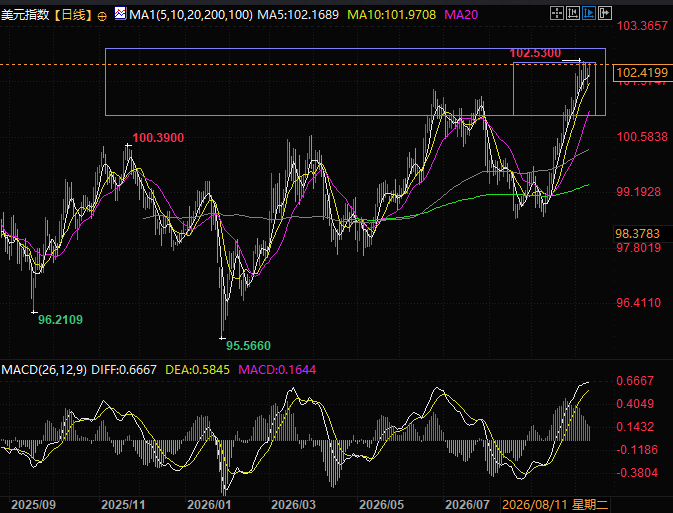 (US Dollar Index Daily Chart Source: FX678) At 20:36 Beijing time, the US Dollar Index is currently at 102.43.
Geopolitical factors: Middle East risks drive safe-haven demand; Russia-Ukraine ceasefire remains uncertain.
Iran, through Qatar's mediation, presented the US with a seven-point negotiation framework, promising to restore normal navigation in the Strait of Hormuz within seven days if all US demands were met. Currently, Iran states that the US response has been insufficient, negotiations have essentially stalled, and shipping in the Strait cannot return to its pre-war stable state. As a vital route for nearly 30% of global oil exports, the stalemate in the Strait creates a risk of resonance between the two straits, supporting the geopolitical premium in oil prices. JPMorgan Chase points out that as long as shipping in the Persian Gulf cannot return to stable and normalized operations, the market will continue to price risk premiums, and geopolitical tensions in the Gulf are beneficial for safe-haven buying of the US dollar. Houthi attacks on Saudi Arabia and oil tankers further amplified oil price volatility, putting pressure on risk sentiment and supporting the US dollar. The US and Russia reached an agreement on a ceasefire at energy facilities, with Zelensky expressing willingness to sign a ceasefire guarantee agreement; however, the implementation of the agreement remains uncertain, and a de-escalation of the conflict would exert marginal pressure on the US dollar.Federal Reserve Policy Expectations: CPI and Official Speeches are Key in the Short Term
The market is focused on Wednesday's US CPI data and Fed Chairman Warsh's speech to confirm the baseline expectation that the Fed will likely pause rate hikes but will still retain the option to raise rates this year. Analysts believe that unless core inflation significantly exceeds expectations, the Fed will keep interest rates unchanged this month, and this pause is only a temporary adjustment. Continued weakness in US consumer confidence and higher-than-expected inflation will support the dollar, while cooling inflation will be bearish for the dollar. Institutions point out that the threshold for a rate hike in October is high; if inflation data significantly exceeds expectations, the market will need to reprice the timing of subsequent rate hikes. Recent weakening of multiple US economic data points and a more cautious stance from the Fed have led the market to lower its short-term rate hike expectations.Euro Fundamental Analysis
The euro continued its weakening trend, declining for several consecutive weeks. Speculative long positions in the US dollar increased rapidly, primarily from shorting the euro. While downward revisions to interest rate hike expectations weakened the dollar's upward momentum, these short positions offset this negative impact. The global bond market continued to be sold off. Inflation, energy prices, and government debt problems in many countries have collectively pushed global financing costs to multi-year highs. Tightening global financing has led to a return of funds to dollar assets, indirectly supporting the dollar. Market concerns about the transmission of French public debt risks to other highly indebted economies in the Eurozone, coupled with political gridlock and social unrest before the election, have weakened the attractiveness of euro assets, keeping the spread between French and German bond yields high. The OCBC strategy team believes it remains uncertain whether high financing costs will force France to tighten fiscal policy. The Citigroup forex team points out that if the French fiscal crisis spreads, it will limit the ECB's room for further policy tightening, widening the gap between European and American monetary policy expectations, continuously suppressing the euro, and indirectly benefiting the dollar. Uto Shinohara, senior strategist at Mesirow Currency Management, analyzes that the continued pressure on the euro has weakened the attractiveness of the dollar as an alternative asset, which is one of the underlying factors contributing to the dollar's continued strength. Corpay's chief strategist, Karl Schamotta, warned that the risks of long-term political and fiscal imbalances in many European countries will continue to be reflected in exchange rate pricing. The euro, being the currency with the highest weighting in the dollar index, is under pressure, which is a key external support for the dollar's continued strength.Japanese Yen Fundamental Analysis
Domestic fiscal issues in Japan are driving the yen's movements. Prime Minister Sanae Takaichi's expansionary fiscal policy, coupled with already high government debt, has suppressed the yen's potential for rebound. However, the Bank of Japan (BOJ) has signaled a policy shift, with Kazuo Ueda proposing a move to proactively address inflation risks rather than solely targeting the 2% inflation target. Furthermore, consecutive months of real wage growth in Japan are creating conditions for monetary policy normalization. ING Forex team analysis suggests that the BOJ's slow pace of interest rate hikes makes it difficult to quickly close the Japan-US interest rate differential, hindering a sustained yen appreciation. Official intervention is primarily a bottom-line tool to curb rapid yen depreciation. The weaker yen is providing slight support to the US dollar index, but its impact is far less significant than that of the euro.Summary and Technical Analysis
The strength of the US dollar is driven by a confluence of factors: Federal Reserve interest rate expectations, risk aversion in the Middle East, and endogenous risks within the Eurozone. Multiple institutions agree that this round of dollar appreciation is not entirely dependent on expectations of US interest rate hikes; French fiscal risk is the most important support for the dollar's continued strength. If the French debt problem continues to escalate, even if US inflation declines, the downside for the dollar will remain limited; if CPI cools significantly and European risks do not worsen, the probability of a dollar correction increases. US inflation data and Warsh's speech will test whether this round of dollar bullish momentum can continue. Technically, the dollar index has recently reached near the measured gains of two different trading ranges, increasing the probability of a short-term correction. (US Dollar Index Daily Chart Source: FX678) At 20:36 Beijing time, the US Dollar Index is currently at 102.43.
- Risk Warning and Disclaimer
- The market involves risk, and trading may not be suitable for all investors. This article is for reference only and does not constitute personal investment advice, nor does it take into account certain users’ specific investment objectives, financial situation, or other needs. Any investment decisions made based on this information are at your own risk.