Institutions warn of diminishing returns from interest rate hikes; Bank of England's next interest rate decision stalled.
2026-10-13 12:28:18
Amidst diverging global monetary policies and persistent energy inflation, the Bank of England's policy choices are becoming increasingly complex. Lloyds Bank's latest warning points directly to the core contradiction: following the Federal Reserve's lead in raising interest rates may no longer be sufficient to support the pound, and policymakers are facing a costly and largely ineffective game.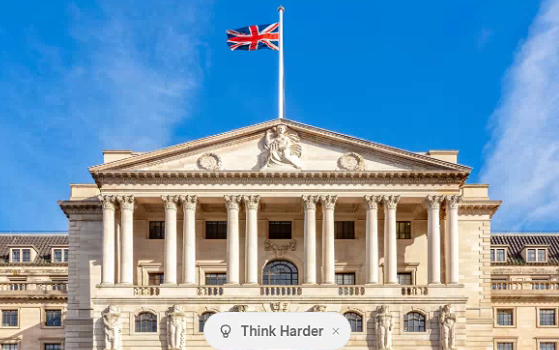
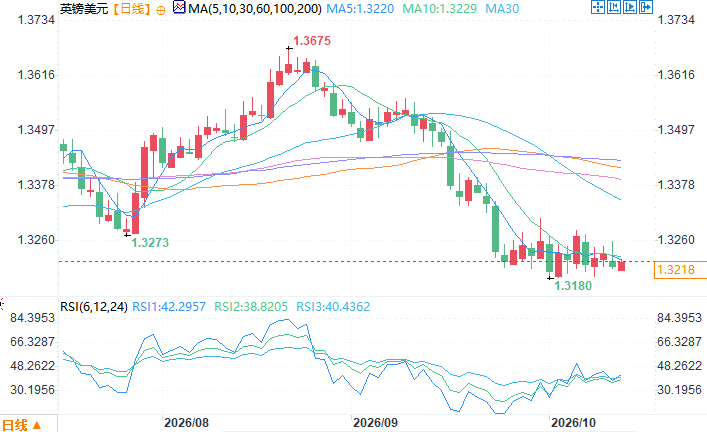 GBP/USD daily chart source: FX678. At 12:26 Beijing time on October 13, GBP/USD was trading at 1.3217/18.
The supporting effect of interest rate hikes has weakened, and the pound's performance has become more divergent.
Lloyds Bank has clearly stated that rising UK interest rates can no longer provide the same effective boost to the pound as in the past. Karim Henide, the bank's interest rate strategist, said that if the UK blindly follows the Federal Reserve Chairman's policy path, it will only incur the economic costs of tightening policy without achieving any relief in the exchange rate. On Tuesday (October 13) during Asian trading hours, the pound rebounded slightly against the dollar, currently trading around 1.3215, near a three-month low, with a gain of about 0.2%. The pound against the euro remained at 1.1835, close to its year-to-date high. Lloyds Bank still believes that a rate hike by the Bank of England in November is highly probable.The exchange rate transmission mechanism is changing, and the effectiveness of policies is gradually diminishing.
Enid further pointed out that while tightening monetary policy in the UK had previously been effective in boosting the pound, this effect has weakened significantly in recent years. A weaker exchange rate will continue to push up domestic import prices, forcing inflation upwards. He illustrated this with data showing that between 2017 and 2019, a mere 10 basis point increase in interest rates by the Bank of England could push the pound up by about 1.5% against the dollar; however, since 2022, the same rate hike has had almost no substantial impact on the exchange rate. He analyzed that a 1% depreciation of the pound would push up the UK inflation rate by about 7 basis points within two years, and further exchange rate weakness would make it difficult to maintain the current inaction. However, the influence of the UK benchmark interest rate on the exchange rate is much less than before; rate hikes will not only put pressure on borrowing costs for households and businesses, but also fail to bring the benefits of lower import costs as they did in the past.Market expectations and policy mismatch
Enid argues that the bond market seems to be ignoring the more difficult trade-off the UK faces between economic growth and inflation. According to model calculations, under a strict inflation target and based on mainstream economic forecasts, the optimal average level for the Bank of England's interest rate in 2027 is approximately 4.2%; however, if the Monetary Policy Committee chooses to ignore the first energy shock, this level would be around 3.5%, significantly lower than the 4.59% currently priced in by the market. It should be clarified that these results are conditional calculations of annual averages, not final interest rate forecasts at the end of the year. The logic supporting this market pricing is the assumption that the average price of Brent crude oil throughout 2027 needs to reach around $125. Enid explicitly emphasizes that a key reason why interest rate hikes have become inappropriate is the policy lag. The tightening effect of interest rate hikes often only fully materializes after inflation has significantly declined, which will greatly increase the risk of long-term inflation falling below the target. In the scenario simulation, the current pricing path is expected to reduce inflation by about 0.3 percentage points by the fourth quarter of 2028, at the cost of a 0.38 percentage point increase in the unemployment rate. Lloyds Bank also discovered a deeper contradiction: a significant misalignment between market expectations of interest rates and expectations of inflation. Market inflation contract pricing indicates that even after anticipated rate hikes, price pressures will remain more persistent than models predict. Enid frankly stated that market pricing signals the ineffectiveness of tightening policies, and given the current demand-side toolkit's inadequacy in addressing supply-side inflationary pressures, he agrees with this view.Energy inflation concerns persist, limiting the Bank of England's policy space.
If high energy costs continue to spread to wages and other commodity prices, it will significantly limit the Bank of England's room for maneuver. Enid points out that the Monetary Policy Committee's ability to retain policy flexibility largely depends on the transmission effect of energy prices. History shows that the UK has often outperformed the US in the transmission effect of second-round inflation, providing a natural reason to not ignore the initial energy shock. It is worth noting that the Bank of England decided to maintain its benchmark interest rate at 3.75% at its September meeting, and its statement also mentioned that there are currently no signs that the second-round effect of inflation has significantly materialized, but if energy prices remain high for an extended period, the associated risks will be amplified. The next interest rate decision is expected to be announced on November 5th.Conclusion
In conclusion, the pound's performance will be a key variable determining the Bank of England's policy flexibility. A strong exchange rate can provide a buffer against external tightening pressures, while a weak exchange rate will force the central bank to adopt a more hawkish stance, even if such interest rate hikes can no longer provide the same support for the pound as they did before 2022. In the current complex and volatile global macroeconomic environment, the market is closely watching how the Bank of England finds a difficult balance between inflation control and exchange rate stability. GBP/USD daily chart source: FX678. At 12:26 Beijing time on October 13, GBP/USD was trading at 1.3217/18.
- Risk Warning and Disclaimer
- The market involves risk, and trading may not be suitable for all investors. This article is for reference only and does not constitute personal investment advice, nor does it take into account certain users’ specific investment objectives, financial situation, or other needs. Any investment decisions made based on this information are at your own risk.