Why did the Bank of Japan close the window for consecutive interest rate hikes?
2026-10-13 19:06:18
On Tuesday, October 13th, the USD/JPY pair is currently fluctuating around the 158 level, experiencing slight downward pressure during the day. Bank of Japan officials tend to avoid a rare series of rate hikes this month, while remaining focused on the possibility of action as early as the December meeting. This internal inclination emerged after the policy rate was raised to 1.25% in September. Japan's producer price index (PPI) rose 6.8% year-on-year in September, down from 7.6% in August, indicating a cooling of input cost pressures. Bank of Japan Governor Kazuo Ueda stated that underlying inflation is very close to the 2% target, and stabilizing price trends is crucial. Overnight, the swap market is pricing in a 10% chance of an October rate hike, with a significantly higher probability of action in December. Oil prices have risen approximately 15% since the July quarterly outlook was compiled, and external cost factors continue to put pressure on import-dependent economies. 
Policy stance and considerations for continuous interest rate hikes
Bank of Japan officials believe there is no need for consecutive interest rate hikes in the absence of signs of a sudden increase in upside inflation risks. The policy committee will carefully review economic data to determine whether conditions are ripe for another adjustment, as early as its December meeting. The final decision at the October 30 meeting could still change at the last minute. The September rate hike, which raised the policy rate to 1.25% in a 7-2 vote, was the second adjustment in nearly three months, the fastest pace since 1990. The Bank of Japan has not raised interest rates consecutively for months since 1980, a historical preference reflecting a tendency to observe the effects of policy before taking further action. Kazuo Ueda pointed out that this adjustment is in line with the need for a policy phase shift, with a current focus on addressing upside price risks. Underlying inflation approaching 2% does not mean the task is complete; the goal is to stabilize price trends around that level, not just reach it once. Officials stated that the economy and inflation are broadly in line with expectations, and price trends are expected to remain consistent with the 2% target over the next 18 months.Inflation data and outlook assessment
Japan's producer price index (PPI) rose 6.8% year-on-year in September, down 0.3% month-on-month, marking the second consecutive month of decline. Declining prices for agricultural, forestry, and fishery products, particularly rice, were the main drag on inflation; the year-on-year increase in oil and coal prices also slowed from 14.7% to 11.5%. Meanwhile, the year-on-year increase in information and communication equipment prices rose to 15.3%, reflecting the continued impact of related demand. While input cost pressures have eased somewhat, they remain at a high level overall, and companies are still willing to pass on costs to downstream customers. The Bank of Japan will release a new quarterly economic outlook along with its policy statement; officials will need to weigh the impact of rising oil prices and whether to include the temporary reduction in food sales tax in the forecast. The Middle East conflict, AI-related demand, and exchange rate fluctuations are listed as factors to be closely monitored to determine the timing of the next adjustment. Underlying inflation can be assessed as close to 2%, but the stabilization process will require time to verify.Yen performance and external factors
The USD/JPY pair is currently trading around 158. Oil prices have risen approximately 15% since the July outlook, putting additional cost pressure on the resource-dependent economy. Exchange rate fluctuations affect domestic inflation in Japan through import prices and are therefore included in the monitoring scope. Adjustments in market expectations regarding the Federal Reserve's policy path this month also briefly raised the probability of a Bank of Japan rate hike in October to around 40%, before declining. This week's US price data will be the focus.Market pricing and path differentiation
Overnight swaps priced in a 10% chance of a Bank of Japan rate hike in October, with the probability of action before December rising to about 88%. A survey of economists showed that about one-third expect an adjustment in December, while more than half believe they will wait until January. The minutes of the September meeting did not explicitly support consecutive rate hikes or larger adjustments, and government representatives had urged caution. Kazuo Ueda recently reiterated that the government will continue to adjust the degree of easing based on economic, price, and financial conditions, emphasizing the importance of anchoring core inflation around 2%. The policy path still depends on the extent to which data validates upside risks and the description of the price stabilization process in the quarterly outlook. The final decision can be delayed until the last minute of the meeting, reflecting room for unforeseen changes.Technical Analysis
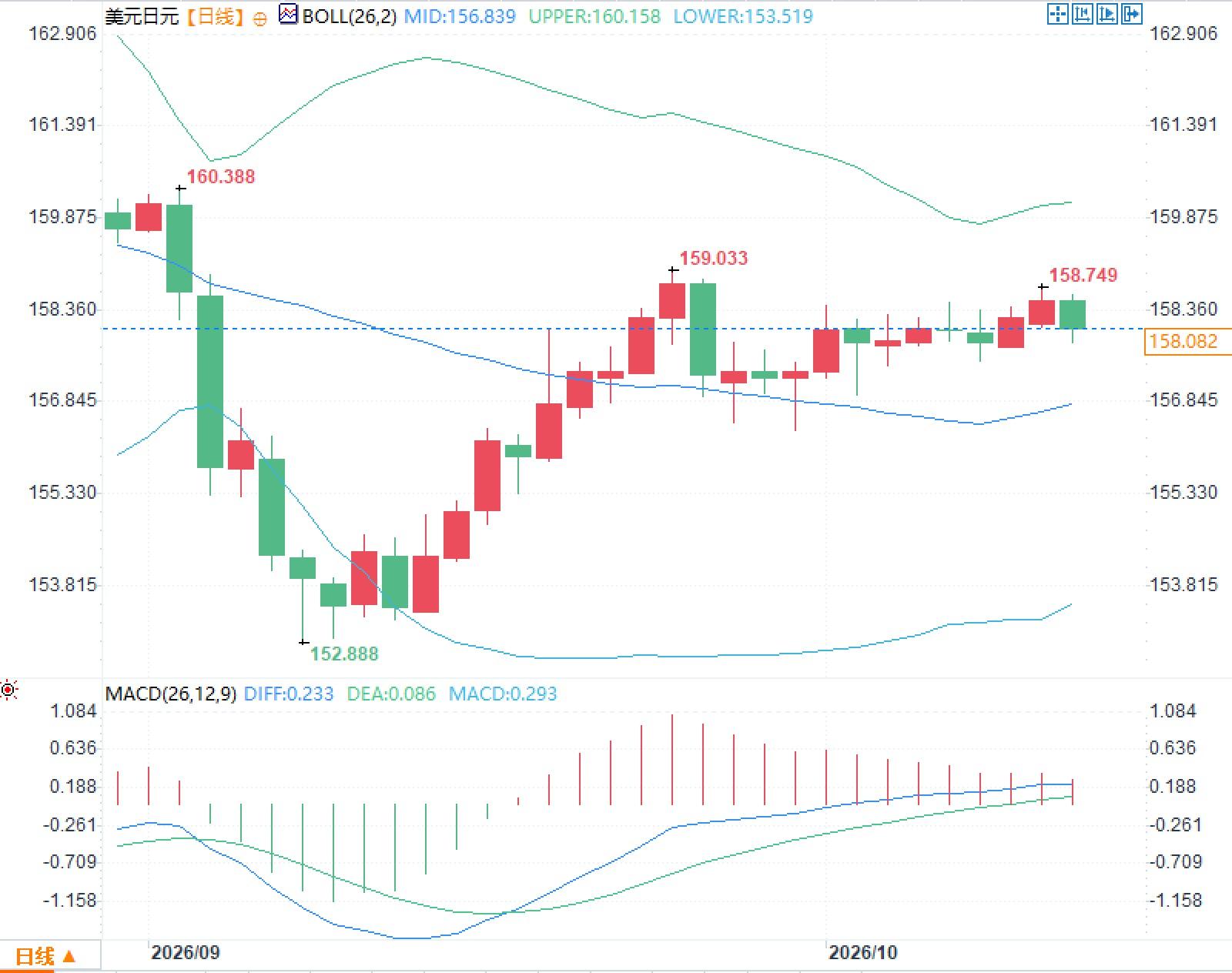
The daily chart shows the Bollinger Bands with the middle band at 156.839, the upper band at 160.158, and the lower band at 153.519. The price is trading around 158. The MACD parameters DIFF is 0.233, DEA is 0.086, and the histogram is 0.293. The price is fluctuating above the middle band, and the histogram remains positive.Frequently Asked Questions
Question 1: Why is the Bank of Japan inclined to avoid consecutive interest rate hikes this month? Answer: Officials believe that in the absence of signs of a sudden increase in upward inflation risks, consecutive action is unnecessary. Instead, they should observe the data to determine the necessity of a rate hike as early as December. This aligns with the historical preference for avoiding consecutive monthly adjustments since 1980. Question 2: What does the September producer price data mean for policy assessment? Answer: The year-on-year increase slowed to 6.8% and the month-on-month decrease was 0.3%, indicating that input cost pressures have cooled somewhat, reducing the urgency for immediate consecutive rate hikes. However, overall levels remain high, and prices for some industrial products are still rising, supporting timely adjustments later.- Risk Warning and Disclaimer
- The market involves risk, and trading may not be suitable for all investors. This article is for reference only and does not constitute personal investment advice, nor does it take into account certain users’ specific investment objectives, financial situation, or other needs. Any investment decisions made based on this information are at your own risk.