Has the European Central Bank been forced to "surrender"? The French debt crisis is rewriting the euro's story.
2026-10-13 21:00:18
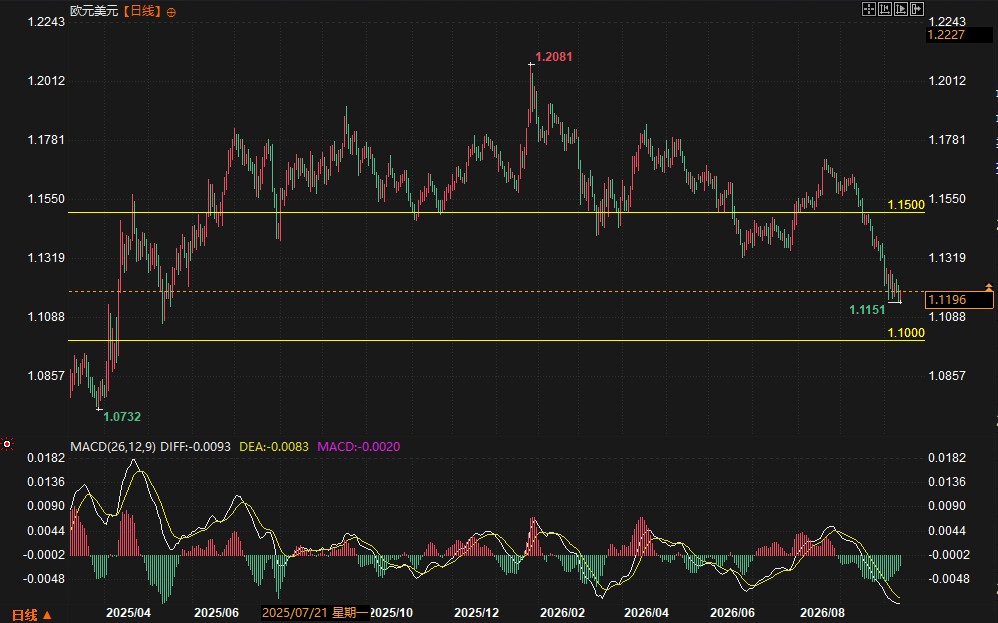
On Tuesday (October 13), the global foreign exchange market continued its recent core theme: a stronger US dollar and a weaker euro. During the European session, the euro/dollar pair remained range-bound at low levels, with thin trading but a clear directional bias. ING's latest strategy report, titled "Goodbye, Euro Bulls," directly points out the euro's current predicament—the bulls are experiencing a temporary setback. At the beginning of the year, the market had high hopes for the euro due to the so-called "de-dollarization" trade, but now the Federal Reserve's stance on inflation is clearly hawkish, and expectations of high inflation, high yields, and tighter monetary policy are likely to persist for the next two quarters. This macroeconomic background constituted the overall pressure on the euro on Tuesday. 
Fundamentals: The double squeeze from French fiscal concerns and the Fed's hawkish stance
The euro is currently facing a confluence of two conflicting factors. First, the US dollar. The US cyclical fundamentals remain robust, and the prevailing market view is that the Federal Reserve is unlikely to shift to easing in the short term, with high interest rate expectations providing continued support for the dollar. One prominent institution even predicts that the ECB may need to follow the Fed in December for its final rate hike to maintain the euro's attractiveness—this shows that the gap in monetary policy stances between the two economies is narrowing, but the dollar's relative advantage has not disappeared. Second, the Eurozone itself. France's fiscal problems are currently the euro's most direct exposure to risk. French budget politics and the upcoming election are intertwined, and market concerns about the sustainability of French debt continue to escalate. One prominent institution has suggested a more extreme scenario: if French bonds experience an unexpected sell-off, the ECB may be forced to abandon rate hikes, stop quantitative tightening, or even resume bond purchases, at which point the euro's downside potential would be far greater than currently priced in. This means the euro's vulnerability lies not in the US, but within its own borders. Furthermore, rising cross-market volatility and high energy prices have weakened the attractiveness of high-yield and emerging market currencies, with funds tending to remain in dollar assets, indirectly putting downward pressure on the euro.Technical Analysis: The price is hovering at low levels within the 1.10-1.15 range.
The weak fundamental expectations are clearly reflected in the market structure. ING's core assessment is that the euro/dollar exchange rate will remain within the 1.10-1.15 range in the coming months, with a short-term bias towards weakness, but the institution maintains its bullish medium-term view on the euro until 2027—which aligns with the current market's "weak but not broken" characteristic. Support and resistance range prediction reference contract: Euro/Dollar (EUR/USD). Range logic: The lower limit of the range, around 1.10, corresponds to the market's pricing floor regarding the ECB's policy independence and the risk of French debt. If fiscal concerns escalate, this level will face real selling pressure. The upper limit of the range, around 1.15, has accumulated defensive positions held by bulls this year, requiring a substantial decline in expected dollar interest rates to reach. Key points to watch during the session: First, the change in the yield spread between French and German government bonds; a widening spread often precedes a decline in the euro. Second, whether the US dollar index can hold its recent highs; if Fed officials reinforce a hawkish tone, the euro will retest the lower end of its range. Third, volatility indicators; if cross-market volatility increases, the euro's rebound momentum as a funding currency will be suppressed. Overall, the euro lacks catalysts in the short term, and a weaker trend within its range is the most likely path.Outlook: Range-bound trading continues; risk events will determine the direction.
Looking ahead, the euro is likely to continue trading within its lower range, with a true directional move depending on two key factors: whether the French budget and election process can stabilize market confidence, and whether the Federal Reserve will ease its interest rate policy. It's worth noting that the pound is viewed favorably by some G10 institutions, and the warming relationship between the UK and the EU could be a potential positive variable for the periphery of the Eurozone. For the euro, the medium-term bullish logic for 2027 remains intact, but in the short term, it needs to digest the dual challenges of fiscal and monetary policy. In terms of trading strategy, investors should focus on price and volume movements at the edges of the trading range and signals from the French bond market, rather than rushing to bet on a breakout.Further Reading
Q: Why does France's fiscal problems have such a significant impact on the euro? A: France is the second-largest economy in the Eurozone, and its government bonds are one of the pricing anchors of the Eurozone financial system. A sell-off of French bonds would raise the marginal financing costs of the entire Eurozone, causing market concerns that the ECB would be forced to intervene, thus shaking confidence in the euro's policy. Q: Why can the Fed's hawkish stance continue to support the dollar? A: In a high-inflation environment, the Fed's continued tight interest rate expectations keep the yield on dollar assets high. Although global hedging costs are rising, the interest rate differential still attracts capital flows to the dollar, forming basic support for the exchange rate. Q: What does the boundary of the 1.10-1.15 range mean? A: The lower edge of the range represents the market's tolerance for Eurozone fiscal risks; reaching it often accompanies expectations of a policy response. The upper edge corresponds to a weakening dollar expectation; a breakout requires a trend change in interest rate expectations. Q: What is the significance of the ECB following suit with interest rate hikes for the euro? A: If the ECB completes its final interest rate hike in December, it can narrow the interest rate differential between Europe and the US, providing interest rate support for the euro and alleviating pressure from capital outflows. Q: What is the logic behind the medium-term bullish outlook for the euro? A: A well-known institution believes that the current weakness is a temporary setback. If the policy focus changes after the US midterm elections or global investors reduce their hedging ratio for US assets again, the cyclical advantage of the US dollar may weaken, and the medium-term allocation value of the euro will reappear.- Risk Warning and Disclaimer
- The market involves risk, and trading may not be suitable for all investors. This article is for reference only and does not constitute personal investment advice, nor does it take into account certain users’ specific investment objectives, financial situation, or other needs. Any investment decisions made based on this information are at your own risk.