Deutsche Bank: Superintelligence may never arrive, what does that mean for the US economy?
2026-10-14 01:26:18
Jim Ryder of Deutsche Bank said, "We all lack enough imagination to predict what new jobs will emerge in the future. People tend to use the current work framework to extrapolate the employment landscape after technological changes." 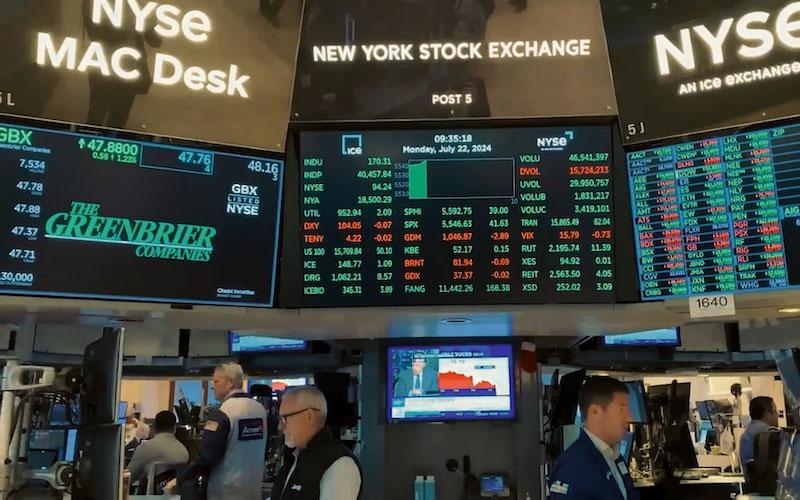 Deutsche Bank argues that the much-discussed "superintelligence" is unlikely to ever be realized. However, even without this ultimate technological breakthrough, the US economy can continue to benefit from the productivity gains brought about by the widespread adoption of artificial intelligence. The economic dividends of AI don't need to wait for superintelligence to materialize. This multinational investment bank defined "superintelligence"—coincidentally, just last month, US President Trump ordered the federal government to use the term "superintelligence" instead of the official term "artificial intelligence." The bank divides the technological hierarchy into three stages: general artificial intelligence, artificial general intelligence, and superintelligence. Superintelligence is a higher-level, continuous technological spectrum above general artificial intelligence. The bank's report explains that general artificial intelligence can reach or even surpass human levels in a single, specific cognitive task; while superintelligence requires comprehensively surpassing human thinking, reasoning, creativity, and decision-making abilities across all areas of human intelligence. Adrian Cox, a thematic strategist at Deutsche Bank's research department, and Azim Azar, founder of the research firm Exponential View, wrote in a recent joint report that the core prerequisite for reaching superintelligence is achieving recursive self-improvement (RSI). Recursive self-improvement refers to the ability of AI systems to autonomously iterate algorithms, optimize their architecture, and continuously upgrade their capabilities without continuous human intervention, forming a self-reinforcing positive cycle. This is also one of the most controversial technical conjectures in the current AI field. Deutsche Bank's baseline scenario is that, limited by the underlying physical constraints on the speed of AI programs and systems, it will be difficult for humans to ultimately achieve superintelligence. Cox and Azar wrote in their report that there is already sporadic data proving that AI has begun to release productivity gains, but at this stage, the huge upfront costs of global companies in AI computing infrastructure, model training, and data reserves remain high. High capital expenditures are actually dragging down overall productivity data in the short term, creating a situation of "input first, output lagging behind." The researchers also mentioned that major AI mega-tech companies continue to increase capital expenditures, directly driving the profit growth of semiconductor manufacturers, computing hardware, and upstream and downstream supporting industrial chains. The AI industrial chain now contributes one-third to one-half of the incremental growth of the US economy and has become one of the most core pillars supporting the expansion of the US economy. They wrote, "Over the past three years, the ratio of US stock wealth to household income has climbed from about 1.8 to nearly 2.5. The wealth effect brought about by the rise in capital markets has boosted the book assets of American households, thereby supporting residents' willingness to consume. Consumption is the largest component of US GDP, and this transmission chain is continuing." Jim Reid, Global Head of Macro and Thematic Research at Deutsche Bank, said, "Looking back at the 250 to 300 years of history since the Industrial Revolution, whenever a disruptive new technology emerges, society repeats the same concerns—that the new technology will destroy a large number of jobs. From the steam engine and electricity to computers, in the early stages of each technological revolution, unemployment fears spread widely in society, but the final reality is often different from pessimistic expectations. We have consistently seen that the productivity gains brought about by technology create new social wealth and generate new labor demand, only the job forms and job content will be completely changed." He cited Henry Ford, the founder of Ford Motor Company, as an example. In 1913, Henry Ford decided to partially automate the Model T production line. The automation of the assembly line caused huge social controversy at the time, with many workers fearing that their jobs would be replaced by machines, leading to strong protests. Reed said that after automation, Ford significantly reduced car production costs, making cars more affordable for ordinary people. The rapid expansion of the automotive market led to the extension of the entire vehicle supply chain, requiring a large influx of new labor in areas such as parts manufacturing, battery production, sales, and maintenance. Ultimately, this created far more new jobs than were replaced by automation. "We all collectively lack imagination; we can't imagine what future jobs will look like," Reed said. "Humans find it difficult to imagine jobs that don't yet exist—this is a common limitation of every era of technological change. But I firmly believe that as long as productivity continues to improve, society will adjust itself, and new job opportunities will inevitably emerge."
Deutsche Bank argues that the much-discussed "superintelligence" is unlikely to ever be realized. However, even without this ultimate technological breakthrough, the US economy can continue to benefit from the productivity gains brought about by the widespread adoption of artificial intelligence. The economic dividends of AI don't need to wait for superintelligence to materialize. This multinational investment bank defined "superintelligence"—coincidentally, just last month, US President Trump ordered the federal government to use the term "superintelligence" instead of the official term "artificial intelligence." The bank divides the technological hierarchy into three stages: general artificial intelligence, artificial general intelligence, and superintelligence. Superintelligence is a higher-level, continuous technological spectrum above general artificial intelligence. The bank's report explains that general artificial intelligence can reach or even surpass human levels in a single, specific cognitive task; while superintelligence requires comprehensively surpassing human thinking, reasoning, creativity, and decision-making abilities across all areas of human intelligence. Adrian Cox, a thematic strategist at Deutsche Bank's research department, and Azim Azar, founder of the research firm Exponential View, wrote in a recent joint report that the core prerequisite for reaching superintelligence is achieving recursive self-improvement (RSI). Recursive self-improvement refers to the ability of AI systems to autonomously iterate algorithms, optimize their architecture, and continuously upgrade their capabilities without continuous human intervention, forming a self-reinforcing positive cycle. This is also one of the most controversial technical conjectures in the current AI field. Deutsche Bank's baseline scenario is that, limited by the underlying physical constraints on the speed of AI programs and systems, it will be difficult for humans to ultimately achieve superintelligence. Cox and Azar wrote in their report that there is already sporadic data proving that AI has begun to release productivity gains, but at this stage, the huge upfront costs of global companies in AI computing infrastructure, model training, and data reserves remain high. High capital expenditures are actually dragging down overall productivity data in the short term, creating a situation of "input first, output lagging behind." The researchers also mentioned that major AI mega-tech companies continue to increase capital expenditures, directly driving the profit growth of semiconductor manufacturers, computing hardware, and upstream and downstream supporting industrial chains. The AI industrial chain now contributes one-third to one-half of the incremental growth of the US economy and has become one of the most core pillars supporting the expansion of the US economy. They wrote, "Over the past three years, the ratio of US stock wealth to household income has climbed from about 1.8 to nearly 2.5. The wealth effect brought about by the rise in capital markets has boosted the book assets of American households, thereby supporting residents' willingness to consume. Consumption is the largest component of US GDP, and this transmission chain is continuing." Jim Reid, Global Head of Macro and Thematic Research at Deutsche Bank, said, "Looking back at the 250 to 300 years of history since the Industrial Revolution, whenever a disruptive new technology emerges, society repeats the same concerns—that the new technology will destroy a large number of jobs. From the steam engine and electricity to computers, in the early stages of each technological revolution, unemployment fears spread widely in society, but the final reality is often different from pessimistic expectations. We have consistently seen that the productivity gains brought about by technology create new social wealth and generate new labor demand, only the job forms and job content will be completely changed." He cited Henry Ford, the founder of Ford Motor Company, as an example. In 1913, Henry Ford decided to partially automate the Model T production line. The automation of the assembly line caused huge social controversy at the time, with many workers fearing that their jobs would be replaced by machines, leading to strong protests. Reed said that after automation, Ford significantly reduced car production costs, making cars more affordable for ordinary people. The rapid expansion of the automotive market led to the extension of the entire vehicle supply chain, requiring a large influx of new labor in areas such as parts manufacturing, battery production, sales, and maintenance. Ultimately, this created far more new jobs than were replaced by automation. "We all collectively lack imagination; we can't imagine what future jobs will look like," Reed said. "Humans find it difficult to imagine jobs that don't yet exist—this is a common limitation of every era of technological change. But I firmly believe that as long as productivity continues to improve, society will adjust itself, and new job opportunities will inevitably emerge."- Risk Warning and Disclaimer
- The market involves risk, and trading may not be suitable for all investors. This article is for reference only and does not constitute personal investment advice, nor does it take into account certain users’ specific investment objectives, financial situation, or other needs. Any investment decisions made based on this information are at your own risk.