A chart shows that the Latin American Dry Index (LADI) fell for the seventh consecutive day, with weaker Capesize freight rates dragging down overall performance.
2026-10-14 01:02:21
The latest data shows that on October 13, 2026, the Baltic Dry Index (BDI) stood at 2801 points, a new low since August 20, 2026, down 1.79% month-on-month, marking the seventh consecutive day of decline (including zero growth). Looking at the short-term charts, the recent 11 BDI data points show: 2 positive increases, 9 negative increases, and 0 zero increases. Specifically, the Panamax Freight Index (BPI) was 2432 points, unchanged from the previous value; the Capesize Freight Index (BCI) was 3994 points, down 3.71%; and the Supramax Freight Index (BSI) was 1833 points, up 0.66%. For detailed charts of the latest 720-day and 10-year trends of the Baltic Dry Index and its three main sub-indices, please refer to the charts specially created by FX678. 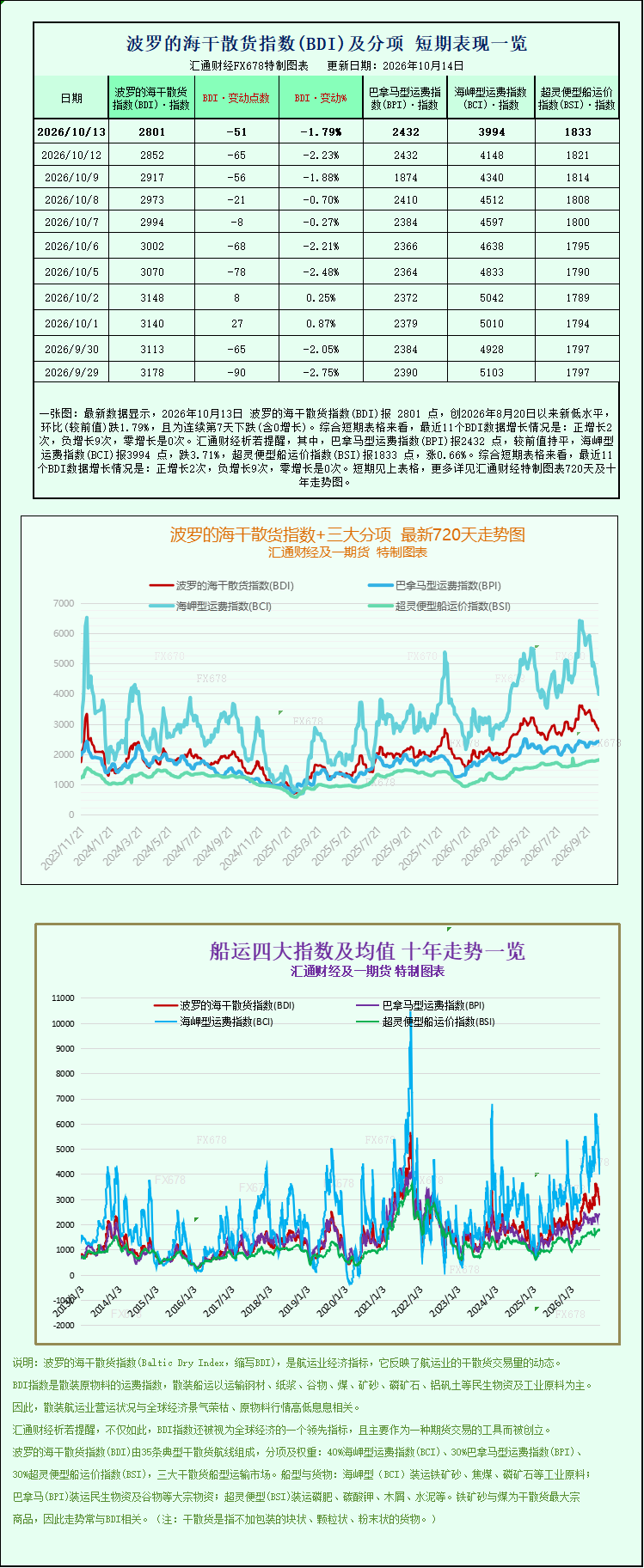 The Baltic Exchange's main shipping index, which tracks dry bulk freight rates, fell for the seventh consecutive trading day on Tuesday, primarily due to weaker Capesize rates, which became the core factor dragging down the overall index performance. Overall Index: Hits Two-Month Low, Seven-Day Decline The Baltic Dry Index, which tracks Capesize, Panamax, and Supramax vessel freight rates, fell 51 points, or 1.79%, to close at 2,801 points. This level is the lowest since August 20th and marks the seventh consecutive trading day of decline for the index, indicating continued weak market sentiment. The continuous decline reflects insufficient overall demand momentum in the dry bulk shipping market, with significant divergence in performance across different vessel types. Capesize Vessels: Leading the Decline, Daily Earnings Shrink Significantly As the largest vessel type in dry bulk shipping and most sensitive to demand for commodity transport, the Capesize index fell 154 points, or 3.71%, to 3,994 points, its lowest level since late July. The average daily earnings of Capesize vessels carrying 150,000 tons of cargo (including iron ore and coal) decreased by $1,396 to $32,719. Capesize freight rates are generally considered a barometer of global dry bulk trade activity in iron ore, coal, and other bulk commodities. A continued decline in daily earnings often corresponds to a weakening marginal demand for shipping capacity from major commodity shippers. Driving Factors: Pressure on Iron Ore Futures, Ample Supply Coupled with High Inventories From a fundamental perspective, the weakening of Capesize freight rates is closely related to the sluggish iron ore market. On Tuesday, iron ore futures prices fell, directly suppressing the freight market. Market participants generally believe that multiple factors are currently affecting prices: First, global iron ore supply is generally ample, with no significant tightening seen on the supply side; second, iron ore inventories at Chinese ports remain high, limiting short-term restocking demand; and third, transportation costs are already on a downward trend, further weakening the support of freight rates for prices. Against the backdrop of ample supply, high inventories, and declining freight rates, iron ore prices are under short-term pressure, which in turn affects Capesize freight rates. Panamax: Stable Performance, Index Unchanged In contrast to Capesize vessels, the Panamax index remained unchanged at 2,432 points. These vessels, typically carrying 60,000 to 70,000 tons of coal or grain, have an average daily earnings of $21,886. Panamax freight rates mainly reflect the transportation demand for medium-tonnage dry bulk cargoes such as coal and grain. Their relatively stable trend indicates that demand for commodities such as grain and coal remains somewhat supported and has not declined in tandem with the weakness in Capesize freight rates. Supramax Vessels: Slight Increase Against the Trend Among smaller vessels, the Very Large Vessels (VLS) index rose slightly by 12 points, or 0.66%, to 1,833 points. Supramax vessels primarily carry small-volume bulk cargo and some near-shore shipping demand. Their upward trend against the market may reflect structural differences between different cargo types and routes, with some niche markets still experiencing demand support. Market Observation: Structural Differentiation, Short-Term Uncertainty Remains Overall, the Baltic Dry Index currently exhibits a clear structural differentiation: Capesize vessels are leading the decline due to weak iron ore demand, Panamax vessels are generally stable, while Supramax vessels have seen a slight rebound. Historically, Capesize freight rates are highly correlated with iron ore prices and Chinese import demand. The future trend of the index will still depend on the pace of iron ore demand recovery, the progress of destocking at Chinese ports, and the overall activity of global dry bulk trade. In the short term, given the ample supply and high inventory levels, whether the market can stabilize and recover remains to be seen, depending on actual changes in iron ore import demand and the release of shipping capacity across different vessel types. Overall, market sentiment is currently cautious, and the divergence in performance among different vessel types suggests that investors should pay close attention to structural changes in the dry bulk shipping market.
The Baltic Exchange's main shipping index, which tracks dry bulk freight rates, fell for the seventh consecutive trading day on Tuesday, primarily due to weaker Capesize rates, which became the core factor dragging down the overall index performance. Overall Index: Hits Two-Month Low, Seven-Day Decline The Baltic Dry Index, which tracks Capesize, Panamax, and Supramax vessel freight rates, fell 51 points, or 1.79%, to close at 2,801 points. This level is the lowest since August 20th and marks the seventh consecutive trading day of decline for the index, indicating continued weak market sentiment. The continuous decline reflects insufficient overall demand momentum in the dry bulk shipping market, with significant divergence in performance across different vessel types. Capesize Vessels: Leading the Decline, Daily Earnings Shrink Significantly As the largest vessel type in dry bulk shipping and most sensitive to demand for commodity transport, the Capesize index fell 154 points, or 3.71%, to 3,994 points, its lowest level since late July. The average daily earnings of Capesize vessels carrying 150,000 tons of cargo (including iron ore and coal) decreased by $1,396 to $32,719. Capesize freight rates are generally considered a barometer of global dry bulk trade activity in iron ore, coal, and other bulk commodities. A continued decline in daily earnings often corresponds to a weakening marginal demand for shipping capacity from major commodity shippers. Driving Factors: Pressure on Iron Ore Futures, Ample Supply Coupled with High Inventories From a fundamental perspective, the weakening of Capesize freight rates is closely related to the sluggish iron ore market. On Tuesday, iron ore futures prices fell, directly suppressing the freight market. Market participants generally believe that multiple factors are currently affecting prices: First, global iron ore supply is generally ample, with no significant tightening seen on the supply side; second, iron ore inventories at Chinese ports remain high, limiting short-term restocking demand; and third, transportation costs are already on a downward trend, further weakening the support of freight rates for prices. Against the backdrop of ample supply, high inventories, and declining freight rates, iron ore prices are under short-term pressure, which in turn affects Capesize freight rates. Panamax: Stable Performance, Index Unchanged In contrast to Capesize vessels, the Panamax index remained unchanged at 2,432 points. These vessels, typically carrying 60,000 to 70,000 tons of coal or grain, have an average daily earnings of $21,886. Panamax freight rates mainly reflect the transportation demand for medium-tonnage dry bulk cargoes such as coal and grain. Their relatively stable trend indicates that demand for commodities such as grain and coal remains somewhat supported and has not declined in tandem with the weakness in Capesize freight rates. Supramax Vessels: Slight Increase Against the Trend Among smaller vessels, the Very Large Vessels (VLS) index rose slightly by 12 points, or 0.66%, to 1,833 points. Supramax vessels primarily carry small-volume bulk cargo and some near-shore shipping demand. Their upward trend against the market may reflect structural differences between different cargo types and routes, with some niche markets still experiencing demand support. Market Observation: Structural Differentiation, Short-Term Uncertainty Remains Overall, the Baltic Dry Index currently exhibits a clear structural differentiation: Capesize vessels are leading the decline due to weak iron ore demand, Panamax vessels are generally stable, while Supramax vessels have seen a slight rebound. Historically, Capesize freight rates are highly correlated with iron ore prices and Chinese import demand. The future trend of the index will still depend on the pace of iron ore demand recovery, the progress of destocking at Chinese ports, and the overall activity of global dry bulk trade. In the short term, given the ample supply and high inventory levels, whether the market can stabilize and recover remains to be seen, depending on actual changes in iron ore import demand and the release of shipping capacity across different vessel types. Overall, market sentiment is currently cautious, and the divergence in performance among different vessel types suggests that investors should pay close attention to structural changes in the dry bulk shipping market.
- Risk Warning and Disclaimer
- The market involves risk, and trading may not be suitable for all investors. This article is for reference only and does not constitute personal investment advice, nor does it take into account certain users’ specific investment objectives, financial situation, or other needs. Any investment decisions made based on this information are at your own risk.