Market pricing in four rate hikes raises questions: Can the pound maintain its current range?
2026-10-14 18:36:18
On Wednesday, October 14th, the pound was consolidating around 1.326 against the dollar, with market attention focused on statements from Bank of England officials at the IMF annual meetings in Bangkok. Chief Economist Hugh Peale expressed skepticism about the market's pricing in a four-rate-hike path, emphasizing that more concrete evidence of an energy shock is needed to support a larger rate adjustment. Governor Andrew Bailey noted that the longer the shock lasts, the more difficult it will be to avoid a rate hike. The Bank of England's interest rate is currently at 3.75%, the August consumer price index rose to 3.1% year-on-year, and core inflation was 2.6%, with energy price volatility remaining a major source of upward pressure. Brent crude oil prices are trading around $105 per barrel, and the related transmission effects are still being observed. 
Difference between market pricing and official statements
Hugh Peale explicitly stated that he is skeptical of market pricing indicating a possible four 25-basis-point rate hikes by the Bank of England by next summer. He pointed out that to achieve a cumulative adjustment of 100 basis points, more concrete manifestations of these risks are needed. Peale believes the Bank of England should have addressed the energy shock earlier, but current evidence is insufficient to support a series of consecutive rate hikes. He emphasized that more data on the second-round effects will be available in the next six to nine months. Meanwhile, the market has almost fully priced in the first rate hike in over three years at the November Monetary Policy Committee meeting, with expectations of three more 25-basis-point increases. Andrew Bailey reiterated that the longer the energy shock persists, the more difficult it will be to avoid rate hikes. He observed greater resilience in UK economic activity, a factor that needs to be taken into account. Bailey also noted that the second-round effects of businesses passing on costs and workers demanding wage increases are currently relatively mild in the UK, but the situation is still in its early stages. The statements from the two officials indicate that there are differences within the Monetary Policy Committee regarding the magnitude and pace of adjustments, and the tension between market pricing and official statements is widening.The transmission of energy shocks to UK inflation and the economy
The UK Consumer Price Index (CPI) rose 3.1% year-on-year in August, up from 2.9% in July, primarily driven by petrol and diesel prices. Core inflation remained at 2.6%. The Bank of England had previously projected inflation to rise to around 3.75% in the fourth quarter of 2026 and slightly above 4% in the first quarter of 2027, a view linked to persistently higher energy prices than the previous benchmark. Brent crude oil prices have risen significantly since the outbreak of the conflict and are currently fluctuating around $105 per barrel, putting pressure on imported energy costs and household bills. Peel emphasized that the resilience of the UK economy and labor market is an important consideration. Current data suggests that the transmission of energy prices to broader price and wage settings remains limited, but the Committee is closely monitoring whether this spreads. Labor market indicators show a degree of moderate activity, and financial conditions have tightened since the conflict, providing a buffer for assessing the risks of persistent inflation. However, uncertainty about the policy path continues to rise as more officials shift towards supporting adjustments.GBP/USD Price Behavior Watch
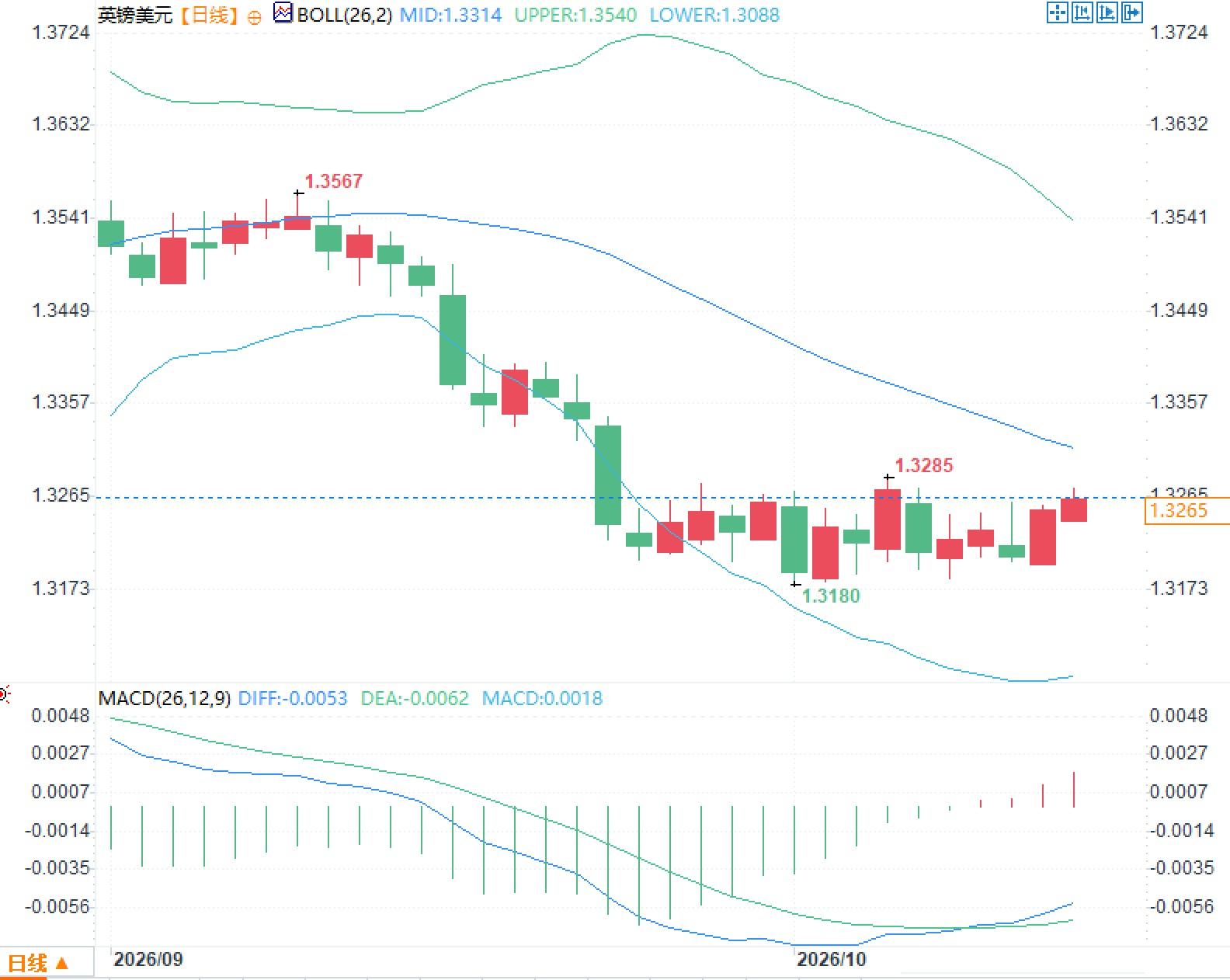
The GBP/USD daily chart shows the price consolidating around 1.32 recently. The Bollinger Band middle line is at 1.3314, the upper line is at 1.3540, and the lower line is at 1.3088. The current price is near the lower band, indicating a narrowing trading range. Recent candlestick patterns show alternating bullish and bearish movements, with the price retracing from previous highs and entering a range-bound pattern. The MACD indicator shows a DIFF of -0.0053, a DEA of -0.0062, and a histogram value of 0.0018, with the indicator lines trading below the zero line.Evolution of the views of the UK Monetary Policy Committee and considerations on policy path
Hugh Peele has been a minority member of the Monetary Policy Committee since April, supporting an immediate rate hike and arguing that there should be no excessive delay in addressing the energy shock. At the September meeting, the committee maintained the bank's interest rate at 3.75% by a 6-3 majority, with Peele and two other members voting to raise it to 4%. Most members believed that a moderate labor market and tightening financial conditions had bought time to assess the risks of persistent inflation. Recent statements indicate that more officials are gradually moving closer to a supportive stance on rate hikes. Bailey's comments suggest that the duration of the shock is a key variable. Peele, however, insists that more concrete evidence of a second-round effect is needed to support the full path of market pricing. The next UK monetary policy meeting is scheduled for November 5th. At the heart of the policy considerations is whether the energy shock will evolve from a direct price effect into a broader dynamic of wages and price setting. The balance between the resilience of the UK economy and the management of inflation expectations will determine the voting outcome at subsequent meetings. Peele emphasizes that the central bank needs to ensure policy is in the right place while avoiding acting solely based on market pricing.- Risk Warning and Disclaimer
- The market involves risk, and trading may not be suitable for all investors. This article is for reference only and does not constitute personal investment advice, nor does it take into account certain users’ specific investment objectives, financial situation, or other needs. Any investment decisions made based on this information are at your own risk.