How does the Federal Reserve typically adjust interest rates in the lead-up to presidential and midterm elections?
2026-10-14 19:58:19
The Federal Open Market Committee (FOMC), responsible for setting monetary policy, raised interest rates on September 16, marking the first rate hike since July 2023 and the first rate adjustment since new Fed Chairman Warsh took office. The impetus for the rate hike was persistently high inflation. The decision raised the target range for the federal funds rate to 3.75%-4.00%.  The market's attention is now entirely focused on the Federal Reserve's next interest rate meeting, scheduled for October 28th—just six days before the November 3rd midterm elections. Will the Fed adjust interest rates again so close to the election? Historically, the Fed has a tradition of avoiding monetary policy adjustments in the lead-up to elections. However, the September rate hike suggests this is merely a tendency, not a hard and fast rule. 27 Federal Elections from 1972 to 2024 This study covers 27 US federal elections (including presidential and midterm elections) from 1972 to 2024. "Lead-up to the election" is defined as the period from September 1st to election day. During these 27 election cycles, the Fed kept interest rates unchanged 52% of the time. When it did take action, it cut rates 57% of the time and raised rates 43% of the time.
 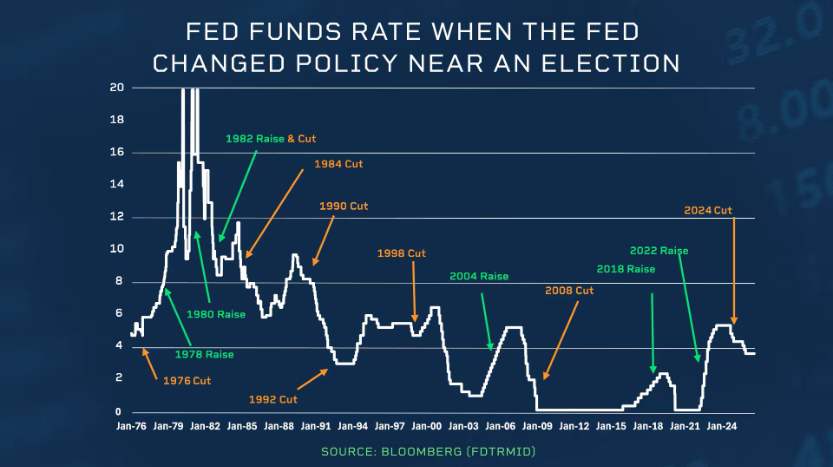 The 1982 midterm election was an outlier: it was the only time the Federal Reserve both raised and lowered interest rates during that window. During Paul Volcker's tenure as Fed Chairman, the FOMC shifted its policy target from M1 money supply back to the federal funds rate. Midterm elections: The Fed intervened less frequently . There were 13 midterm elections between 1972 and 2024. The Fed kept interest rates unchanged 54% of the time; when it did adjust rates, the number of rate hikes and cuts was roughly equal. If the 1982 exception is excluded, the rate of unchanged rates rises to 62%. The Fed has raised interest rates four times before midterm elections: 1978, 1982, 2018, and 2022, all due to rising inflation. It has cut rates three times: 1982, 1990, and 1998, driven by economic slowdowns or crises: the 1990 savings and loan crisis plus the energy shock from the Iraq War; and the 1998 Russian debt default and the collapse of Long-Term Capital Management (LTCM). Presidential Election Years: 50/50 Probability of Rate Hikes and Cuts, with a Stronger Inclination Towards Cuts In presidential election years, the Federal Reserve's probability of maintaining interest rates is 50/50, and its probability of adjusting rates is 50/50. If it chooses to adjust rates, 71% of the time it's a rate cut. Only two presidential election years saw rate hikes: 1980 (to combat double-digit inflation) and 2004 (rates normalized after the dot-com bubble). There have been five election years with rate cuts: 1976, 1984, 1992, 2008, and 2024. Narrower Time Window: October 1st to Election Day If the observation window is shortened to October 1st to Election Day, the Fed keeps rates unchanged 67% of the time. If rates are adjusted within October, 67% of the time it's a rate cut. The Fed has only adjusted rates twice before the November election: in 1978 and 2022, both midterm elections, and both times inflation was rising. Key Conclusion The general market perception is that the Fed is reluctant to adjust rates as the election approaches. Data largely supports this view. Throughout the period from September to Election Day, the Federal Reserve held rates steady for about 52% of the time; starting from October, the rate adjustment rate reached 67%. However, the Fed will intervene if inflation surges or a crisis erupts. When taking action, the probability of a rate cut is higher than a rate hike; policy adjustments occur more frequently in September than in October. The Fed already raised rates in September. Now, everyone is focused on the decision on October 28, just six days before the midterm elections. Historical patterns show that the Fed usually chooses to wait and see in October. But Warsh has broken the precedent of not raising rates in September. Will he break the October precedent again? The real question worth paying attention to is how the Fed will act after the election.
The market's attention is now entirely focused on the Federal Reserve's next interest rate meeting, scheduled for October 28th—just six days before the November 3rd midterm elections. Will the Fed adjust interest rates again so close to the election? Historically, the Fed has a tradition of avoiding monetary policy adjustments in the lead-up to elections. However, the September rate hike suggests this is merely a tendency, not a hard and fast rule. 27 Federal Elections from 1972 to 2024 This study covers 27 US federal elections (including presidential and midterm elections) from 1972 to 2024. "Lead-up to the election" is defined as the period from September 1st to election day. During these 27 election cycles, the Fed kept interest rates unchanged 52% of the time. When it did take action, it cut rates 57% of the time and raised rates 43% of the time. The 1982 midterm election was an outlier: it was the only time the Federal Reserve both raised and lowered interest rates during that window. During Paul Volcker's tenure as Fed Chairman, the FOMC shifted its policy target from M1 money supply back to the federal funds rate. Midterm elections: The Fed intervened less frequently . There were 13 midterm elections between 1972 and 2024. The Fed kept interest rates unchanged 54% of the time; when it did adjust rates, the number of rate hikes and cuts was roughly equal. If the 1982 exception is excluded, the rate of unchanged rates rises to 62%. The Fed has raised interest rates four times before midterm elections: 1978, 1982, 2018, and 2022, all due to rising inflation. It has cut rates three times: 1982, 1990, and 1998, driven by economic slowdowns or crises: the 1990 savings and loan crisis plus the energy shock from the Iraq War; and the 1998 Russian debt default and the collapse of Long-Term Capital Management (LTCM). Presidential Election Years: 50/50 Probability of Rate Hikes and Cuts, with a Stronger Inclination Towards Cuts In presidential election years, the Federal Reserve's probability of maintaining interest rates is 50/50, and its probability of adjusting rates is 50/50. If it chooses to adjust rates, 71% of the time it's a rate cut. Only two presidential election years saw rate hikes: 1980 (to combat double-digit inflation) and 2004 (rates normalized after the dot-com bubble). There have been five election years with rate cuts: 1976, 1984, 1992, 2008, and 2024. Narrower Time Window: October 1st to Election Day If the observation window is shortened to October 1st to Election Day, the Fed keeps rates unchanged 67% of the time. If rates are adjusted within October, 67% of the time it's a rate cut. The Fed has only adjusted rates twice before the November election: in 1978 and 2022, both midterm elections, and both times inflation was rising. Key Conclusion The general market perception is that the Fed is reluctant to adjust rates as the election approaches. Data largely supports this view. Throughout the period from September to Election Day, the Federal Reserve held rates steady for about 52% of the time; starting from October, the rate adjustment rate reached 67%. However, the Fed will intervene if inflation surges or a crisis erupts. When taking action, the probability of a rate cut is higher than a rate hike; policy adjustments occur more frequently in September than in October. The Fed already raised rates in September. Now, everyone is focused on the decision on October 28, just six days before the midterm elections. Historical patterns show that the Fed usually chooses to wait and see in October. But Warsh has broken the precedent of not raising rates in September. Will he break the October precedent again? The real question worth paying attention to is how the Fed will act after the election.
- Risk Warning and Disclaimer
- The market involves risk, and trading may not be suitable for all investors. This article is for reference only and does not constitute personal investment advice, nor does it take into account certain users’ specific investment objectives, financial situation, or other needs. Any investment decisions made based on this information are at your own risk.