Brent crude oil prices show no signs of falling.
2026-10-14 18:42:18
On Wednesday (October 14), WTI crude oil prices rose for the fifth consecutive day during the European trading session, trading at approximately $95.32 per barrel. Meanwhile, Brent crude oil futures prices climbed above $106.10 per barrel, with the spread (the difference between near-month and far-month contracts) maintaining a deep cash premium structure, and the near-month-far-month spread widening further. This clearly reflects an extremely tight supply situation in the spot market.  According to Kpler data, oil shipments through the Strait of Hormuz dropped sharply in October. In the seven days ending October 10, the average daily shipment was 10.5 million barrels, a 38% decrease from the pre-conflict level of 17.1 million barrels. Another authoritative figure is even higher: the average daily shipment in the strait in September was 18.11 million barrels, while the average daily shipment in the eight weeks before the Middle East conflict was 18.22 million barrels. The renewed attacks on Saudi tankers and oil facilities have caused deep concern among oil-exporting countries. Furthermore, although OPEC+ has gradually implemented a nominal production quota increase plan since the second quarter of this year, and major producing countries such as Saudi Arabia have increased their production figures, geopolitical blockades have made it difficult for these "paper increases" to smoothly translate into actual physical supply. Coupled with escalating geopolitical threats, major international insurance companies have increased the "tactical risk surcharge" for the Persian Gulf by nearly 150%, resulting in a surge of millions of yuan in premiums for a single Very Large Crude Carrier (VLCC) voyage, further squeezing the actual liquidity of the crude oil trade. The recent diesel agreement reached between the US and Russia appears to be highly effective, but in reality, it can only meet the US's diesel needs for nine days, and the goods will be delivered in batches. From the perspective of the refining industry chain, current global diesel inventories are about 18% lower than the five-year average, and refinery profit margins remain high. A one-off, short-term increase is simply insufficient to fill the systemic diesel shortage caused by the overlap of the autumn harvest and winter heating season. For oil prices to continue to decline, a systemic solution is needed to address the supply shortages and various risks caused by conflicts among oil-producing countries. In addition to persistently high geopolitical risk premiums and historically high transportation costs, reports of increased Chinese oil imports are also driving up Brent crude prices. During the height of the Middle East conflict, Chinese oil imports declined significantly, a factor that prevented Brent crude prices from breaking historical records and helped the world avert an economic crisis. According to Bloomberg, 96 oil tankers with a deadweight tonnage of 2 million barrels or more will arrive at Chinese ports in the next 90 days, the highest figure since the end of February. This equates to approximately 192 million barrels of crude oil arriving at ports over the next three months, with an average daily increase of over 2 million barrels. The main reasons are the recovery in operating rates at domestic refineries after their autumn maintenance shutdowns, and the demand for stockpiling in anticipation of the upcoming peak travel season and industrial recovery.
 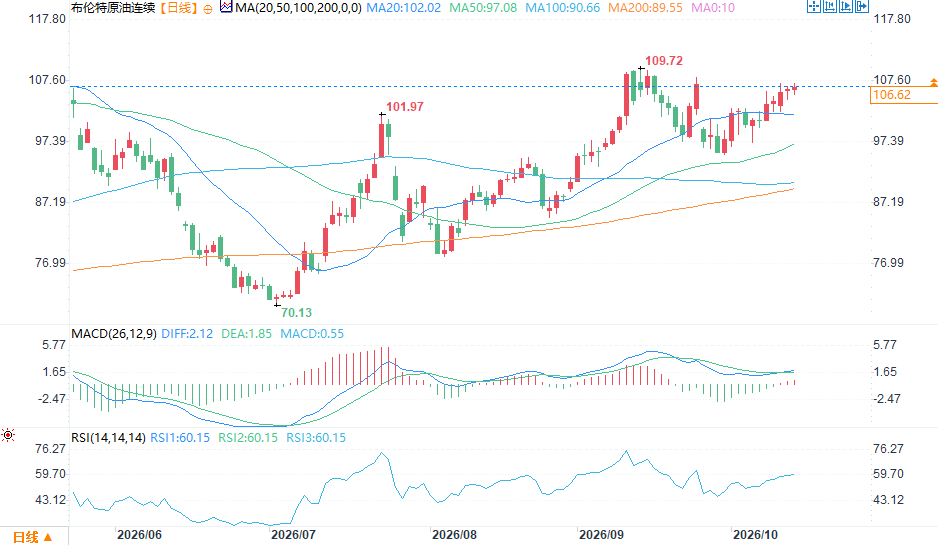 (Brent crude oil daily chart source: FX678) Nevertheless, several points remain worth noting. First, the closer oil prices approach $100, the more actively the US will push for conflict resolution and peace. For Brent crude oil, which is priced slightly higher, the psychological threshold for US intervention is around $105. Once oil prices reach this threshold, the Federal Reserve's efforts to curb inflation risk being undone, directly dragging down domestic consumer confidence and the White House's approval rating. Therefore, Washington is likely to release tactical petroleum reserves (SPR), fine-tune policies on specific sanctions exemptions, or pressure OPEC+ to further relax quota restrictions to forcibly suppress oil prices. Second, both oil supply and demand lack price elasticity; a mere 1% change in the supply-demand balance can cause oil prices to fluctuate by 10-20%. Given the current extremely fragile marginal supply and demand, even a small increase in OPEC+ production capacity or any hint of ceasefire negotiations in the market could trigger rapid liquidation of highly leveraged short or long positions in the derivatives market. In other words, even limited regulatory measures could lead to a drop in oil prices, which is not surprising, as the market seems to have developed a conditioned reflex to this. Third, demand from China continues to rise. This spring, the market generally expected the conflict with Iran to end quickly, leading China to reduce purchases and utilize its oil reserves for an extended period under high oil prices, a key factor suppressing prices at the time. However, in the fall, China began purchasing contracts for October delivery, and demand continued to rise. It is worth noting that as China's strategic petroleum reserves (SPR) entered a replenishment cycle after previous depletion, coupled with geopolitical uncertainties prompting buyers to seek higher safety stock thresholds, this "replenishment demand," combined with the recovery in consumption, formed strong buyer support. In addition to supply reduction, tanker freight costs have reached new highs, accounting for one-third of the total cost of crude oil; this is further compounded by increased risk premiums due to market volatility. Looking at the Baltic Dry Index (BDTI), freight rates on the Middle East-Asia route have doubled in a short period, with tight capacity significantly pushing up "CIF (Cost Per Term)". Even if OPEC+ attempts to balance the market by increasing quotas, the bottleneck has shifted from "no oil to extract" to the shipping and logistics sector, where "no ships to transport" are available. All of these factors could accelerate inflation, pushing up bond yields and further strengthening the US dollar. The rising risk of double-dip inflation has reinforced market expectations that major central banks like the Federal Reserve will maintain high interest rates for an extended period. This has led to a rise in the yield on 10-year US Treasury bonds, causing funds to flow back into dollar assets and creating liquidity pressure on global non-US currencies, potentially triggering a new round of macroeconomic and financial ripples.
According to Kpler data, oil shipments through the Strait of Hormuz dropped sharply in October. In the seven days ending October 10, the average daily shipment was 10.5 million barrels, a 38% decrease from the pre-conflict level of 17.1 million barrels. Another authoritative figure is even higher: the average daily shipment in the strait in September was 18.11 million barrels, while the average daily shipment in the eight weeks before the Middle East conflict was 18.22 million barrels. The renewed attacks on Saudi tankers and oil facilities have caused deep concern among oil-exporting countries. Furthermore, although OPEC+ has gradually implemented a nominal production quota increase plan since the second quarter of this year, and major producing countries such as Saudi Arabia have increased their production figures, geopolitical blockades have made it difficult for these "paper increases" to smoothly translate into actual physical supply. Coupled with escalating geopolitical threats, major international insurance companies have increased the "tactical risk surcharge" for the Persian Gulf by nearly 150%, resulting in a surge of millions of yuan in premiums for a single Very Large Crude Carrier (VLCC) voyage, further squeezing the actual liquidity of the crude oil trade. The recent diesel agreement reached between the US and Russia appears to be highly effective, but in reality, it can only meet the US's diesel needs for nine days, and the goods will be delivered in batches. From the perspective of the refining industry chain, current global diesel inventories are about 18% lower than the five-year average, and refinery profit margins remain high. A one-off, short-term increase is simply insufficient to fill the systemic diesel shortage caused by the overlap of the autumn harvest and winter heating season. For oil prices to continue to decline, a systemic solution is needed to address the supply shortages and various risks caused by conflicts among oil-producing countries. In addition to persistently high geopolitical risk premiums and historically high transportation costs, reports of increased Chinese oil imports are also driving up Brent crude prices. During the height of the Middle East conflict, Chinese oil imports declined significantly, a factor that prevented Brent crude prices from breaking historical records and helped the world avert an economic crisis. According to Bloomberg, 96 oil tankers with a deadweight tonnage of 2 million barrels or more will arrive at Chinese ports in the next 90 days, the highest figure since the end of February. This equates to approximately 192 million barrels of crude oil arriving at ports over the next three months, with an average daily increase of over 2 million barrels. The main reasons are the recovery in operating rates at domestic refineries after their autumn maintenance shutdowns, and the demand for stockpiling in anticipation of the upcoming peak travel season and industrial recovery. (Brent crude oil daily chart source: FX678) Nevertheless, several points remain worth noting. First, the closer oil prices approach $100, the more actively the US will push for conflict resolution and peace. For Brent crude oil, which is priced slightly higher, the psychological threshold for US intervention is around $105. Once oil prices reach this threshold, the Federal Reserve's efforts to curb inflation risk being undone, directly dragging down domestic consumer confidence and the White House's approval rating. Therefore, Washington is likely to release tactical petroleum reserves (SPR), fine-tune policies on specific sanctions exemptions, or pressure OPEC+ to further relax quota restrictions to forcibly suppress oil prices. Second, both oil supply and demand lack price elasticity; a mere 1% change in the supply-demand balance can cause oil prices to fluctuate by 10-20%. Given the current extremely fragile marginal supply and demand, even a small increase in OPEC+ production capacity or any hint of ceasefire negotiations in the market could trigger rapid liquidation of highly leveraged short or long positions in the derivatives market. In other words, even limited regulatory measures could lead to a drop in oil prices, which is not surprising, as the market seems to have developed a conditioned reflex to this. Third, demand from China continues to rise. This spring, the market generally expected the conflict with Iran to end quickly, leading China to reduce purchases and utilize its oil reserves for an extended period under high oil prices, a key factor suppressing prices at the time. However, in the fall, China began purchasing contracts for October delivery, and demand continued to rise. It is worth noting that as China's strategic petroleum reserves (SPR) entered a replenishment cycle after previous depletion, coupled with geopolitical uncertainties prompting buyers to seek higher safety stock thresholds, this "replenishment demand," combined with the recovery in consumption, formed strong buyer support. In addition to supply reduction, tanker freight costs have reached new highs, accounting for one-third of the total cost of crude oil; this is further compounded by increased risk premiums due to market volatility. Looking at the Baltic Dry Index (BDTI), freight rates on the Middle East-Asia route have doubled in a short period, with tight capacity significantly pushing up "CIF (Cost Per Term)". Even if OPEC+ attempts to balance the market by increasing quotas, the bottleneck has shifted from "no oil to extract" to the shipping and logistics sector, where "no ships to transport" are available. All of these factors could accelerate inflation, pushing up bond yields and further strengthening the US dollar. The rising risk of double-dip inflation has reinforced market expectations that major central banks like the Federal Reserve will maintain high interest rates for an extended period. This has led to a rise in the yield on 10-year US Treasury bonds, causing funds to flow back into dollar assets and creating liquidity pressure on global non-US currencies, potentially triggering a new round of macroeconomic and financial ripples.
- Risk Warning and Disclaimer
- The market involves risk, and trading may not be suitable for all investors. This article is for reference only and does not constitute personal investment advice, nor does it take into account certain users’ specific investment objectives, financial situation, or other needs. Any investment decisions made based on this information are at your own risk.