Crude Oil Trading Alert: API inventory decline supports oil prices; US crude oil failed to break through the upper limit of its trading range and retreated slightly.
2026-10-15 09:44:21
West Texas Intermediate (WTI) crude oil prices retreated after five consecutive days of gains, trading around $94.30 per barrel in Asian trading on Thursday. The previous trading day, WTI futures settled at $95.09 per barrel, up 95 cents, or 1.01%. Brent crude futures closed at $106.06 per barrel. The immediate catalyst for the short-term price correction came from signs of easing supply in the US – the Trump administration is considering easing sanctions on "shadow fleet" tankers, aiming to reduce the currently historically high global shipping rates.  A U.S. official confirmed the potential policy shift on Wednesday. The policy targets tankers that have transported crude oil and petroleum products from sanctioned countries such as Russia, Iran, and Venezuela. The core of the U.S. discussion is whether to allow these vessels to transport so-called "legitimate oil"—crude oil and refined products not subject to U.S. sanctions. If implemented, the U.S. hopes to increase shipping supply and alleviate pressure on ocean freight prices by encouraging more crude oil and refined products from the Gulf region. This discussion follows Trump's recent decision to temporarily lift sanctions on Russian diesel fuel, a move that has drawn strong criticism from Ukrainian President Zelensky, several European allies, and a number of Republican senators. However, the downside for crude oil prices is strongly constrained by multiple supply risks. The escalating geopolitical conflict in the Middle East saw a container ship sink on Wednesday after being hit by a catapult in the Strait of Hormuz, one of the most serious incidents recently affecting this crucial energy transport route. Meanwhile, the Iranian-backed Houthi rebels continue to launch drone and missile attacks on Saudi Arabia, targeting Dhahran, the headquarters of Saudi Aramco, and several other cities. Analysts at MUFG Financial Group pointed out that the Houthi rebels "show no signs of backing down" and have already attacked Saudi Aramco headquarters and multiple infrastructure sites. "The market consensus is that energy prices are unlikely to fall, and the current situation may continue," and "the risks now seem more inclined towards a worsening crisis." These escalating attacks have prompted more and more oil tankers to avoid standard crude oil loading areas, actively disrupting export logistics. Regarding inventory data, the weekly report released by the American Petroleum Institute (API) early Wednesday morning became the market focus. For the week ending October 9, U.S. crude oil inventories plummeted by 11.123 million barrels, far exceeding the market expectation of an increase of 1.9 million barrels, and also significantly exceeding the previous week's decrease of 2.09 million barrels, marking the largest weekly decline since the end of January. However, refined product inventory data was mixed—gasoline inventories unexpectedly increased by 1.091 million barrels, contrasting with the market expectation of a decrease of 800,000 barrels; distillate inventories decreased by 1.458 million barrels, less than the market expectation of a 2 million barrel decrease. The sharp drop in crude oil inventories reflects strong domestic demand in the United States and a temporary contraction in imports, but the unexpected increase in gasoline inventories suggests that end-user consumption may be slowing. It is worth noting that due to the Columbus Day holiday in the United States, both the API and EIA weekly inventory data were delayed – the API data was released at 4:30 AM on Thursday, while the more authoritative official EIA data will be released at 12:00 AM on Friday. The market usually regards the API as a leading indicator for predicting the direction of the EIA data. This time, the API crude oil inventory decline far exceeded expectations, which may suggest that the EIA data also shows a significant destocking pattern. If this is confirmed, it will provide further upward catalysts for oil prices. Another important variable on the supply side comes from the production adjustments of OPEC+. The OPEC monthly report shows that in September, broad OPEC+ crude oil production increased by approximately 900,000 barrels per day month-on-month to 39.07 million barrels per day. Among them, Saudi Arabia's production rose to 8.37 million barrels per day in September, an increase of more than 2 million barrels per day compared to August, reflecting the rapid recovery of production capacity after the country's east-west oil pipeline resumed operation. Russia's September production fell by approximately 38,000 barrels per day month-on-month, impacted by ongoing attacks on energy infrastructure in Ukraine. Despite significant increases in Saudi production, shipping risks in the Strait of Hormuz, soaring tanker freight rates, and high insurance costs mean that the recovery in actual exports remains fragile. OPEC lowered its 2026 global oil demand growth forecast to 180,000 barrels per day, down from the previous 380,000 barrels per day, marking the sixth consecutive downward revision, indicating that high oil prices are exerting a restraining effect on actual consumption. From a broader supply and demand perspective, the global crude oil market is in a state of "structural shortage." Data from the International Energy Agency (IEA) shows that global oil inventories fell by an average of 1.9 million barrels per day in the third quarter, and are expected to fall by an average of 700,000 barrels per day in the fourth quarter. Saudi Aramco CEO Nasser previously warned that global commercial crude oil inventories are below 6 billion barrels, at an "extremely dangerous" low level, and could take two years to return to normal. The US Strategic Petroleum Reserve has fallen to 283 million barrels, the lowest level since October 1982, significantly narrowing the domestic energy buffer. Goldman Sachs estimates that the geopolitical risk premium for Brent crude oil reached $22 per barrel in September, the second highest level on record, far exceeding the peak of no more than $16 during the Russia-Ukraine conflict in 2022. From a technical perspective, WTI crude oil saw a pullback after five consecutive days of gains on the daily chart, but the medium-term bullish structure remains intact. The price is trading steadily above the 20-day simple moving average of approximately $92.88. The MACD indicator is above the zero line, with the DIFF at 2.89 and the DEA at 1.98, indicating that while bullish momentum has weakened somewhat, it still dominates. The Bollinger Bands remain upward-opening, with the price trading in a relatively strong area between the middle and upper bands. The 14-day Relative Strength Index (RSI) has retreated after the recent gains, returning from a relatively strong area to near neutral, indicating that short-term overbought pressure has eased somewhat, but the directional signal remains bullish. On the upside, the $95.60 to $96.00 area forms an immediate resistance zone, corresponding to recent highs and psychological levels. A decisive break above this level could lead to a short-term test of $96.50 to $97.00. Stronger resistance lies at $98.00, a key barrier before the highs of the April volatility. On the downside, the $93.00 psychological level forms the first line of support. A decisive break below this level could lead to a pullback to the $92.00 to $91.70 area. Deeper support lies at $90.50 to $90.00, which is also a previous CTA trigger level and a densely traded area, and is expected to receive strong buying support. From the 4-hour chart, oil prices have entered a directional selection phase after falling from their highs. Short-term moving averages are starting to turn downwards, and the MACD histogram is expanding, indicating that the short-term bearish structure is in control. If the price stabilizes around $93 and recovers above $94, it may mean that buyers are still in control; conversely, if it closes below $93 for several consecutive days and the rebound strength continues to weaken, it may seek further support at $91.70.
 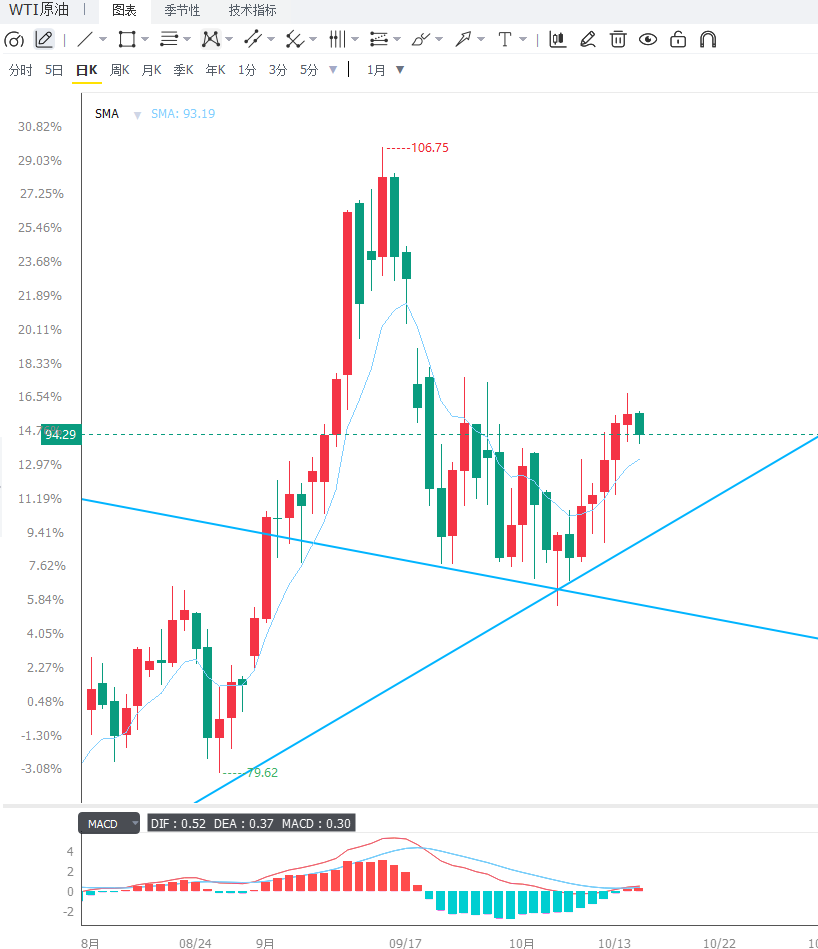 The editor summarizes that WTI crude oil is currently caught in a fierce battle between the "bullish impact of the API inventory plunge" and the "bearish impact of the easing of sanctions on shadow shipping fleets." The API data showed a record weekly drop of 11.123 million barrels, far exceeding the market's expected increase of 1.9 million barrels, providing strong fundamental support for oil prices. However, the Trump administration's policy signal of considering easing sanctions on shadow shipping fleets to lower shipping rates, coupled with the previous temporary lifting of sanctions on Russian diesel, is conveying expectations of marginal easing on the supply side, limiting further price increases. In the Middle East, the sinking of a container ship in the Strait of Hormuz, the Houthi attacks on Saudi Aramco headquarters and infrastructure, and the accusations of default on the Russia-Ukraine "energy ceasefire" all contribute to the risk premium in oil prices. Looking ahead, the short-term direction will depend on three key variables: whether tonight's EIA official inventory data can confirm the significant inventory reduction pattern shown by the API, whether the Middle East conflict will escalate further into a wider supply disruption, and the impact of US CPI data on the dollar and interest rate expectations. If the EIA confirms a significant inventory reduction coupled with escalating geopolitical risks, WTI crude oil is expected to retest the resistance zone of $95.60 to $96.00, with a potential target of $98.00 after a breakout. Conversely, if sanctions against shadow fleet vessels are eased and expectations of supply recovery increase, oil prices may consolidate towards the $93.00 or even $91.70 range. The IEA's forecast that global inventories will continue to decline in the fourth quarter, Goldman Sachs' estimated risk premium of $22/barrel is at the second highest level in history, and the "extremely dangerous" low level of global commercial inventories together constitute a solid bottom support for oil prices in the medium to long term.
A U.S. official confirmed the potential policy shift on Wednesday. The policy targets tankers that have transported crude oil and petroleum products from sanctioned countries such as Russia, Iran, and Venezuela. The core of the U.S. discussion is whether to allow these vessels to transport so-called "legitimate oil"—crude oil and refined products not subject to U.S. sanctions. If implemented, the U.S. hopes to increase shipping supply and alleviate pressure on ocean freight prices by encouraging more crude oil and refined products from the Gulf region. This discussion follows Trump's recent decision to temporarily lift sanctions on Russian diesel fuel, a move that has drawn strong criticism from Ukrainian President Zelensky, several European allies, and a number of Republican senators. However, the downside for crude oil prices is strongly constrained by multiple supply risks. The escalating geopolitical conflict in the Middle East saw a container ship sink on Wednesday after being hit by a catapult in the Strait of Hormuz, one of the most serious incidents recently affecting this crucial energy transport route. Meanwhile, the Iranian-backed Houthi rebels continue to launch drone and missile attacks on Saudi Arabia, targeting Dhahran, the headquarters of Saudi Aramco, and several other cities. Analysts at MUFG Financial Group pointed out that the Houthi rebels "show no signs of backing down" and have already attacked Saudi Aramco headquarters and multiple infrastructure sites. "The market consensus is that energy prices are unlikely to fall, and the current situation may continue," and "the risks now seem more inclined towards a worsening crisis." These escalating attacks have prompted more and more oil tankers to avoid standard crude oil loading areas, actively disrupting export logistics. Regarding inventory data, the weekly report released by the American Petroleum Institute (API) early Wednesday morning became the market focus. For the week ending October 9, U.S. crude oil inventories plummeted by 11.123 million barrels, far exceeding the market expectation of an increase of 1.9 million barrels, and also significantly exceeding the previous week's decrease of 2.09 million barrels, marking the largest weekly decline since the end of January. However, refined product inventory data was mixed—gasoline inventories unexpectedly increased by 1.091 million barrels, contrasting with the market expectation of a decrease of 800,000 barrels; distillate inventories decreased by 1.458 million barrels, less than the market expectation of a 2 million barrel decrease. The sharp drop in crude oil inventories reflects strong domestic demand in the United States and a temporary contraction in imports, but the unexpected increase in gasoline inventories suggests that end-user consumption may be slowing. It is worth noting that due to the Columbus Day holiday in the United States, both the API and EIA weekly inventory data were delayed – the API data was released at 4:30 AM on Thursday, while the more authoritative official EIA data will be released at 12:00 AM on Friday. The market usually regards the API as a leading indicator for predicting the direction of the EIA data. This time, the API crude oil inventory decline far exceeded expectations, which may suggest that the EIA data also shows a significant destocking pattern. If this is confirmed, it will provide further upward catalysts for oil prices. Another important variable on the supply side comes from the production adjustments of OPEC+. The OPEC monthly report shows that in September, broad OPEC+ crude oil production increased by approximately 900,000 barrels per day month-on-month to 39.07 million barrels per day. Among them, Saudi Arabia's production rose to 8.37 million barrels per day in September, an increase of more than 2 million barrels per day compared to August, reflecting the rapid recovery of production capacity after the country's east-west oil pipeline resumed operation. Russia's September production fell by approximately 38,000 barrels per day month-on-month, impacted by ongoing attacks on energy infrastructure in Ukraine. Despite significant increases in Saudi production, shipping risks in the Strait of Hormuz, soaring tanker freight rates, and high insurance costs mean that the recovery in actual exports remains fragile. OPEC lowered its 2026 global oil demand growth forecast to 180,000 barrels per day, down from the previous 380,000 barrels per day, marking the sixth consecutive downward revision, indicating that high oil prices are exerting a restraining effect on actual consumption. From a broader supply and demand perspective, the global crude oil market is in a state of "structural shortage." Data from the International Energy Agency (IEA) shows that global oil inventories fell by an average of 1.9 million barrels per day in the third quarter, and are expected to fall by an average of 700,000 barrels per day in the fourth quarter. Saudi Aramco CEO Nasser previously warned that global commercial crude oil inventories are below 6 billion barrels, at an "extremely dangerous" low level, and could take two years to return to normal. The US Strategic Petroleum Reserve has fallen to 283 million barrels, the lowest level since October 1982, significantly narrowing the domestic energy buffer. Goldman Sachs estimates that the geopolitical risk premium for Brent crude oil reached $22 per barrel in September, the second highest level on record, far exceeding the peak of no more than $16 during the Russia-Ukraine conflict in 2022. From a technical perspective, WTI crude oil saw a pullback after five consecutive days of gains on the daily chart, but the medium-term bullish structure remains intact. The price is trading steadily above the 20-day simple moving average of approximately $92.88. The MACD indicator is above the zero line, with the DIFF at 2.89 and the DEA at 1.98, indicating that while bullish momentum has weakened somewhat, it still dominates. The Bollinger Bands remain upward-opening, with the price trading in a relatively strong area between the middle and upper bands. The 14-day Relative Strength Index (RSI) has retreated after the recent gains, returning from a relatively strong area to near neutral, indicating that short-term overbought pressure has eased somewhat, but the directional signal remains bullish. On the upside, the $95.60 to $96.00 area forms an immediate resistance zone, corresponding to recent highs and psychological levels. A decisive break above this level could lead to a short-term test of $96.50 to $97.00. Stronger resistance lies at $98.00, a key barrier before the highs of the April volatility. On the downside, the $93.00 psychological level forms the first line of support. A decisive break below this level could lead to a pullback to the $92.00 to $91.70 area. Deeper support lies at $90.50 to $90.00, which is also a previous CTA trigger level and a densely traded area, and is expected to receive strong buying support. From the 4-hour chart, oil prices have entered a directional selection phase after falling from their highs. Short-term moving averages are starting to turn downwards, and the MACD histogram is expanding, indicating that the short-term bearish structure is in control. If the price stabilizes around $93 and recovers above $94, it may mean that buyers are still in control; conversely, if it closes below $93 for several consecutive days and the rebound strength continues to weaken, it may seek further support at $91.70. The editor summarizes that WTI crude oil is currently caught in a fierce battle between the "bullish impact of the API inventory plunge" and the "bearish impact of the easing of sanctions on shadow shipping fleets." The API data showed a record weekly drop of 11.123 million barrels, far exceeding the market's expected increase of 1.9 million barrels, providing strong fundamental support for oil prices. However, the Trump administration's policy signal of considering easing sanctions on shadow shipping fleets to lower shipping rates, coupled with the previous temporary lifting of sanctions on Russian diesel, is conveying expectations of marginal easing on the supply side, limiting further price increases. In the Middle East, the sinking of a container ship in the Strait of Hormuz, the Houthi attacks on Saudi Aramco headquarters and infrastructure, and the accusations of default on the Russia-Ukraine "energy ceasefire" all contribute to the risk premium in oil prices. Looking ahead, the short-term direction will depend on three key variables: whether tonight's EIA official inventory data can confirm the significant inventory reduction pattern shown by the API, whether the Middle East conflict will escalate further into a wider supply disruption, and the impact of US CPI data on the dollar and interest rate expectations. If the EIA confirms a significant inventory reduction coupled with escalating geopolitical risks, WTI crude oil is expected to retest the resistance zone of $95.60 to $96.00, with a potential target of $98.00 after a breakout. Conversely, if sanctions against shadow fleet vessels are eased and expectations of supply recovery increase, oil prices may consolidate towards the $93.00 or even $91.70 range. The IEA's forecast that global inventories will continue to decline in the fourth quarter, Goldman Sachs' estimated risk premium of $22/barrel is at the second highest level in history, and the "extremely dangerous" low level of global commercial inventories together constitute a solid bottom support for oil prices in the medium to long term.
- Risk Warning and Disclaimer
- The market involves risk, and trading may not be suitable for all investors. This article is for reference only and does not constitute personal investment advice, nor does it take into account certain users’ specific investment objectives, financial situation, or other needs. Any investment decisions made based on this information are at your own risk.