Institutions have lowered their fourth-quarter gold price forecasts, but still expect prices to reach $5,000 next year, stating that pullbacks present good opportunities to buy gold mining stocks.
2026-10-15 10:46:19
Gold prices have been under pressure recently amid persistent inflationary pressures and rising expectations of interest rate hikes. However, Jefferies, in its latest industry report, offers a different perspective, arguing that the short-term weakness in gold prices presents a buying opportunity, and that long-term upward trends in gold prices will continue to support the gold mining sector. Despite rising US Treasury yields suppressing precious metals prices, Jefferies maintains its long-term bullish stance on gold, while offering a neutral assessment of gold mining companies' third-quarter performance. The institution has also adjusted its gold price forecasts for different phases, considering factors such as US fiscal pressure and central bank gold purchases to outline the future trajectory of gold and mining stocks. This metals and mining research report provides the market with an analytical framework that balances short-term volatility with long-term value.
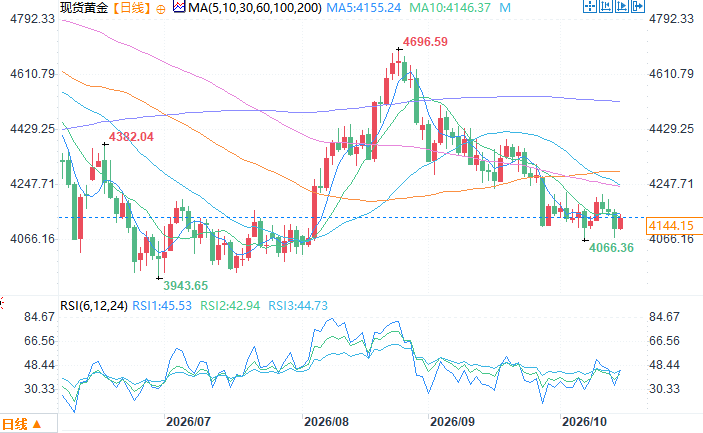 Spot gold daily chart source: FX678. At 10:45 AM Beijing time on October 15th, spot gold was trading at $4145.15 per ounce.
Gold prices are under short-term pressure, with institutions lowering short-term targets while maintaining high long-term targets.
Jefferies has lowered its short-term gold price forecast due to rising real interest rates, reducing its Q4 gold price forecast from $4,600/oz to $4,400/oz and its full-year 2026 gold price forecast from $4,595/oz to $4,511/oz. Jefferies market analysts stated that while rising US Treasury yields pose a significant headwind for gold, the long-term outlook remains positive, with prices expected to rise next year. Analysts noted that even with short-term interest rate pressures, gold remains resilient, reiterating their 2027 gold price target of $5,000/oz. The firm believes the US cannot sustain significantly higher yields in the long term, and short-term gold price fluctuations present a favorable investment window for high-quality listed gold companies. Analysts mentioned that gold still demonstrated good resilience even after US Treasury yields hit a 24-year high earlier this month. While high bond yields increase the opportunity cost of holding non-interest-bearing assets like gold, the firm questions whether the US economy and government finances can sustain high borrowing costs in the long run.US fiscal pressures may hold a turning point; four factors provide long-term support for gold prices.
Jefferies points out that the US annual fiscal deficit is approximately $2 trillion, accounting for about 6% of GDP, and annual interest payments on national debt have exceeded $1 trillion. The continuously expanding fiscal pressure may ultimately force policymakers to take measures to control financing costs, thereby creating a market environment favorable for gold. In addition, persistent inflation, expanding government debt, currency depreciation, and continued gold purchases by central banks worldwide remain the four core drivers supporting the long-term upward trend of gold . These underlying factors will not disappear due to short-term surges in US Treasury yields, forming the fundamental logic behind institutions' long-term bullish view on gold.Gold mining companies faced pressure on their third-quarter performance but remained resilient, with labor costs posing a new risk.
Jefferies predicts that despite rising energy costs, the gold mining sector's overall performance in the third quarter will be acceptable, with raw material cost pressures remaining manageable. The industry faced multiple challenges in the third quarter, including rising fuel prices, adjustments to mining schedules, equipment maintenance, stripping operations, and various weather disturbances all impacting production. Diesel prices rose approximately 12% this quarter, while spot gold prices fell 14.14% in the second quarter, closing at $4,156 in the third quarter and currently trading above $4,100. These factors combined squeezed profit margins, but the impact was relatively limited, with mining gross margins remaining significantly higher than historical averages. The firm expects total free cash flow per ounce of gold to improve in the third quarter, primarily due to reduced tax expenses compared to the second quarter. However, analysts also warn that rising labor costs may become an increasingly prominent risk for the industry. Mining companies generally believe that rising diesel costs are manageable, but management has begun frequently discussing the pressure from labor inflation. The firm predicts that with the fading of short-term production disruptions and improved mine operations, the operating conditions of mining companies will improve in the fourth quarter. If gold prices approach the $5,000 target next year, mining profitability is expected to improve significantly, and free cash flow margins will rise significantly in 2027. The gains from rising gold prices will be sufficient to cover the continuously increasing operating costs.Gold ETFs saw outflows, but institutions remain optimistic about high-quality mining companies.
Gold mining stocks have recently underperformed the spot gold market. The report noted that the Van Eck Gold Miners ETF experienced approximately $1 billion in outflows in September, reversing earlier inflows this year. Despite this, analysts believe the industry's underlying profitability remains robust, and during this period of gold price consolidation, they prioritize leading, high-quality gold producers. Analysts stated that they remain bullish on gold, and the recent price pullback presents an attractive entry opportunity.Conclusion
In summary, Jefferies' views show a clear divergence between short-term and long-term perspectives: Rising real interest rates are putting downward pressure on gold prices in the short term, leading institutions to lower their year-to-date and fourth-quarter gold price forecasts; however, factors such as the heavy fiscal burden in the US, currency depreciation, and central bank gold purchases support a long-term bullish outlook on gold, maintaining a target of $5,000/ounce for 2027. The gold mining sector faces the dual challenges of fuel and labor costs, with third-quarter profits under slight pressure, but the profit floor remains solid. If gold prices rise, the profit potential is significant. Although gold mining ETFs have experienced outflows, institutions believe the short-term pullback in gold prices is a healthy adjustment, and high-quality gold mining companies are worth investing in. In a macroeconomic environment of high US Treasury yields and recurring inflation, the opportunities for gold and gold stocks lie more in the medium to long term. Spot gold daily chart source: FX678. At 10:45 AM Beijing time on October 15th, spot gold was trading at $4145.15 per ounce.
- Risk Warning and Disclaimer
- The market involves risk, and trading may not be suitable for all investors. This article is for reference only and does not constitute personal investment advice, nor does it take into account certain users’ specific investment objectives, financial situation, or other needs. Any investment decisions made based on this information are at your own risk.