With expectations of a Fed rate hike rising, silver is nearing the lower edge of its trading range; be wary of an oversold rebound.
2026-10-15 15:50:18
After three consecutive days of decline, spot silver saw a modest rebound during Thursday's Asian session, trading around $56.00 per ounce, with COMEX silver futures also rising slightly. However, the sustainability of this rebound is questionable—silver initially benefited from a triple boost from falling oil prices, a weaker dollar, and a pullback in US Treasury yields, but the better-than-expected US September CPI data quickly reversed market sentiment, bringing hawkish expectations for interest rate hikes back to the forefront.  The initial catalyst for silver's intraday strength came from marginal easing across multiple dimensions. WTI crude oil prices retreated from their highs after five consecutive days of gains, following news that the Trump administration was considering easing sanctions on "shadow fleet" tankers to lower shipping rates, which eased extreme expectations of tight energy supplies. The decline in oil prices indirectly weakened the pressure on non-interest-bearing assets through a transmission path of "easing inflationary pressures → reduced urgency for interest rate hikes." Meanwhile, the US dollar index weakened slightly before the CPI data release, and the 10-year US Treasury yield retreated from its previous highs, creating more relaxed financial conditions for assets like silver that do not generate interest income. However, this favorable environment was quickly disrupted after the release of the US CPI data. Data released by the US Bureau of Labor Statistics on Wednesday showed that the overall CPI rose 0.6% month-on-month in September and surged to 3.7% year-on-year, higher than the market expectation of 3.6% and the highest level in four months. More importantly, core CPI rose 0.3% month-on-month (expected 0.2%) and 2.6% year-on-year (expected 2.5%) – the unexpected rise in core inflation indicates that price pressures are no longer limited to the energy sector but are spreading to a wider range of economic sectors. This data directly prompted a recalibration of the Federal Reserve's interest rate hike expectations: the CME FedWatch Tool showed that the probability of a rate hike at the October 27-28 meeting rose from about 22% before the data release to 31.6%, while the probability of a rate hike in December remained at a high level of about 89.7%. For silver, the transmission path of the CPI data is doubly negative. On the one hand, the higher inflation reading strengthens the Fed's case for maintaining or even increasing its tightening policy, pushing US Treasury yields and the dollar to rebound after the data release, directly increasing the opportunity cost of holding non-interest-bearing silver. On the other hand, the diffusion signal of inflation – core CPI exceeding expectations means that price increases have spread from energy to services and core commodities – makes the market more determined to price in "high interest rates for longer", which puts systemic pressure on silver valuations. San Francisco Fed President Mary Daly's remarks on Wednesday further solidified the hawkish tone. Daly's speech received a 6.8 out of 10 rating, higher than her historical average of 6.1, signaling a "hawkish but patient" policy stance. She stated that overall CPI, driven by gasoline, is rising, core inflation remains stubborn, and further rate hikes are "possible," but the timing should be "cautious and well-considered." Daly's concerns about persistently above-target inflation, a stable labor market, and market confidence in the Fed's reaction function collectively constitute a policy tone that maintains a tightening bias but avoids hasty action. The Fed sentiment index fell slightly by 0.84 points to 128.17, showing a marginal decline but remaining firmly above the 100 neutral line, indicating that the Fed's overall communication remains clearly hawkish—meaning that even if there is no hasty rate hike in the short term, the "higher and longer" path for policy rates is essentially established. From the perspective of silver's own market structure, the current pricing environment is extremely unfavorable for silver. In a recent report, senior commodities strategist McGraw warned that after its historic surge to over $120 earlier this year, silver may be confined to a wide range of $50 to $84 per ounce for the next few years. Silver's 260-day volatility is currently 5.1 times that of the S&P 500, the highest relative level since 1980, with a 10-year mean reversion price of approximately $31 per ounce. Goldman Sachs' commodities trading desk previously pointed out that silver is facing a rare dilemma: "positive news is failing to push up prices, while negative factors are continuously suppressing the market"—the rise in AI data centers and solar baskets has failed to attract speculative funds back because the upward forces of the dollar and real interest rates are stronger. However, the extreme positioning also suggests a possible reversal. Trend-following CTA funds have reversed their net long positions in silver to a net short position of approximately $1.4 billion, a new high in at least one year; the 25-delta put/call skew has risen to the top 2% of the two-year percentile, and the 3-month implied volatility has plummeted from over 100% at its January peak to approximately 33%. When short positions reach such extreme levels, a stabilization and rebound in silver may not require significant positive news; it only needs that negative factors cease to escalate. The World Silver Institute predicts that the global silver deficit will reach 46.3 million ounces in 2026, marking the sixth consecutive year of supply shortage. Structural demand increases from AI data centers and electric vehicles provide a bottom support in the medium to long term. Tonight's US September PPI and retail sales data will provide further directional guidance for silver. The PPI will verify the extent of inflation spread reflected in the CPI from the wholesale side—if the PPI also exceeds expectations, it will further solidify the hawkish narrative, and silver may face a new round of selling; if the data is moderate, it may alleviate market panic about overall inflation, providing breathing room for silver to stabilize at low levels. From a technical perspective, silver continues its clear downtrend on the daily chart. The price is deeply below the 9-day and 50-day exponential moving averages, which form a dynamic resistance zone, effectively capping any potential rebound. The downtrend line from the August high remains intact, and the moving average system exhibits a typical bearish alignment (short-term moving averages below, long-term moving averages above), indicating that the medium-term downtrend structure remains unbroken. The 14-day Relative Strength Index (RSI) is around 32.36, hovering just above the edge of the oversold zone (below 30), indicating that selling pressure persists but is approaching an extreme level that could trigger a technical rebound. The MACD indicator is deep below the zero line, and the green bars are still expanding, suggesting that the bearish momentum has not yet shown signs of exhaustion. On the upside, the 9-day EMA at approximately $58.80 forms the first key resistance level. A sustained daily close above this level is needed to alleviate immediate downward pressure. Further strong resistance lies at the 50-day EMA at approximately $62.61, which is also a medium-term dividing line between bullish and bearish trends. As long as silver trades below this moving average, any rebound will be considered a correction within the downtrend, not a trend reversal. On the downside, the $56.00 level provides immediate psychological support. A decisive break below this level would bring $55.50 and $50.00 into focus – the latter being what McGraw-Hill refers to as the "first good support level," and a crucial landing zone on the long-term mean reversion path.
 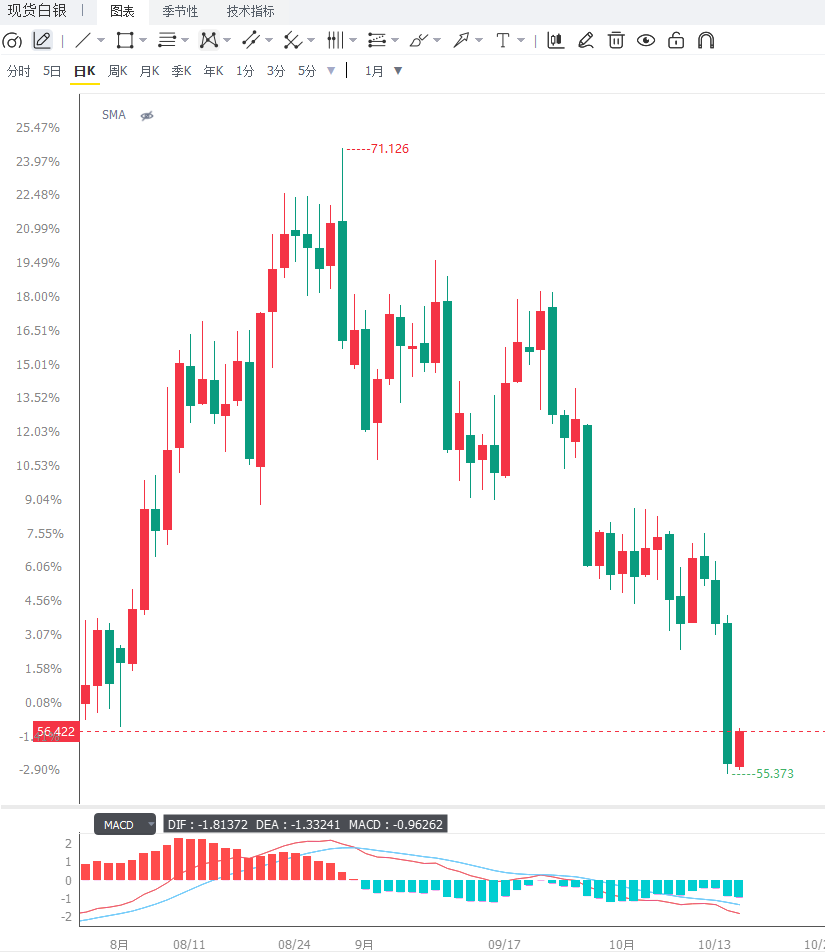 Editor's Summary: Silver is currently embroiled in a deep struggle between a "hawkish CPI shock" and a "reversal brewing from extreme short positions." The unexpected surge in US September CPI to 3.7% and core CPI to 2.6% quickly reversed the brief gains from falling oil prices and a weakening dollar, pushing the probability of a Fed rate hike in October to 31.6%, putting pressure on silver and keeping it near the low of $56. San Francisco Fed President Daly's "hawkish but cautious" remarks and the Fed sentiment index of 128.17 jointly confirm that a "higher and longer" interest rate path has been largely established, exerting systemic pressure on non-interest-bearing silver. However, the extreme positioning signals—CTA net short positions hitting a one-year high, options put skew at a two-year extreme, and implied volatility near a one-year low—suggest that a silver rebound may not require significant positive news; it only needs no further escalation of negative factors.
The initial catalyst for silver's intraday strength came from marginal easing across multiple dimensions. WTI crude oil prices retreated from their highs after five consecutive days of gains, following news that the Trump administration was considering easing sanctions on "shadow fleet" tankers to lower shipping rates, which eased extreme expectations of tight energy supplies. The decline in oil prices indirectly weakened the pressure on non-interest-bearing assets through a transmission path of "easing inflationary pressures → reduced urgency for interest rate hikes." Meanwhile, the US dollar index weakened slightly before the CPI data release, and the 10-year US Treasury yield retreated from its previous highs, creating more relaxed financial conditions for assets like silver that do not generate interest income. However, this favorable environment was quickly disrupted after the release of the US CPI data. Data released by the US Bureau of Labor Statistics on Wednesday showed that the overall CPI rose 0.6% month-on-month in September and surged to 3.7% year-on-year, higher than the market expectation of 3.6% and the highest level in four months. More importantly, core CPI rose 0.3% month-on-month (expected 0.2%) and 2.6% year-on-year (expected 2.5%) – the unexpected rise in core inflation indicates that price pressures are no longer limited to the energy sector but are spreading to a wider range of economic sectors. This data directly prompted a recalibration of the Federal Reserve's interest rate hike expectations: the CME FedWatch Tool showed that the probability of a rate hike at the October 27-28 meeting rose from about 22% before the data release to 31.6%, while the probability of a rate hike in December remained at a high level of about 89.7%. For silver, the transmission path of the CPI data is doubly negative. On the one hand, the higher inflation reading strengthens the Fed's case for maintaining or even increasing its tightening policy, pushing US Treasury yields and the dollar to rebound after the data release, directly increasing the opportunity cost of holding non-interest-bearing silver. On the other hand, the diffusion signal of inflation – core CPI exceeding expectations means that price increases have spread from energy to services and core commodities – makes the market more determined to price in "high interest rates for longer", which puts systemic pressure on silver valuations. San Francisco Fed President Mary Daly's remarks on Wednesday further solidified the hawkish tone. Daly's speech received a 6.8 out of 10 rating, higher than her historical average of 6.1, signaling a "hawkish but patient" policy stance. She stated that overall CPI, driven by gasoline, is rising, core inflation remains stubborn, and further rate hikes are "possible," but the timing should be "cautious and well-considered." Daly's concerns about persistently above-target inflation, a stable labor market, and market confidence in the Fed's reaction function collectively constitute a policy tone that maintains a tightening bias but avoids hasty action. The Fed sentiment index fell slightly by 0.84 points to 128.17, showing a marginal decline but remaining firmly above the 100 neutral line, indicating that the Fed's overall communication remains clearly hawkish—meaning that even if there is no hasty rate hike in the short term, the "higher and longer" path for policy rates is essentially established. From the perspective of silver's own market structure, the current pricing environment is extremely unfavorable for silver. In a recent report, senior commodities strategist McGraw warned that after its historic surge to over $120 earlier this year, silver may be confined to a wide range of $50 to $84 per ounce for the next few years. Silver's 260-day volatility is currently 5.1 times that of the S&P 500, the highest relative level since 1980, with a 10-year mean reversion price of approximately $31 per ounce. Goldman Sachs' commodities trading desk previously pointed out that silver is facing a rare dilemma: "positive news is failing to push up prices, while negative factors are continuously suppressing the market"—the rise in AI data centers and solar baskets has failed to attract speculative funds back because the upward forces of the dollar and real interest rates are stronger. However, the extreme positioning also suggests a possible reversal. Trend-following CTA funds have reversed their net long positions in silver to a net short position of approximately $1.4 billion, a new high in at least one year; the 25-delta put/call skew has risen to the top 2% of the two-year percentile, and the 3-month implied volatility has plummeted from over 100% at its January peak to approximately 33%. When short positions reach such extreme levels, a stabilization and rebound in silver may not require significant positive news; it only needs that negative factors cease to escalate. The World Silver Institute predicts that the global silver deficit will reach 46.3 million ounces in 2026, marking the sixth consecutive year of supply shortage. Structural demand increases from AI data centers and electric vehicles provide a bottom support in the medium to long term. Tonight's US September PPI and retail sales data will provide further directional guidance for silver. The PPI will verify the extent of inflation spread reflected in the CPI from the wholesale side—if the PPI also exceeds expectations, it will further solidify the hawkish narrative, and silver may face a new round of selling; if the data is moderate, it may alleviate market panic about overall inflation, providing breathing room for silver to stabilize at low levels. From a technical perspective, silver continues its clear downtrend on the daily chart. The price is deeply below the 9-day and 50-day exponential moving averages, which form a dynamic resistance zone, effectively capping any potential rebound. The downtrend line from the August high remains intact, and the moving average system exhibits a typical bearish alignment (short-term moving averages below, long-term moving averages above), indicating that the medium-term downtrend structure remains unbroken. The 14-day Relative Strength Index (RSI) is around 32.36, hovering just above the edge of the oversold zone (below 30), indicating that selling pressure persists but is approaching an extreme level that could trigger a technical rebound. The MACD indicator is deep below the zero line, and the green bars are still expanding, suggesting that the bearish momentum has not yet shown signs of exhaustion. On the upside, the 9-day EMA at approximately $58.80 forms the first key resistance level. A sustained daily close above this level is needed to alleviate immediate downward pressure. Further strong resistance lies at the 50-day EMA at approximately $62.61, which is also a medium-term dividing line between bullish and bearish trends. As long as silver trades below this moving average, any rebound will be considered a correction within the downtrend, not a trend reversal. On the downside, the $56.00 level provides immediate psychological support. A decisive break below this level would bring $55.50 and $50.00 into focus – the latter being what McGraw-Hill refers to as the "first good support level," and a crucial landing zone on the long-term mean reversion path. Editor's Summary: Silver is currently embroiled in a deep struggle between a "hawkish CPI shock" and a "reversal brewing from extreme short positions." The unexpected surge in US September CPI to 3.7% and core CPI to 2.6% quickly reversed the brief gains from falling oil prices and a weakening dollar, pushing the probability of a Fed rate hike in October to 31.6%, putting pressure on silver and keeping it near the low of $56. San Francisco Fed President Daly's "hawkish but cautious" remarks and the Fed sentiment index of 128.17 jointly confirm that a "higher and longer" interest rate path has been largely established, exerting systemic pressure on non-interest-bearing silver. However, the extreme positioning signals—CTA net short positions hitting a one-year high, options put skew at a two-year extreme, and implied volatility near a one-year low—suggest that a silver rebound may not require significant positive news; it only needs no further escalation of negative factors.
- Risk Warning and Disclaimer
- The market involves risk, and trading may not be suitable for all investors. This article is for reference only and does not constitute personal investment advice, nor does it take into account certain users’ specific investment objectives, financial situation, or other needs. Any investment decisions made based on this information are at your own risk.