Behind the three-day consecutive decline in LME copper, what expectations have been changed by inflation data?
2026-10-15 15:56:18
On Thursday, October 15th, the base metals market underwent a correction. The U.S. Bureau of Labor Statistics released its September Consumer Price Index (CPI), showing an overall month-on-month increase of 0.6%, the fastest pace in nearly five months, and a year-on-year increase of 3.7%; the core index rose 0.3% month-on-month and 2.6% year-on-year. Gasoline prices surged 9.1% month-on-month, accounting for more than half of the overall monthly increase, while the energy index rose 5.2% month-on-month. Following the data release, market expectations for further policy tightening by the Federal Reserve at its upcoming meeting increased significantly, risk appetite cooled, technology-related sectors came under pressure, and base metals weakened in tandem. Copper prices on the London Metal Exchange fell, other industrial metals followed suit, and aluminum prices touched near their lowest levels for the year. 
Macroeconomic inflation data and changes in policy expectations
US September inflation readings exceeded market expectations, primarily driven by energy prices, while the core component also showed some stickiness. Rising gasoline and overall energy costs, coupled with previous oil price volatility, reinforced inflation expectations. Market pricing indicated a significantly increased probability of a 25 basis point rate hike at the Fed's October meeting, following statements from some officials emphasizing the need for more data to confirm the path forward. Higher interest rate expectations are putting pressure on industrial metals through two channels: firstly, increasing financing costs for holding inventory and production; and secondly, potentially slowing manufacturing and construction activity, thus impacting demand prospects for copper, aluminum, and other commodities. Dollar-related assets were supported by these changing expectations, exerting some downward pressure on dollar-denominated metals. Following the data release, market risk appetite shifted rapidly, with the technology sector leading the correction, weakening sentiment towards commodities.LME copper price performance and year-to-date pattern
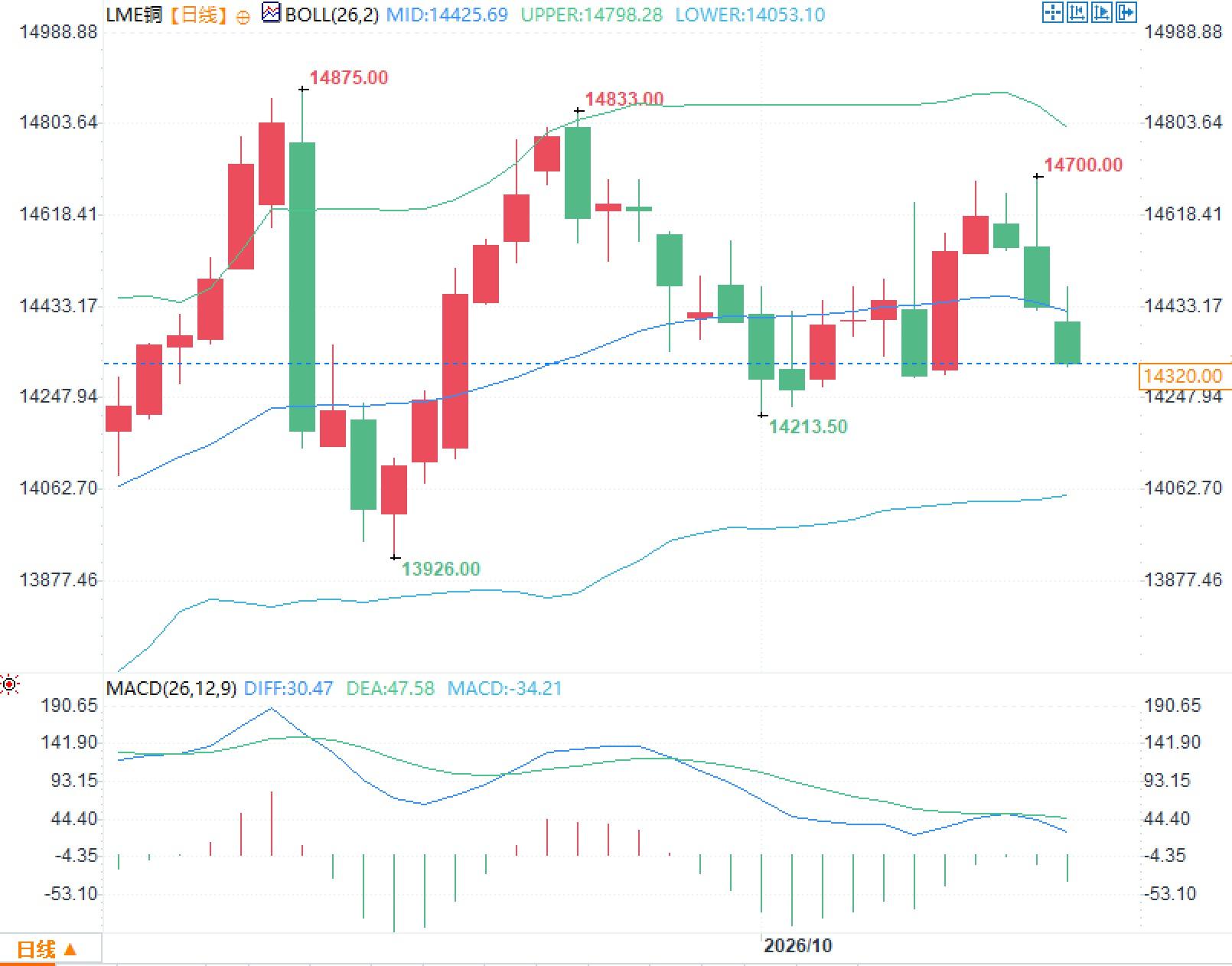
Copper prices on the London Metal Exchange are currently trading around $14,300 per tonne, marking their third consecutive day of decline, the longest losing streak since June. Year-to-date gains still exceed 15%, having previously reached a high of nearly $14,875 per tonne. On the daily chart, prices are currently trading near the middle Bollinger Band, with the upper band around $14,798 per tonne and the lower band around $14,053 per tonne. The MACD indicator shows the DIFF value below the DEA value, and the histogram below the zero line. Regarding inventories, exchange inventories have recently shown a downward trend, but distribution is uneven across regions. Some metals are flowing to specific markets due to anticipated tariffs, leading to relatively tight supply in other regions.Supply constraints and structural demand factors
Copper supply continues to face pressure from mine disruptions and declining grades. Some Chilean mines face risks of labor negotiations and operational disruptions, including preliminary agreements or restarted negotiations at large mines, which will continue to constrain concentrate supply in the short term. Data from organizations such as the International Copper Study Group shows that the global refined copper market may experience a slight surplus or tight balance in 2026, but regional differentiation is significant, with non-US inventories relatively low. On the demand side, the market remains focused on copper consumption expectations driven by electrification, grid upgrades, and data center construction. Investment in AI-related infrastructure previously supported some optimism, but recent valuation adjustments in the technology sector and rising doubts about the sustainability of financing are putting this demand narrative to the test. Recent significant declines in chip companies such as Samsung Electronics and SK Hynix reflect the market's cautious attitude towards the returns on large-scale capital expenditures. As a key material for electricity and data transmission, copper prices remain sensitive to the pace of related investments.Other metal correlations and market sentiment transmission
Aluminum prices also came under pressure, with London Metal Exchange prices falling below $3,000/ton, a low for the year. Other base metals such as zinc, nickel, and tin also saw varying degrees of decline. Overall risk aversion dominated short-term trends, with adjustments in technology stocks and changes in interest rate expectations creating a synergy. The continued contribution of high energy prices to inflation perpetuates policy uncertainty, thus impacting commodity pricing. Inventory structure, tariff expectations, and mine dynamics remain key variables to watch in the medium to long term. Market participants are focusing on subsequent inflation data, statements from central bank officials, and the actual implementation of AI-related capital expenditures, factors that will continue to influence the supply-demand balance and pricing logic of base metals.Frequently Asked Questions
Question 1: Why did the US September inflation data put pressure on base metals such as copper? Answer: Both overall and core inflation exceeded expectations, increasing the market's probability of further tightening by the Federal Reserve. Higher interest rate expectations will raise financing costs and may suppress manufacturing demand, while strengthening dollar-related assets, thus suppressing the prices of dollar-denominated industrial metals. Question 2: What are the main supporting factors for LME copper's cumulative increase of over 15% this year? Answer: Disruptions in mine supply, the expected flow of some metals to specific markets due to tariffs leading to tight inventories in other regions, and structural demand expectations brought about by electrification and data center construction have collectively supported prices remaining at a high level despite macroeconomic pressures.- Risk Warning and Disclaimer
- The market involves risk, and trading may not be suitable for all investors. This article is for reference only and does not constitute personal investment advice, nor does it take into account certain users’ specific investment objectives, financial situation, or other needs. Any investment decisions made based on this information are at your own risk.