Inflation coupled with economic slowdown, a shift in the Federal Reserve's stance, and a reversal in gold prices.
2026-10-15 16:26:21
On Thursday (October 15th) during the Asian and European sessions, international gold prices experienced a rollercoaster ride following the release of the CPI data. Prices fell by over 2% on Wednesday but rose by over 1% on Thursday, currently trading around 4145. The immediate triggers were a sharp drop in US Treasury yields, the US dollar, and expectations of an October rate hike. Recently, the market has entered a typical phase of a dual game of "inflation resilience + economic slowdown": rising energy costs are making inflation sticky, but signals such as the weakening narrative of high AI growth and declining wages are constantly confirming the pressure on the endogenous momentum of the US economy. The CPI data triggered a rollercoaster ride of rate hike expectations, coupled with cautious rhetoric from Federal Reserve officials, leading to a decline in long-term US Treasury yields and a weaker US dollar. These multiple factors combined to push up gold prices. The following analysis, combining the Beige Book, Fed officials' speeches, and market institution opinions, dissects the core logic behind the sharp correction in the US dollar, interest rates, and rate hike expectations behind this round of gold price movements. 
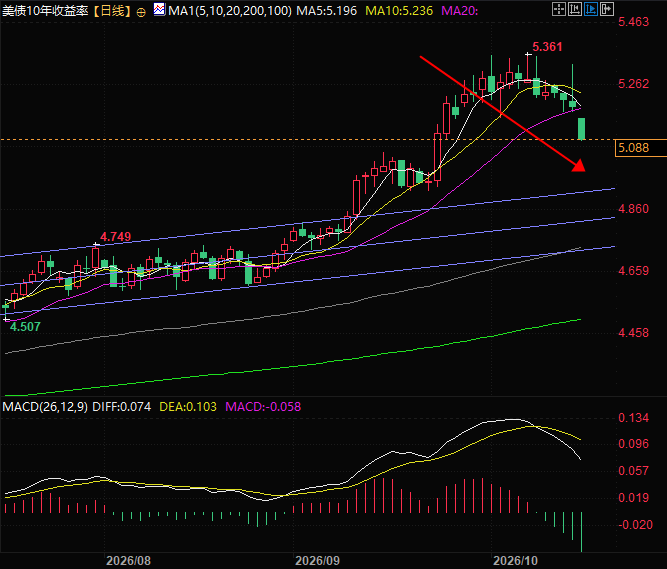 (10-year US Treasury yield daily chart, source: EasyForex) Inflation data also reflects a weakening economy: September CPI showed a rise in core inflation, but wage growth declined. This combination indirectly confirms the weakening of the US's endogenous economic momentum. This round of inflation is more of a cost transmission from energy sources than broad-spectrum endogenous inflation driven by overheated domestic demand. The Fed's Beige Book also confirms this judgment: price pressures are rising in half of the districts, with high diesel prices leading to fuel surcharges being passed down the supply chain, and commodities, insurance, and tariffs jointly increasing companies' input costs. Analysts commented that this round of price increases is only at the upstream cost side, and companies' ability to pass on price increases to end consumers is limited. It has not formed a wage-driven, comprehensive inflation, and companies face profit squeeze. Only two of the 12 Fed districts achieved moderate economic growth, employment levels in most areas remained basically flat, overall economic growth was weak, with only manufacturing providing a slight support. Uncertainty continues to weigh on the economic outlook.
 (FedWatch Interest Rate Watch, Source: CME Group) Richmond Fed's Barkin acknowledged that CPI was higher than expected and that further PPI data is needed to assess inflation trends, refusing to predict the outcome of the October meeting. Chicago Fed's Goolsby stated that inflation data was disappointing but insisted that more data is needed before raising interest rates, while remaining wary of overheated demand and demanding more evidence to support tightening. San Francisco Fed's Daly was more explicit: a rate hike is possible in the future, but not imminent, and there is no need to rush into a decision at the October meeting. FWDBonds Chief Economist Chris Rupkey suggested that geopolitical conflicts in the Middle East are pushing up energy prices, which is gradually being transmitted to core goods and services, indicating sticky inflation, and the Fed may maintain higher interest rates in 2027. This series of dovish statements from Fed officials directly triggered a sell-off in the dollar index, opening up upward space for gold prices.
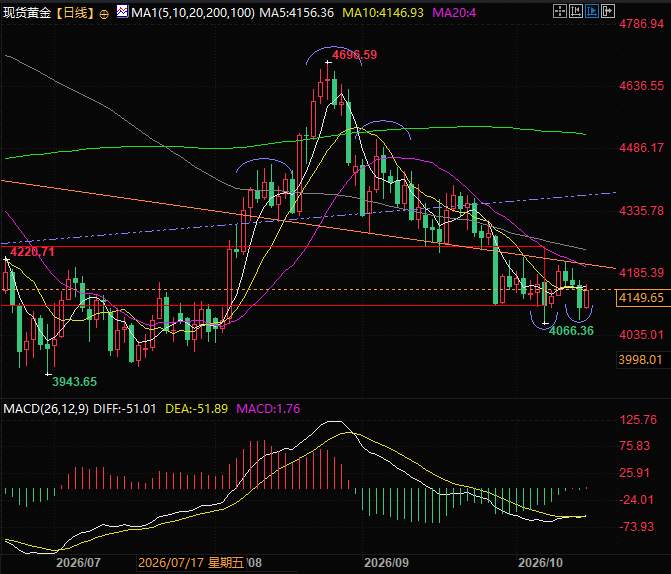 (Spot gold daily chart, source: EasyTrade) At 16:18 Beijing time, spot gold is currently trading at $4153 per ounce.
The narrative of rapid AI growth cools, and the market reprices the risk of a US economic slowdown.
The recent sharp decline in 10-year US Treasury yields is largely driven by market concerns about a slowdown in the US economy. Previously, the prevailing narrative was that AI capital expenditure would underpin the resilience of the US economy, but this optimistic story has recently begun to show cracks. Elon Musk hinted on social media that China will begin mass production of memory chips in 2028; South Korea's KB Securities also warned that the memory market may face oversupply pressure in 2029, leading to consecutive declines in the share prices of Samsung Electronics and SK Hynix. KB Securities' research report pointed out that investors still view semiconductors as a highly cyclical industry and have significant doubts about the industry's ability to maintain profitability. Bank of America's derivatives team also warned that AI capital expenditure is currently a core pillar supporting US growth expectations; if AI capital expenditure slows down, the market will lower its long-term US growth expectations, and there is room for long-term US Treasury yields to decline. (10-year US Treasury yield daily chart, source: EasyForex) Inflation data also reflects a weakening economy: September CPI showed a rise in core inflation, but wage growth declined. This combination indirectly confirms the weakening of the US's endogenous economic momentum. This round of inflation is more of a cost transmission from energy sources than broad-spectrum endogenous inflation driven by overheated domestic demand. The Fed's Beige Book also confirms this judgment: price pressures are rising in half of the districts, with high diesel prices leading to fuel surcharges being passed down the supply chain, and commodities, insurance, and tariffs jointly increasing companies' input costs. Analysts commented that this round of price increases is only at the upstream cost side, and companies' ability to pass on price increases to end consumers is limited. It has not formed a wage-driven, comprehensive inflation, and companies face profit squeeze. Only two of the 12 Fed districts achieved moderate economic growth, employment levels in most areas remained basically flat, overall economic growth was weak, with only manufacturing providing a slight support. Uncertainty continues to weigh on the economic outlook.The CPI has triggered dramatic fluctuations in interest rate hike expectations, with the latest statements from Fed officials conveying a cautious tone.
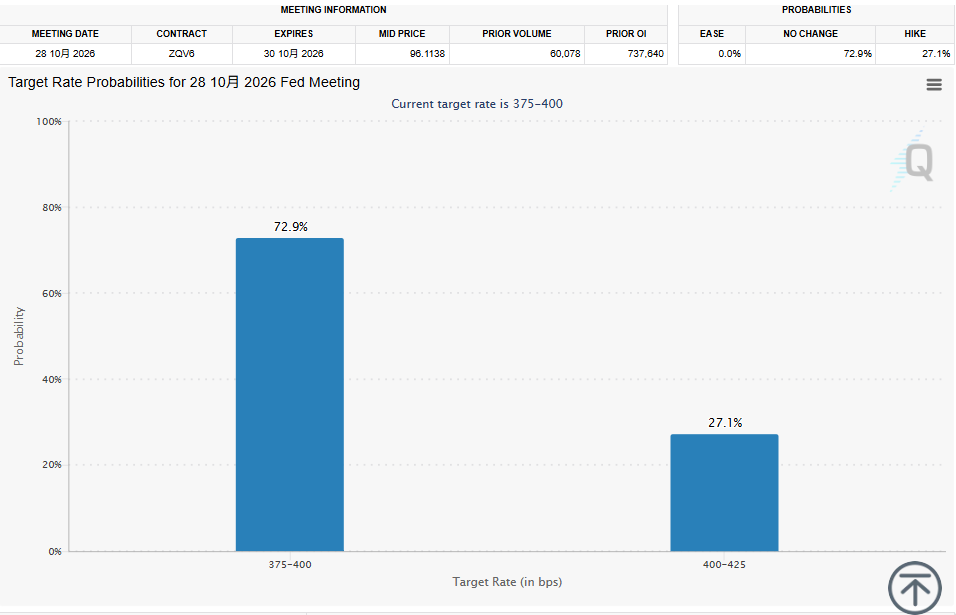
Following the release of the September CPI, market policy expectations experienced a rapid rollercoaster ride: the probability of an FOMC rate hike in October surged from 20% to over 50%. However, with rising expectations of an economic slowdown, a sharp correction in US stocks, and Fed officials collectively expressing restraint and not supporting an immediate rate hike, the rate hike expectation quickly fell back to only 27%. (FedWatch Interest Rate Watch, Source: CME Group) Richmond Fed's Barkin acknowledged that CPI was higher than expected and that further PPI data is needed to assess inflation trends, refusing to predict the outcome of the October meeting. Chicago Fed's Goolsby stated that inflation data was disappointing but insisted that more data is needed before raising interest rates, while remaining wary of overheated demand and demanding more evidence to support tightening. San Francisco Fed's Daly was more explicit: a rate hike is possible in the future, but not imminent, and there is no need to rush into a decision at the October meeting. FWDBonds Chief Economist Chris Rupkey suggested that geopolitical conflicts in the Middle East are pushing up energy prices, which is gradually being transmitted to core goods and services, indicating sticky inflation, and the Fed may maintain higher interest rates in 2027. This series of dovish statements from Fed officials directly triggered a sell-off in the dollar index, opening up upward space for gold prices.The three core drivers of rising gold prices are: the convergence of US Treasury yields, the US dollar, and policy expectations.
As a non-interest-bearing asset, gold's price is highly correlated with the real yield of US Treasury bonds and the US dollar index. The recent surge in gold prices is primarily driven by three factors. Analysts point out that declining real interest rates coupled with a weakening dollar form the core macroeconomic framework supporting gold prices, and the medium- to long-term upward trend in gold prices remains intact: The expectation of a short-term rate hike in October has been quickly corrected: the market has lowered its pricing of an immediate tightening in October, easing upward pressure on short-term US Treasury yields; Expectations of an economic slowdown have dragged down the yield on 10-year Treasury bonds, directly reducing the opportunity cost of holding gold, which is beneficial to gold prices; The Fed's cautious statements have suppressed the dollar, leading to a weaker dollar and increasing the attractiveness of dollar-denominated gold to global buyers. Simultaneously, a large influx of funds into the market to buy US Treasuries indicates that the market has already partially reflected the long-term credit risk premium of US Treasuries in current prices, limiting the potential for further increases in long-term yields. Wall Street institutions such as Goldman Sachs and Morgan Stanley have recently adjusted their views, believing that after a round of yield increases, the valuation of US Treasuries has become more attractive, and funds have begun to buy long-term bonds on dips. However, Barclays warns that long-term bonds still face the risk of rising yields due to repeated inflation, and it is not appropriate to simply conclude that long-term bond yields have peaked.Summary and Technical Analysis:
The market currently prices in an 89% probability of at least one interest rate hike before the end of the year, and the stickiness of energy-driven inflation remains. The continued tug-of-war between inflation resilience and economic slowdown is likely to amplify short-term gold price volatility. Subsequent PPI inflation data, speeches by Fed officials, and international energy prices will continue to dominate policy expectations and gold price movements. Technically, spot gold has held above the bottom of its trading range, offering a potential rebound around a double bottom. However, apart from the 5-day moving average, other moving averages remain in a bearish alignment, hindering a smooth upward move. Support lies around 4100 at the bottom of the range, while resistance is around 4200, near the neckline of a head and shoulders pattern. (Spot gold daily chart, source: EasyTrade) At 16:18 Beijing time, spot gold is currently trading at $4153 per ounce.
- Risk Warning and Disclaimer
- The market involves risk, and trading may not be suitable for all investors. This article is for reference only and does not constitute personal investment advice, nor does it take into account certain users’ specific investment objectives, financial situation, or other needs. Any investment decisions made based on this information are at your own risk.