Judging from Hammark's latest remarks, is the Fed's policy tight enough?
2026-10-16 07:44:19
According to the latest data, the US PPI rose 6.3% year-on-year in September, exceeding the forecast of 5.3% and the previous value of 5.4%. The US PPI rose 1.3% month-on-month in September, below the forecast of 0.6%. The September PPI rose at its fastest pace in over four years, further transmitting the impact of rising energy costs into the economy. Cleveland Fed President Hammark warned on Thursday (October 15) that the Fed may need to take more aggressive action if inflationary sentiment takes hold. Hammark's hawkish stance echoes the recent strength of the US dollar index. The US dollar index is currently trading around 102, still in its highest range since April 2025. 
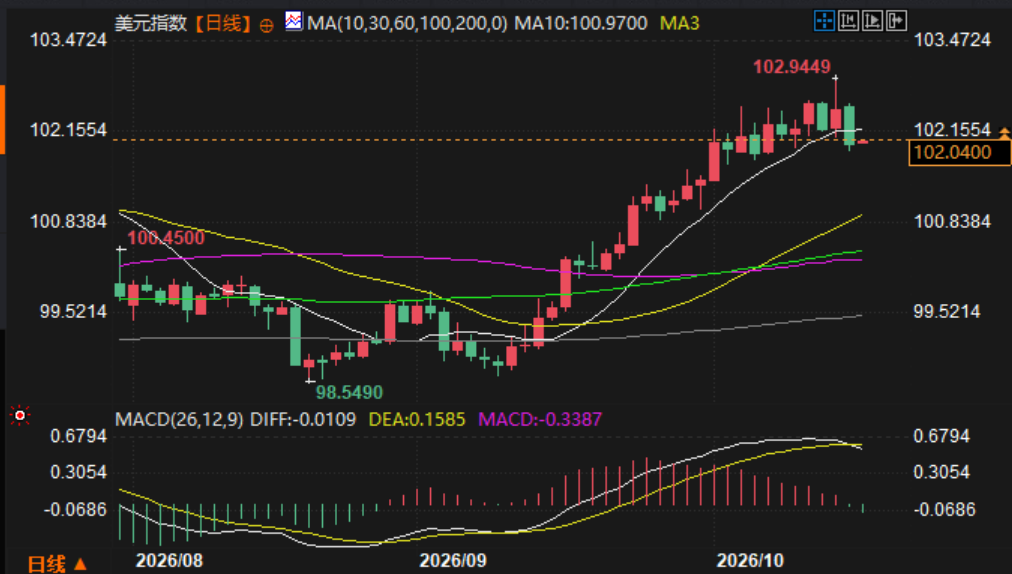 (US Dollar Index Daily Chart, Source: FX678) At 7:23 Beijing time, the US Dollar Index was at 102.04.
Key concern: A ingrained inflationary mindset may demand more aggressive action.
Hammark stated that her primary concern is the emergence of an inflationary mindset—households and businesses beginning to anticipate persistent price pressures. If this takes hold, she said, monetary policy will be less effective, and the Federal Reserve may need to act more forcefully than before. Her hawkish stance reinforces the argument for further Fed tightening. At the heart of this assessment is that Hammark is more concerned about worsening inflation expectations than the current level of inflation. Her focus on expectations means that if surveys or business reports indicate that price pressures are becoming deeply entrenched, the threshold for her to support another rate hike may lower.Business cost pressures: Heavy investment costs, squeezing low-income groups.
Hammark stated that businesses have reported significant pressure from input costs, and she is increasingly hearing about low-income Americans struggling with inflation. She emphasized that anecdotal reports from businesses and communities, like official data, are important guides to understanding the economy. This implies that Hammark is concerned about the impact of inflation on the real economy, particularly the squeeze on low-income groups. Fuel costs are central to input cost pressures, therefore oil prices are a key variable in determining whether her concerns will materialize.Policy stance: The neutral interest rate is difficult to determine, and financial conditions are not restrictive.
On policy stance, Hammark stated that it is difficult to determine the position of the neutral interest rate—that is, the level of interest rate that neither stimulates nor inhibits the economy. She added that financial conditions currently do not appear restrictive. This view implies that the current interest rate setting may not be sufficient to suppress inflation. The core of this statement is that Hammark believes financial conditions are not restrictive, which refutes the assumption that a September rate hike would be sufficient. If she believes current policy is not tight enough, she may support further rate hikes.Policy path: Leaning towards further tightening, but without committing to the timing.
These statements point to a preference for further tightening rather than any pause. The Federal Reserve raised its target range by 25 basis points to 3.75% to 4.00% in September, marking the first rate hike of the cycle. Policymakers will next meet on October 27-28. Hammark is a voting member on policy this year. Her remarks reinforced market focus on Fed Chairman Warsh, who will speak later in the Asian session, as well as the upcoming release of inflation expectations indicators. Hammark did not commit to any timing of action, but her hawkish leanings suggest she might support further action if inflation expectations worsen.Market Implications: The US dollar and US Treasury yields were supported, while gold came under pressure.
Hammark's hawkish remarks reinforced the argument for further tightening by the Federal Reserve, typically supporting the dollar and pushing up short-term Treasury yields. Her view that financial conditions are not restrictive is more market-relevant, as it refutes the assumption that a September rate hike would be sufficient. A more defiant interest rate path also puts headwinds on gold, as it tends to fall when rate hike expectations rise. Fuel costs are central to input cost pressures, making oil prices the most likely key variable to determine whether Hammark's concerns materialize.Summarize
Hammark warned that the Federal Reserve may need to act more aggressively if inflationary sentiment takes hold. She stated that businesses are facing heavy input cost pressures, low-income groups are struggling due to inflation, and financial conditions do not appear restrictive. These hawkish remarks reinforced the argument for further Fed tightening, supporting the dollar and pushing up short-term Treasury yields, while also creating headwinds for gold. Hammark's focus on inflation expectations, rather than the current inflation rate, suggests that the threshold for her to support another rate hike may be lower—if surveys or business reports indicate that price pressures are deeply entrenched. She did not commit to any timing for action, but her statements pointed to a preference for further tightening rather than any pause. (US Dollar Index Daily Chart, Source: FX678) At 7:23 Beijing time, the US Dollar Index was at 102.04.
- Risk Warning and Disclaimer
- The market involves risk, and trading may not be suitable for all investors. This article is for reference only and does not constitute personal investment advice, nor does it take into account certain users’ specific investment objectives, financial situation, or other needs. Any investment decisions made based on this information are at your own risk.