Gold Trading Alert: Gold Prices Rebound Strongly by Over 1%! Driven by a Weaker Dollar and Falling Treasury Yields, Focus on Warsh's Speech
2026-10-16 07:48:19
On Thursday (October 15), spot gold surged more than 1.6%, closing at $4,170.58 per ounce, successfully ending a three-day losing streak and rebounding strongly from a one-week low of $4,073.30 reached the previous day. December gold futures also rose 1.5%, settling at $4,170.10 per ounce. This occurred against a backdrop of a 0.5% decline in the US dollar index and a three-week low in the yield on the 10-year US Treasury bond. Despite generally strong US inflation data, market expectations for a Fed rate hike this month cooled rapidly, easing the cost pressure of holding gold as a non-yielding asset and becoming the core driver of the price increase. On Friday (October 16) in early Asian trading, spot gold fluctuated slightly lower, currently trading at $4,158 per ounce. 
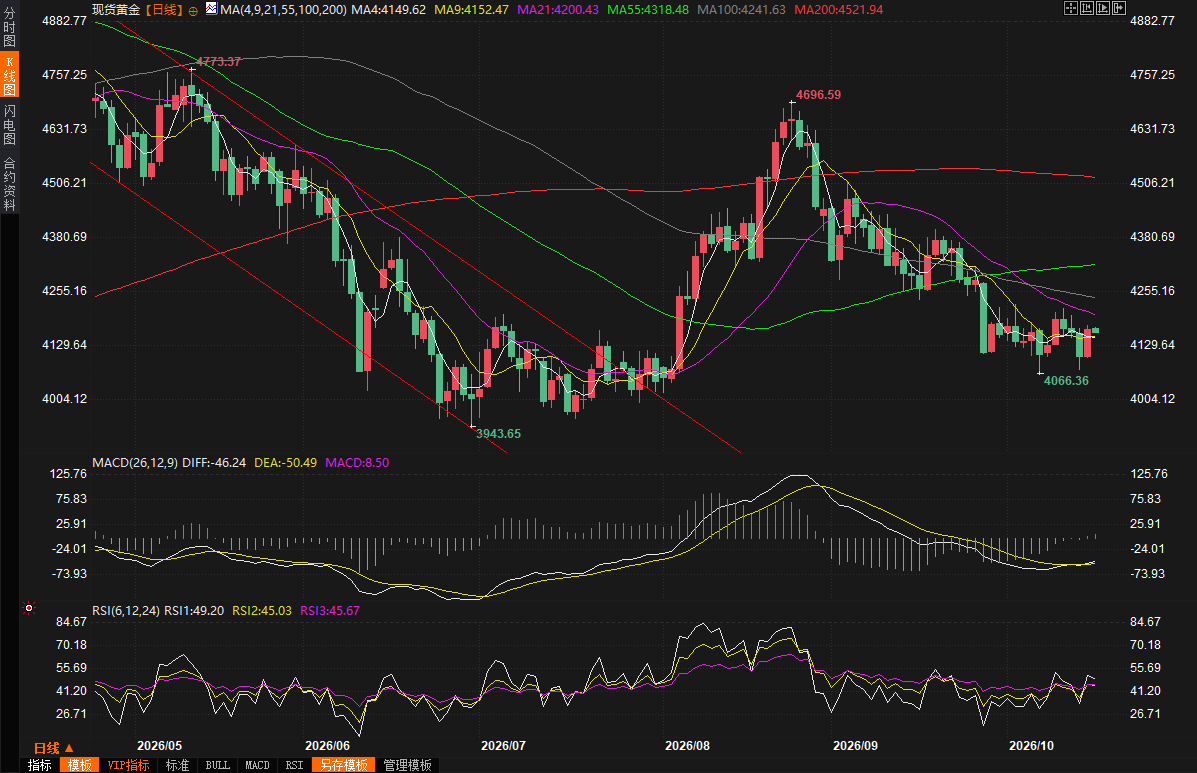 (Spot gold daily chart, source: EasyTrade) At 07:46 Beijing time, spot gold is currently trading at $4157.42 per ounce.
Strong inflation data failed to change market expectations; statements from Federal Reserve officials became a key turning point.
U.S. Producer Price Index (PPI) rose for the largest increase in four and a half years in September, with both the cost of goods and services rising, indicating that inflationary pressures are spreading from the energy sector to broader parts of the economy. Previously released Consumer Price Index (CPI) also accelerated due to soaring gasoline prices, briefly increasing market bets on a Federal Reserve rate hike in October. However, San Francisco Fed President Daly and Fed Vice Chairman for Supervision Bowman signaled caution, suggesting that an immediate rate hike might not be necessary, quickly reversing market sentiment. The CME FedWatch tool shows traders now expect only about a 29% probability of a Fed rate hike later this month, while the probability of keeping rates unchanged has risen to around 73%. Peter Grant, Vice President and Senior Metals Strategist at Zaner Metals, pointed out that the market has largely priced in the possibility of higher-than-expected PPI data and is beginning to realize the real constraints fiscal conditions place on the Fed. Further large rate hikes would place a heavy burden on the economy, making a restrained interest rate path more likely. Rising interest rates would normally increase the opportunity cost of holding non-yielding gold, but as rate hike expectations cool and Treasury yields decline, gold's relative attractiveness is highlighted again. Investors are currently closely watching Federal Reserve Chairman Warsh's speech at the International Monetary Fund's annual meeting on Friday, hoping to glean more policy clues. Before the meeting enters its quiet period, this could become a significant variable influencing gold price fluctuations in the short term.The dollar retreated from an 18-month high, driven by a combination of risk aversion and concerns about AI debt.
In stark contrast to the rise in gold prices, the dollar retreated. The dollar index, which measures the dollar against a basket of currencies, fell from an 18-month high to around 101.98. Despite generally strong inflation and retail sales data, the market turned its attention to the debt burden of artificial intelligence-related companies and the sell-off of securities. Corrections in technology sectors, such as chip stocks, drove funds into US Treasuries for safety, thus pushing down bond yields. The 10-year Treasury yield fell more than 10 basis points to 5.089% in late trading, hitting its lowest level since late September; the 30-year and 2-year yields also declined in tandem. Colin Martin, head of fixed income research and strategy at Charles Schwab, believes that while retail sales and PPI headline data were strong, a deeper analysis suggests that their sustainability and drag on economic growth may be overestimated. Meanwhile, slowing growth in artificial intelligence and potential risks in the stock market further supported safe-haven buying. This narrative of a "bearish dollar" is spreading in the market. Juan Perez, head of trading at Monex USA, stated that the current high and rapidly rising inflation is viewed as unsustainable by the market. Coupled with geopolitical uncertainty and a pessimistic outlook for the stock market, traders are more inclined to be bearish on the dollar after its significant strengthening over the past four weeks. The impact of economic stagnation on traders appears to have outweighed the impact of short-term inflation data. Joel Krueger, market strategist at London-based LMAX Group, further pointed out that if US Treasury yields fail to continue rising while the dollar's rebound continues to attract selling, it will prove that the market has largely priced in inflation news, and the risk balance is tilting back towards risk assets. Gold, as a traditional safe-haven asset and hedge against a weakening dollar, naturally benefits from this.Geopolitical undercurrents and safe-haven demand are providing additional support for gold prices.
Beyond macroeconomic data and monetary policy expectations, geopolitical risks are quietly escalating. The Houthi rebels in Yemen have again warned Saudi Arabian airspace and airports that they are "unsafe," emphasizing that their military operations are defensive in nature and will continue until Saudi Arabia ceases its attacks and blockades. Meanwhile, Ukraine has resumed attacks on Russian oil refineries. Zelenskyy explicitly stated that the energy ceasefire agreement previously announced by Trump but ignored by Russia is no longer being observed, and Ukraine will only consider ceasing its attacks after receiving more US-made Patriot interceptor missiles. Russian President Putin downplayed the impact of these attacks, stating that they "have not caused particularly serious consequences." The rift between Ukraine and Washington over issues such as intelligence sharing and restrictions on the use of satellite communication systems is also deepening, further increasing global uncertainty. While these events have not directly triggered large-scale market panic, they continue to provide background support for safe-haven assets. Gold has historically shown resilience during periods of geopolitical tension and policy uncertainty; the current combination of a weakening dollar and declining yields further amplifies its appeal.Overall, the short-term momentum for gold prices remains bullish, but caution is advised regarding potential policy and data-related disruptions.
In light of the current market landscape, the core logic behind the gold price rebound is clear: a weaker dollar reduces the cost of gold denominated in dollars, declining Treasury yields alleviate opportunity cost pressures, and cautious statements from Federal Reserve officials have effectively curbed rising expectations of interest rate hikes. Despite strong inflation data, the market is more focused on safe-haven demand stemming from fiscal constraints, the risk of slowing economic growth, and debt issues in the artificial intelligence sector. Continued geopolitical turmoil provides additional emotional support for gold prices. Looking ahead, investors need to closely monitor the Federal Reserve Chairman's speech at 11:30 AM Beijing time on Friday, subsequent inflation and employment data, and the evolution of the geopolitical situation. If the dollar continues to be under pressure and yields remain low, gold prices are expected to further consolidate their rebound above $4100 and may even test higher levels. Conversely, if inflation data continues to exceed expectations or Federal Reserve officials release more hawkish signals, short-term downward pressure may still exist. (Spot gold daily chart, source: EasyTrade) At 07:46 Beijing time, spot gold is currently trading at $4157.42 per ounce.
- Risk Warning and Disclaimer
- The market involves risk, and trading may not be suitable for all investors. This article is for reference only and does not constitute personal investment advice, nor does it take into account certain users’ specific investment objectives, financial situation, or other needs. Any investment decisions made based on this information are at your own risk.