The decline in US Treasury yields coupled with stabilizing oil prices put pressure on the USD/CAD pair in Asian trading, hovering around 1.4180.
2026-10-16 14:58:19
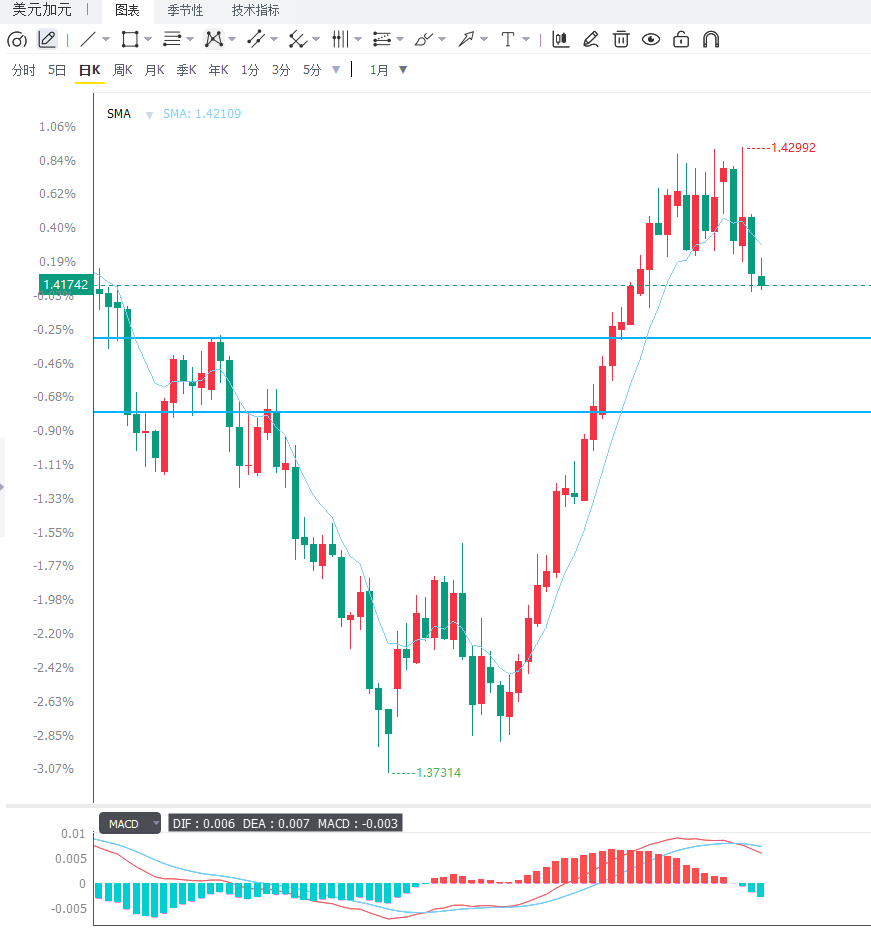
The USD/CAD pair traded around 1.4175 in Asian trading on Friday, slightly lower than the previous day's close of 1.4188. The pair has been under pressure for two consecutive days and is likely to close lower this week. The core drivers are the combined effect of the fading interest rate premium on the US dollar and the restoration of the Canadian dollar's commodity attributes.  On the dollar side, Federal Reserve Chairman Warsh stated clearly during the IMF annual meeting in Bangkok that he "would not predict the outcome of the meeting" and did not disclose any possible actions to be taken at the monetary policy meeting on October 27-28. Following this statement, the market's expectation of a rate hike in October fell from over 25% on Thursday to about 15%, and the Bloomberg Dollar Index fell 0.2%. US Treasury yields also declined, with the 10-year Treasury yield falling to around 5.10%, weakening the dollar's interest rate advantage. However, the US September PPI released this week showed a year-on-year increase of 6.3% and a month-on-month increase of 1.3%, both the highest since 2022; core PPI rose 5.0% year-on-year and 0.7% month-on-month, indicating that upstream inflation remains resilient. The market currently prices in at least one rate hike in December at nearly 90%, and the medium-term support for the dollar has not completely disappeared. The Canadian dollar, on the other hand, received a double boost. WTI crude oil settled at $97.97 per barrel in the previous trading session, up $2.88, or 3.03%, having briefly broken through the $98 mark, its highest level since late September. Higher oil prices directly benefit Canada, a major oil exporter, strengthening the commodity attributes of the Canadian dollar. Meanwhile, Bank of Canada Governor Macklem stated at the IMF annual meeting that "the longer it drags on, the harder it is to ignore rising energy prices," suggesting that if oil prices remain high, the central bank may need to consider raising interest rates rather than lowering them. The Bank of Canada had previously kept its policy rate unchanged at 2.25%, but explicitly warned of increased upside risks to inflation and removed the phrase "interest rates are at an appropriate level." Market expectations for a rate hike at the Bank of Canada's October 28 meeting have increased, but most economists still expect the central bank to hold rates steady, with action possibly taking place as early as the beginning of 2027. However, the upside potential of the Canadian dollar is also constrained by multiple factors. The US-Canada trade friction continues to escalate, with the US imposing high tariffs on approximately $20 billion worth of Canadian goods, and Canada retaliating with measures involving a similar amount. Macklem acknowledged that if the new tariffs remain in place, Canada's fourth-quarter economic growth could fall below 1%. Furthermore, escalating geopolitical tensions in the Middle East have strengthened demand for the safe-haven US dollar, providing implicit support for the USD/CAD pair. Technically, the USD/CAD pair remains above its 20-day exponential moving average on the daily chart, indicating that the medium-term bullish structure has not been completely broken, but short-term pullback pressure is evident. The price is currently consolidating around 1.4173, which provides immediate support; a break below this level would target a dense support zone between 1.4094 and 1.4030. The daily RSI is around 59, in positive territory but not yet overbought, suggesting some room for further buying. On the 4-hour chart, the pair encountered resistance around 1.4186, with short-term moving averages flattening and MACD momentum weak, failing to generate a clear breakout signal. Resistance levels are at 1.4186, 1.4237, and 1.4300, while support levels are at 1.4173, 1.4094, and 1.4030. If the price breaks below 1.4094 with significant volume, the short-term bullish structure may be weakened, and the exchange rate may further retrace to the 1.4030 to 1.4050 area.
  Editor's Summary: The USD/CAD pair is currently caught in a short-term tug-of-war between the fading premium of a US dollar interest rate hike and the restoration of the Canadian dollar's commodity attributes. Warsh's "no prediction" stance has significantly weakened the pricing of an October rate hike, and the decline in US Treasury yields has further suppressed the US dollar. High WTI crude oil prices and hawkish signals from Macklem are jointly supporting the Canadian dollar. However, the drag on Canadian economic growth from the US-Canada trade friction and the demand for safe-haven dollars due to Middle East geopolitical risks still limit the Canadian dollar's unilateral upside potential. Going forward, key attention should be paid to the Bank of Canada and Federal Reserve meetings at the end of October, US September industrial production data, and the evolution of oil supply and demand and geopolitical developments.
On the dollar side, Federal Reserve Chairman Warsh stated clearly during the IMF annual meeting in Bangkok that he "would not predict the outcome of the meeting" and did not disclose any possible actions to be taken at the monetary policy meeting on October 27-28. Following this statement, the market's expectation of a rate hike in October fell from over 25% on Thursday to about 15%, and the Bloomberg Dollar Index fell 0.2%. US Treasury yields also declined, with the 10-year Treasury yield falling to around 5.10%, weakening the dollar's interest rate advantage. However, the US September PPI released this week showed a year-on-year increase of 6.3% and a month-on-month increase of 1.3%, both the highest since 2022; core PPI rose 5.0% year-on-year and 0.7% month-on-month, indicating that upstream inflation remains resilient. The market currently prices in at least one rate hike in December at nearly 90%, and the medium-term support for the dollar has not completely disappeared. The Canadian dollar, on the other hand, received a double boost. WTI crude oil settled at $97.97 per barrel in the previous trading session, up $2.88, or 3.03%, having briefly broken through the $98 mark, its highest level since late September. Higher oil prices directly benefit Canada, a major oil exporter, strengthening the commodity attributes of the Canadian dollar. Meanwhile, Bank of Canada Governor Macklem stated at the IMF annual meeting that "the longer it drags on, the harder it is to ignore rising energy prices," suggesting that if oil prices remain high, the central bank may need to consider raising interest rates rather than lowering them. The Bank of Canada had previously kept its policy rate unchanged at 2.25%, but explicitly warned of increased upside risks to inflation and removed the phrase "interest rates are at an appropriate level." Market expectations for a rate hike at the Bank of Canada's October 28 meeting have increased, but most economists still expect the central bank to hold rates steady, with action possibly taking place as early as the beginning of 2027. However, the upside potential of the Canadian dollar is also constrained by multiple factors. The US-Canada trade friction continues to escalate, with the US imposing high tariffs on approximately $20 billion worth of Canadian goods, and Canada retaliating with measures involving a similar amount. Macklem acknowledged that if the new tariffs remain in place, Canada's fourth-quarter economic growth could fall below 1%. Furthermore, escalating geopolitical tensions in the Middle East have strengthened demand for the safe-haven US dollar, providing implicit support for the USD/CAD pair. Technically, the USD/CAD pair remains above its 20-day exponential moving average on the daily chart, indicating that the medium-term bullish structure has not been completely broken, but short-term pullback pressure is evident. The price is currently consolidating around 1.4173, which provides immediate support; a break below this level would target a dense support zone between 1.4094 and 1.4030. The daily RSI is around 59, in positive territory but not yet overbought, suggesting some room for further buying. On the 4-hour chart, the pair encountered resistance around 1.4186, with short-term moving averages flattening and MACD momentum weak, failing to generate a clear breakout signal. Resistance levels are at 1.4186, 1.4237, and 1.4300, while support levels are at 1.4173, 1.4094, and 1.4030. If the price breaks below 1.4094 with significant volume, the short-term bullish structure may be weakened, and the exchange rate may further retrace to the 1.4030 to 1.4050 area. Editor's Summary: The USD/CAD pair is currently caught in a short-term tug-of-war between the fading premium of a US dollar interest rate hike and the restoration of the Canadian dollar's commodity attributes. Warsh's "no prediction" stance has significantly weakened the pricing of an October rate hike, and the decline in US Treasury yields has further suppressed the US dollar. High WTI crude oil prices and hawkish signals from Macklem are jointly supporting the Canadian dollar. However, the drag on Canadian economic growth from the US-Canada trade friction and the demand for safe-haven dollars due to Middle East geopolitical risks still limit the Canadian dollar's unilateral upside potential. Going forward, key attention should be paid to the Bank of Canada and Federal Reserve meetings at the end of October, US September industrial production data, and the evolution of oil supply and demand and geopolitical developments.
- Risk Warning and Disclaimer
- The market involves risk, and trading may not be suitable for all investors. This article is for reference only and does not constitute personal investment advice, nor does it take into account certain users’ specific investment objectives, financial situation, or other needs. Any investment decisions made based on this information are at your own risk.