Why did gold remain stable after Warsh's speech?
2026-10-16 18:58:20
On Friday, October 16th, the spot gold market traded relatively steadily following a speech by Federal Reserve Chairman Kevin Warsh in Bangkok. The speech offered no clear clues about the October policy path, and market expectations for a rate hike that month fell from about one-third to 15%. Spot gold rose 1.6% on Thursday, its biggest one-day gain in over two weeks, and is currently trading around $4180 per ounce. Overall volatility this week has been limited, with the release of US September inflation data, producer price data, and retail sales data having some impact on market sentiment. 
Warsh's speech and interest rate expectation adjustments
In his speech in Bangkok, Warsh reiterated his commitment to price stability but made it clear that he would not prejudge the meeting's outcome. This statement did not dispel market expectations that the Federal Reserve would keep interest rates unchanged this month; instead, it prompted traders to lower the probability of a rate hike. A rate hike puts pressure on gold, which does not pay interest, so the lower probability provided short-term support for prices. Market analysts pointed out that Warsh intended to ease market expectations of a hawkish path in order to restore stability to the US Treasury market. Although inflation concerns remain and further tightening cannot be completely ruled out, the latest tone suggests a lower urgency for consecutive rate hikes. Before the speech, the market priced in a 25 basis point rate hike at about one-third; after the speech, this fell to 15%, reflecting a repricing of expectations. The Fed's media blackout period will begin on Saturday, limiting the market's access to additional information before the meeting.US Inflation Data and Policy Background
The US Consumer Price Index (CPI) rose 3.7% year-on-year in September, while the core index rose 2.6% year-on-year, exceeding some previous expectations. Rising energy prices were the main driving factor. Energy costs remain high due to the Middle East conflict, which has disrupted the energy market and pushed up inflation since the end of February. The Federal Reserve implemented its first interest rate hike since 2023 last month, raising the policy rate by 25 basis points to a range of 3.75% to 4%. Warsh stated that the economy has largely performed as expected since the last meeting, and central banks globally have generally adopted a synchronized tightening stance to address common inflation challenges. Concerns about AI-related investments on Thursday triggered outflows from tech stocks and a decline in bond yields, providing a brief boost to gold. Overall, gold prices remained relatively stable this week, indicating that the balance between data and policy expectations continues.Price performance review since the conflict
Since the outbreak of the Middle East conflict at the end of February, spot gold prices have fallen by about one-fifth. The conflict has driven up energy prices and exacerbated inflationary pressures, prompting major central banks to tighten policies, which is the main macroeconomic headwind facing gold. Gold does not generate interest, and the higher real interest rate environment reduces its relative attractiveness. Although conflict is often seen as a potential source of demand for safe-haven assets, this round of price performance reflects more a reaction to interest rate paths and inflation expectations than a simple safe-haven premium. Thursday's rise in gold prices was related to the recovery in the bond market, but the overall market remained range-bound this week. The US dollar index fell 0.3% during the same period, silver rose 0.7%, and platinum and palladium also recorded gains, indicating divergence within the precious metals sector.Daily chart structure and indicator status
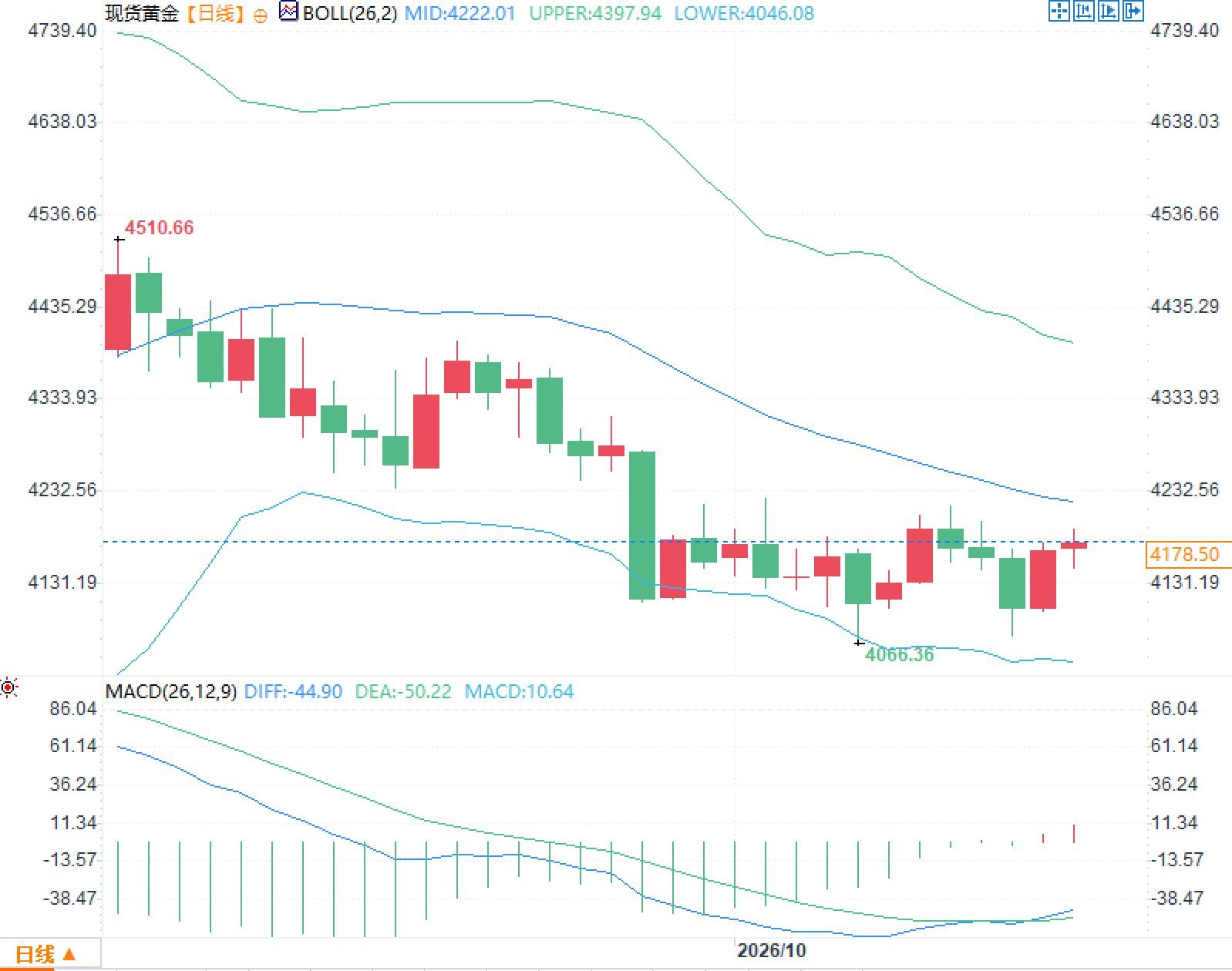
The daily chart shows that spot gold prices are currently below the middle Bollinger Band. The middle band is around 4222, the upper band is around 4398, and the lower band is around 4046. Recently, prices touched a low of around 4066 and a high of around 4510. In the MACD indicator, the DIFF is at -44.90, the DEA is at -50.22, and the histogram value is 10.64, indicating that the short-term histogram is positive while the fast and slow lines are still in negative territory. The price is trading below the middle band, and the discrepancy between the histogram and the fast and slow lines reflects that the current volatility and momentum indicators are at different stages. This week, prices remained relatively stable after the data release, without significant one-sided movements.Frequently Asked Questions
Question 1: Why did spot gold remain stable after Warsh's speech? Answer: The speech did not provide a clear signal of an interest rate hike. The market lowered the probability of an October rate hike from about one-third to 15%, reducing the pressure of rising interest rates on non-interest-bearing assets, thus keeping prices relatively stable. Question 2: What impact did the US September inflation data have on the market? Answer: The year-on-year reading of 3.7% was higher than some expectations, with energy prices being the main contributor, reinforcing the backdrop of policy tightening. However, gold prices saw limited overall movement this week, indicating that the data had already been partially priced in. Question 3: What are the main reasons for the decline in gold prices since the conflict? Answer: The conflict pushed up energy costs and inflation, prompting central banks such as the Federal Reserve to tighten policies. The higher interest rate environment has put continuous pressure on gold, which does not generate interest, and its price has fallen by about one-fifth since the end of February.- Risk Warning and Disclaimer
- The market involves risk, and trading may not be suitable for all investors. This article is for reference only and does not constitute personal investment advice, nor does it take into account certain users’ specific investment objectives, financial situation, or other needs. Any investment decisions made based on this information are at your own risk.