Potential inflation near 2%: An analysis of the yen's assessment and adjustment window
2026-10-16 22:00:19
On Friday, October 16th, the USD/JPY exchange rate was essentially flat around 158, with limited intraday fluctuations, while the US dollar was relatively weaker than other major currency pairs. The market's focus was on the remarks made by Bank of Japan Governor Kazuo Ueda during the International Monetary Fund meeting. Ueda stated that the Bank of Japan would continue to raise interest rates because underlying inflation was quite close to the 2% target and financial conditions remained accommodative. The current policy rate is 1.25%, and market expectations for a rate hike at the October 30th meeting are low, while the probability of a rate hike at the December 18th meeting has risen to approximately 75%. 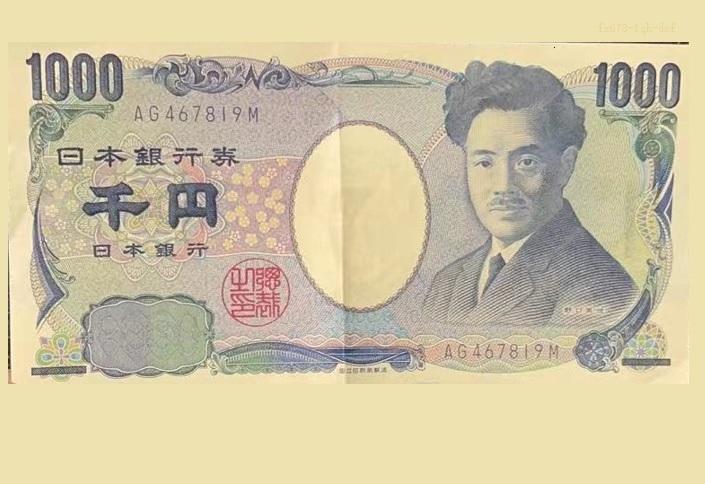
 Overall, the exchange rate's performance around 158 is intertwined with policy statements, inflation data, and international factors. Market attention is focused on policy assessments and adjustments, as well as the ongoing observation of multiple external influences.
Policy enters a new phase: the core logic of inflation anchoring
Kazuo Ueda pointed out that policy has entered a new phase, with underlying inflation quite close to 2%, therefore, further inflation cannot be allowed to rise. Unlike the previous approach of pushing inflation close to the target, anchoring inflation near the target is now more important. He stated that the upcoming meeting will discuss whether to adjust the assessment that "underlying inflation is approaching 2%." Economic and price trends are broadly in line with the Bank of Japan's forecasts, and the views heard at this week's meeting did not deviate from the baseline scenario. This stance continues the statement made after raising the policy rate to 1.25% (a 31-year high) in September, when the focus shifted from pushing up inflation to preventing overshooting. The core consumer price index in the Tokyo area rose 2.7% year-on-year in September, and the index excluding fresh food and energy reached 3.0%, with service price inflation also accelerating, showing a spreading characteristic of price pressures. At the national level, core inflation in Japan was 1.7% in August, and the September data is expected to accelerate. Ueda emphasized that economic and price changes are broadly in line with forecasts, meaning that policy adjustments are still based on the baseline scenario, rather than short-term fluctuations. Loose financial conditions provide room for continued interest rate hikes, but the pace needs to take into account multiple impacts.Uncertainty surrounding the neutral interest rate and considerations regarding the pace of interest rate hikes
Ueda acknowledged that it is difficult to give a clear judgment on Japan's neutral interest rate. The timing and pace of future rate hikes will depend on foreign exchange fluctuations, AI demand, and the impact of Middle East conflict on prices. The main takeaway from this week's meeting was exchanging views with other policymakers on how Middle East conflict and AI demand will affect the global and Japanese economies and inflation. The International Monetary Fund (IMF) expects the Bank of Japan to raise interest rates once more to near the neutral level, emphasizing flexibility amid global uncertainty. Its estimated neutral interest rate range is roughly 1.1% to 2.2%, with a central value of around 1.5%. The difficulty in precisely estimating the neutral interest rate means that the policy path needs to be continuously monitored based on actual data and risk evolution. Foreign exchange fluctuations can affect domestic prices in Japan through import price channels, Middle East conflict may be transmitted through energy costs, and AI demand involves balancing productivity gains with demand-pull factors. Market pricing indicates a limited likelihood of a rate hike at the Bank of Japan's October meeting, with a significantly higher probability in December, reflecting an expectation of a data-dependent, gradual path rather than a one-off large adjustment.AI Demand Observation and International Policy Exchange
Ueda stated that more policymakers at this week's meeting were optimistic about AI demand, exceeding previous estimates. However, the Bank of Japan's assessment of inflationary pressures from AI demand is not significantly different from views heard from its global counterparts. He exchanged views with Federal Reserve Chairman Warsh but declined to comment on the content of the discussion. Furthermore, he has not contacted US Treasury Secretary Bessenter since his meeting in Asheville. This detail has drawn attention in discussions related to intervention. The impact of AI demand on inflation needs to be observed from both demand-side pull and supply-side efficiency perspectives. Ueda's remarks indicate that the Bank of Japan's assessment is largely consistent with international views. International exchanges help calibrate judgments about global factors, but specific policy decisions remain centered on domestic Japanese data. The lack of contact with Bessenter suggests limited recent communication frequency, which the market is observing.Observations on the Current Exchange Rate Situation and Technical Indicator Characteristics
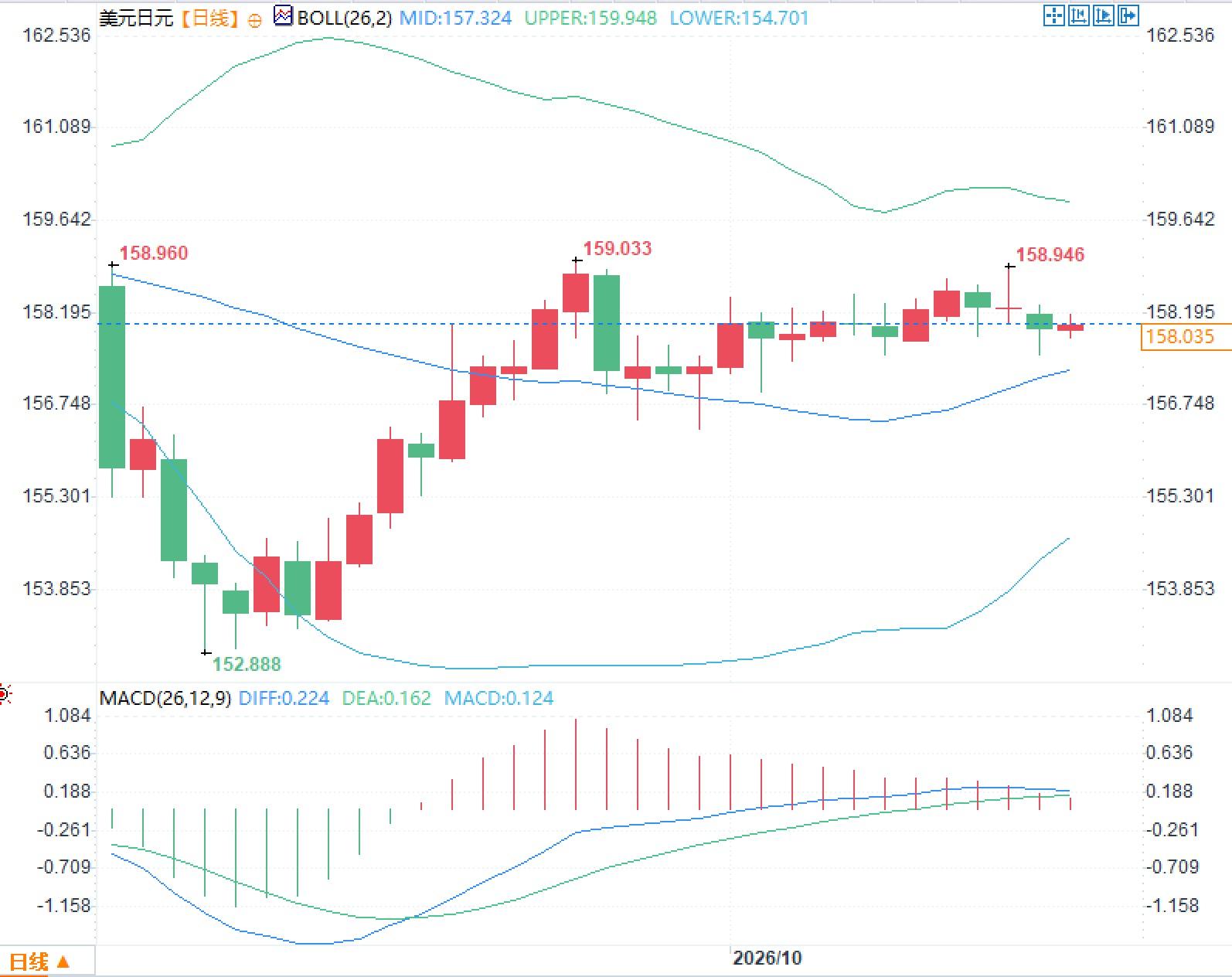
The USD/JPY pair was essentially unchanged at around 158 on the day. Looking at the daily chart, the Bollinger Bands' middle band is at 157.324, the upper band at 159.948, and the lower band at 154.701. The MACD parameters are DIFF at 0.224, DEA at 0.162, and MACD at 0.124. The chart shows that the price recently touched a high of around 159.033 and a low of 152.888. Overall, the exchange rate's performance around 158 is intertwined with policy statements, inflation data, and international factors. Market attention is focused on policy assessments and adjustments, as well as the ongoing observation of multiple external influences.Frequently Asked Questions
Question 1: Why did Kazuo Ueda emphasize that policy has entered a new phase and that further inflation should not be allowed to rise? Answer: Because potential inflation is already quite close to the 2% target, the current focus is on anchoring inflation rather than pushing it higher, preventing overshooting from negatively impacting the economy. This is more important than ever. Question 2: How will the difficulty in determining the neutral interest rate affect the future path of interest rate hikes? Answer: The difficulty in assessing the neutral interest rate means that the timing and pace of interest rate hikes need to continuously observe the impact of foreign exchange, AI demand, and the Middle East conflict on prices. Policy remains highly data-dependent. Question 3: What does the difference in market expectations for the Bank of Japan's October and December meetings reflect? Answer: The probability of a rate hike is lower on October 30th and higher in December, reflecting observations of recent meeting assessments and the influence of multiple factors. The market expects a gradual adjustment path.- Risk Warning and Disclaimer
- The market involves risk, and trading may not be suitable for all investors. This article is for reference only and does not constitute personal investment advice, nor does it take into account certain users’ specific investment objectives, financial situation, or other needs. Any investment decisions made based on this information are at your own risk.