World Gold Council: China buys gold aggressively during price corrections, ETF holdings hit record high.
2026-10-16 22:00:20
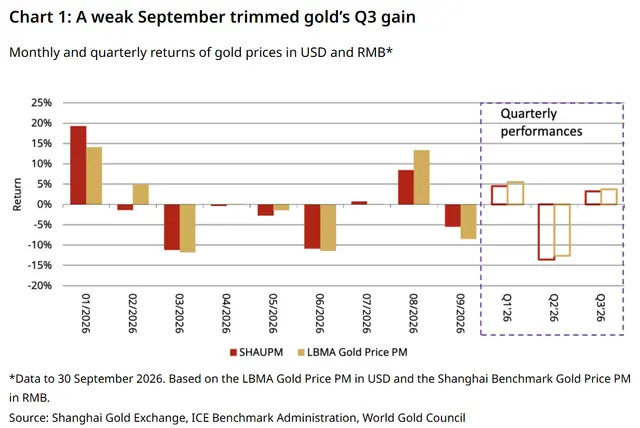
Ray Jia, Head of Research for China at the World Gold Council (WGC), stated that the People's Bank of China increased its gold reserves by 23 tons last month; domestic gold ETFs saw continued inflows in September, marking a strong end to the third quarter. With gold prices declining, recent holidays have boosted demand for gold jewelry, bars, and coins.  In the World Gold Council's latest report on the Chinese gold market, Jia Shuchang pointed out that although the decline in gold prices in September eroded some of the gains in the third quarter, gold still achieved an increase this quarter. “Gold prices corrected in September (Chart 1), with the London Bullion Market Association afternoon fixing price (LBMA Gold Price PM) in US dollars and the Shanghai Gold Exchange afternoon price (SHAUPM) in RMB falling by 8.5% and 5.5% respectively,” he said. “According to our Gold Return Attribution Model (GRAM), the Fed’s tightening policy pushed up US Treasury yields, coupled with a stronger dollar, which together put downward pressure on gold prices.” “RMB-denominated gold rose 3% in the third quarter, narrowing its year-to-date decline to 7%,” he said. “The escalating conflict between the US and Iran intensified market concerns about inflation, and investors expected the Fed to continue raising interest rates—the Fed raised rates by 25 basis points in September. Coupled with stronger-than-expected US economic data, US short-term Treasury yields rose sharply; long-term US Treasury yields also rose, mainly due to fiscal issues pushing up term premiums. Under the mutual offsetting of multiple forces, gold rose slightly this quarter.” In early October, gold prices gradually stabilized, with domestic gold prices remaining around 900 yuan/gram and international gold prices holding above $4,100/ounce. He stated, "Geopolitical conflicts and their impact on energy prices, coupled with market expectations regarding inflation and the Fed's subsequent interest rate hike path, remain the core factors determining the short-term trend of gold."
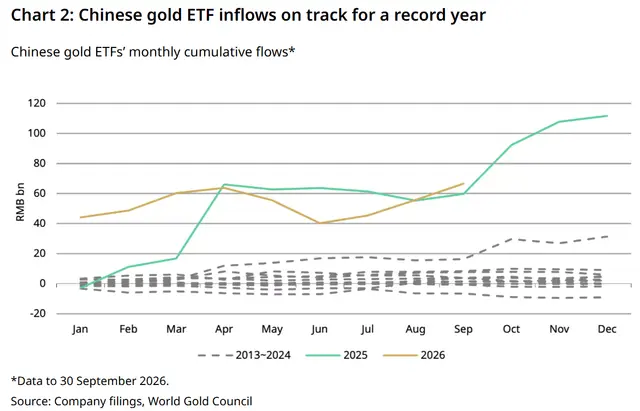
  However, gold ETFs did not perform weakly in September, with Chinese gold ETFs seeing a net inflow of 11 tons, marking the third consecutive month of inflows. Jia Shuchang stated, "The total holdings of domestic gold ETFs reached 304 tons, a record high for the end of the month. However, dragged down by declining gold prices, despite a net inflow of 11 billion yuan (equivalent to US$1.6 billion), the assets under management (AUM) of domestic gold ETFs still declined by 2% to 276 billion yuan (equivalent to US$41 billion)." In the third quarter, Chinese gold ETFs saw a total net inflow of US$3.9 billion, with quarterly AUM increasing by 13% and total holdings increasing by 27 tons. "The continued decline in the domestic stock market has increased the demand for diversified asset allocation, supporting investment demand for gold; the continuous decline in government bond yields has reduced the opportunity cost of holding gold; and the central bank's continued announcements of gold purchases have further stimulated gold ETF allocation," he explained. "It is worth mentioning that the inflows in the third quarter offset the outflows in the second quarter, and the inflows into Chinese gold ETFs this year are expected to reach a new annual high," Jia Shuchang noted. As the domestic stock market continued to weaken in early October, investors continued to diversify their asset allocation, and the investment enthusiasm for gold ETFs continued.
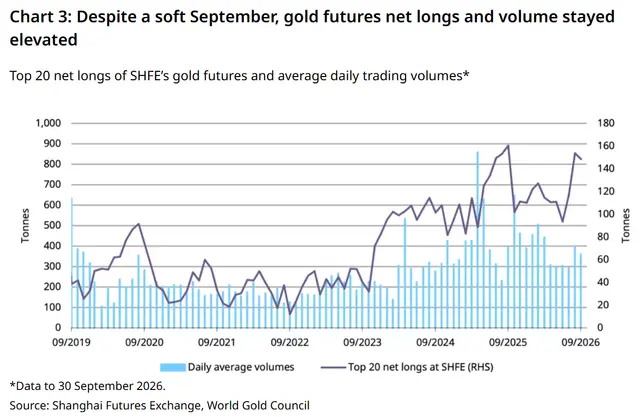
  Meanwhile, the domestic gold futures market cooled down in September along with gold prices. "The average daily trading volume of gold on the Shanghai Futures Exchange (SHFE) fell 9% month-on-month to 360 tons; current data shows that the net long positions of the top 20 traders decreased by 5 tons from the end of August, falling to 149 tons," he said. "The decline in trading volume and net positions reflects the lower gold prices and market volatility during the month, indicating a more cautious market sentiment." Despite the decline in trading activity in September, the overall net long positions in the third quarter still increased by 59% month-on-month, and trading volume also increased by 18% year-on-year. "The main reason driving these changes was the recovery in gold prices after the second quarter, especially in August."
  The decline in gold prices has spurred a recovery in retail demand, with wholesale gold demand experiencing a seasonal rebound. Jia Shuchang wrote: “In September, major banks, jewelers, and other market participants withdrew 92 tons of gold from the Shanghai Gold Exchange (SGE), a 48% increase month-on-month. Before the National Day holiday (early October), the jewelry industry typically replenishes its inventory seasonally, marking the start of the peak season for gold jewelry sales in the fourth quarter. The price correction further boosted purchases. Market feedback indicates that many investors see the price drop as a good entry point, leading to improved sales of gold bars. The sluggish performance of the domestic stock market, with fewer investment options available, has driven domestic investors to seek safe-haven assets; the public announcement of the People's Bank of China's continued gold purchases has further reinforced this trend.” “However, gold jewelry consumption is still lower than in previous years. Even with a temporary recovery, the gold withdrawal volume from the SGE in September remains at a relatively low historical level, down 22% year-on-year.”
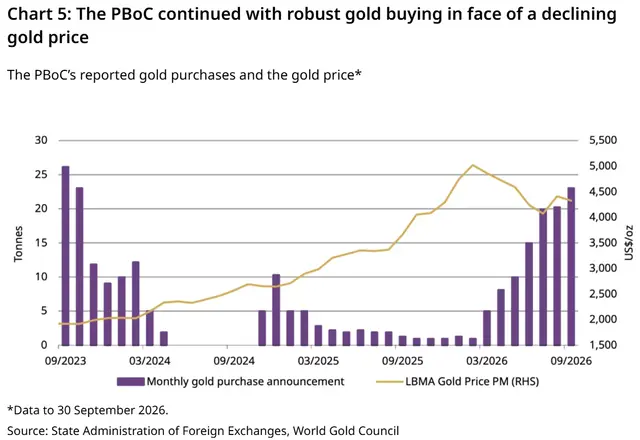
 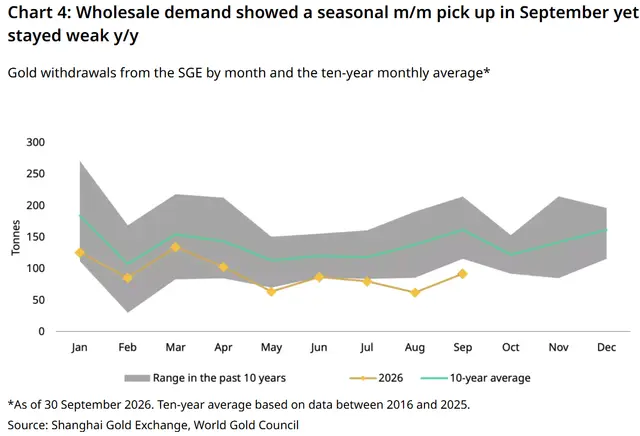 Total wholesale gold demand in the third quarter fell 21% year-on-year to 234 tons, 44% lower than the ten-year average of 418 tons. "The core drag came from continued weak gold jewelry consumption," he said. The People's Bank of China (PBOC) also took advantage of the lower gold prices to increase its gold purchases in the third quarter, especially in September. Jia Shuchang stated, "The PBOC purchased 23 tons of gold in September, the largest monthly purchase since October 2023. After the September increase, China's official gold reserves reached 2,410 tons, accounting for 8.5% of total reserves; affected by the decline in foreign exchange assets, total reserves decreased by 2% that month to $3.8 trillion." Following the September purchase, the PBOC has increased its gold holdings for 23 consecutive months; the cumulative purchase of 63 tons in the third quarter is the strongest single-quarter gold purchase performance since the third quarter of 2023. "Since the beginning of this year, the PBOC has cumulatively increased its gold holdings by 103 tons, making it one of the most active central bank gold buyers globally."
  Looking ahead, Jia Shuchang stated, "The Mid-Autumn Festival holiday at the end of September and the seven-day National Day holiday at the beginning of October are expected to boost sales. The pre-holiday price correction will attract bargain hunters, significantly stimulating demand for gold jewelry, bars, and coins." He added, "The current macroeconomic environment still supports gold investment, and the traditional peak consumption season in the fourth quarter will bring seasonal benefits to gold jewelry consumption; however, insufficient purchasing power and weak consumer confidence may continue to suppress the tonnage of physical gold consumption."
In the World Gold Council's latest report on the Chinese gold market, Jia Shuchang pointed out that although the decline in gold prices in September eroded some of the gains in the third quarter, gold still achieved an increase this quarter. “Gold prices corrected in September (Chart 1), with the London Bullion Market Association afternoon fixing price (LBMA Gold Price PM) in US dollars and the Shanghai Gold Exchange afternoon price (SHAUPM) in RMB falling by 8.5% and 5.5% respectively,” he said. “According to our Gold Return Attribution Model (GRAM), the Fed’s tightening policy pushed up US Treasury yields, coupled with a stronger dollar, which together put downward pressure on gold prices.” “RMB-denominated gold rose 3% in the third quarter, narrowing its year-to-date decline to 7%,” he said. “The escalating conflict between the US and Iran intensified market concerns about inflation, and investors expected the Fed to continue raising interest rates—the Fed raised rates by 25 basis points in September. Coupled with stronger-than-expected US economic data, US short-term Treasury yields rose sharply; long-term US Treasury yields also rose, mainly due to fiscal issues pushing up term premiums. Under the mutual offsetting of multiple forces, gold rose slightly this quarter.” In early October, gold prices gradually stabilized, with domestic gold prices remaining around 900 yuan/gram and international gold prices holding above $4,100/ounce. He stated, "Geopolitical conflicts and their impact on energy prices, coupled with market expectations regarding inflation and the Fed's subsequent interest rate hike path, remain the core factors determining the short-term trend of gold." However, gold ETFs did not perform weakly in September, with Chinese gold ETFs seeing a net inflow of 11 tons, marking the third consecutive month of inflows. Jia Shuchang stated, "The total holdings of domestic gold ETFs reached 304 tons, a record high for the end of the month. However, dragged down by declining gold prices, despite a net inflow of 11 billion yuan (equivalent to US$1.6 billion), the assets under management (AUM) of domestic gold ETFs still declined by 2% to 276 billion yuan (equivalent to US$41 billion)." In the third quarter, Chinese gold ETFs saw a total net inflow of US$3.9 billion, with quarterly AUM increasing by 13% and total holdings increasing by 27 tons. "The continued decline in the domestic stock market has increased the demand for diversified asset allocation, supporting investment demand for gold; the continuous decline in government bond yields has reduced the opportunity cost of holding gold; and the central bank's continued announcements of gold purchases have further stimulated gold ETF allocation," he explained. "It is worth mentioning that the inflows in the third quarter offset the outflows in the second quarter, and the inflows into Chinese gold ETFs this year are expected to reach a new annual high," Jia Shuchang noted. As the domestic stock market continued to weaken in early October, investors continued to diversify their asset allocation, and the investment enthusiasm for gold ETFs continued. Meanwhile, the domestic gold futures market cooled down in September along with gold prices. "The average daily trading volume of gold on the Shanghai Futures Exchange (SHFE) fell 9% month-on-month to 360 tons; current data shows that the net long positions of the top 20 traders decreased by 5 tons from the end of August, falling to 149 tons," he said. "The decline in trading volume and net positions reflects the lower gold prices and market volatility during the month, indicating a more cautious market sentiment." Despite the decline in trading activity in September, the overall net long positions in the third quarter still increased by 59% month-on-month, and trading volume also increased by 18% year-on-year. "The main reason driving these changes was the recovery in gold prices after the second quarter, especially in August." The decline in gold prices has spurred a recovery in retail demand, with wholesale gold demand experiencing a seasonal rebound. Jia Shuchang wrote: “In September, major banks, jewelers, and other market participants withdrew 92 tons of gold from the Shanghai Gold Exchange (SGE), a 48% increase month-on-month. Before the National Day holiday (early October), the jewelry industry typically replenishes its inventory seasonally, marking the start of the peak season for gold jewelry sales in the fourth quarter. The price correction further boosted purchases. Market feedback indicates that many investors see the price drop as a good entry point, leading to improved sales of gold bars. The sluggish performance of the domestic stock market, with fewer investment options available, has driven domestic investors to seek safe-haven assets; the public announcement of the People's Bank of China's continued gold purchases has further reinforced this trend.” “However, gold jewelry consumption is still lower than in previous years. Even with a temporary recovery, the gold withdrawal volume from the SGE in September remains at a relatively low historical level, down 22% year-on-year.” Total wholesale gold demand in the third quarter fell 21% year-on-year to 234 tons, 44% lower than the ten-year average of 418 tons. "The core drag came from continued weak gold jewelry consumption," he said. The People's Bank of China (PBOC) also took advantage of the lower gold prices to increase its gold purchases in the third quarter, especially in September. Jia Shuchang stated, "The PBOC purchased 23 tons of gold in September, the largest monthly purchase since October 2023. After the September increase, China's official gold reserves reached 2,410 tons, accounting for 8.5% of total reserves; affected by the decline in foreign exchange assets, total reserves decreased by 2% that month to $3.8 trillion." Following the September purchase, the PBOC has increased its gold holdings for 23 consecutive months; the cumulative purchase of 63 tons in the third quarter is the strongest single-quarter gold purchase performance since the third quarter of 2023. "Since the beginning of this year, the PBOC has cumulatively increased its gold holdings by 103 tons, making it one of the most active central bank gold buyers globally." Looking ahead, Jia Shuchang stated, "The Mid-Autumn Festival holiday at the end of September and the seven-day National Day holiday at the beginning of October are expected to boost sales. The pre-holiday price correction will attract bargain hunters, significantly stimulating demand for gold jewelry, bars, and coins." He added, "The current macroeconomic environment still supports gold investment, and the traditional peak consumption season in the fourth quarter will bring seasonal benefits to gold jewelry consumption; however, insufficient purchasing power and weak consumer confidence may continue to suppress the tonnage of physical gold consumption."
- Risk Warning and Disclaimer
- The market involves risk, and trading may not be suitable for all investors. This article is for reference only and does not constitute personal investment advice, nor does it take into account certain users’ specific investment objectives, financial situation, or other needs. Any investment decisions made based on this information are at your own risk.