Marginal rise in unemployment rate vs. wage stickiness: Is the pound entering a "critical window" ahead of the November 5th interest rate meeting?
2026-10-19 16:22:20
On Monday, October 19th, the British pound was trading around 1.332 against the US dollar. This week, the UK Office for National Statistics will release employment data for the three months to August and the September Consumer Price Index. These indicators directly impact the Bank of England's interest rate expectations for its November monetary policy meeting. The market's weighing of the secondary effects of inflation against the degree of labor market slack has entered a critical window. 
UK Labor Market Data Expectations and Background
The market expects the International Labour Organization (ILO) unemployment rate for the three months to August to rise to 5% from 4.9% in the three months to July. Average income (including bonuses) growth is also expected to slow to 3.8% year-on-year from 3.9% previously. Previous data showed average income (including bonuses) grew by 3.9% year-on-year in the three months to July, while regular income growth excluding bonuses remained at 3.5%. The marginal rise in the unemployment rate and the slowdown in income growth reflect signs of cooling hiring demand and easing labor cost pressures on businesses. However, real income, after adjusting for inflation, remains positive, indicating that the transmission of wages to prices has not yet fully subsided. The Bank of England continues to use wage growth and service prices as key variables in assessing the risk of double-dip inflation. If this data confirms further easing in the labor market, it will provide the policy committee with more room for observation.Market institution assessment
Deutsche Bank economists Sanjay Raja and Maui Brennan predict that the UK's overall consumer price index (CPI) will rise to 3.49% year-on-year in September, the core CPI to 2.74%, and services prices to 3.71%. They point to base effects and continued rising energy prices as contributing factors, while food costs are also beginning to show pressure due to declining harvests. The institution has revised its average CPI forecast for 2027 upward to 3.7%, up from its previous forecast of 3.5%, and believes the average for 2026 will be 3.2%. The overall retail price index is expected to rise from 3.7% to 5.2%. Raja stated that price pressures will increase further, with energy prices still on an upward trend, and the overall CPI may peak at 4.3% in February next year. This forecast is generally higher than the Bank of England's official path, only slightly lower than the central bank's expectations for the core goods and food and non-alcoholic beverages sub-categories. The continued rise in energy prices is a major source of medium-term inflation risk, and if service prices fail to fall in tandem, it will be more difficult for the policy committee to maintain interest rates unchanged at its November meeting.Impact of data on Bank of England policy expectations
The Bank of England's current interest rate is 3.75%, with its next decision scheduled for November 5th. Recent surveys show that most economists expect a rate hike to 4% at this meeting, but a consensus on further rate increases has not yet formed. Bank of England Chief Economist Hugh Peele recently stated that a single rate hike should not be interpreted as the start of a new round of consecutive increases, noting that "we shouldn't give the impression that we're moving to another level just because we're acting now." Peele is skeptical of the market's pricing of four rate hikes this year, emphasizing the need to observe whether the secondary effects have materialized. He also pointed out that the UK economy is sensitive to catch-up inflation dynamics, and compensatory wage demands to offset price increases may require restrictive policies to be maintained for a longer period. Specific readings of labor market and inflation data will directly test whether the secondary effects have begun to solidify, thus influencing the voting pattern of the Policy Committee at its November meeting.GBP/USD Market Performance and Key Indicators
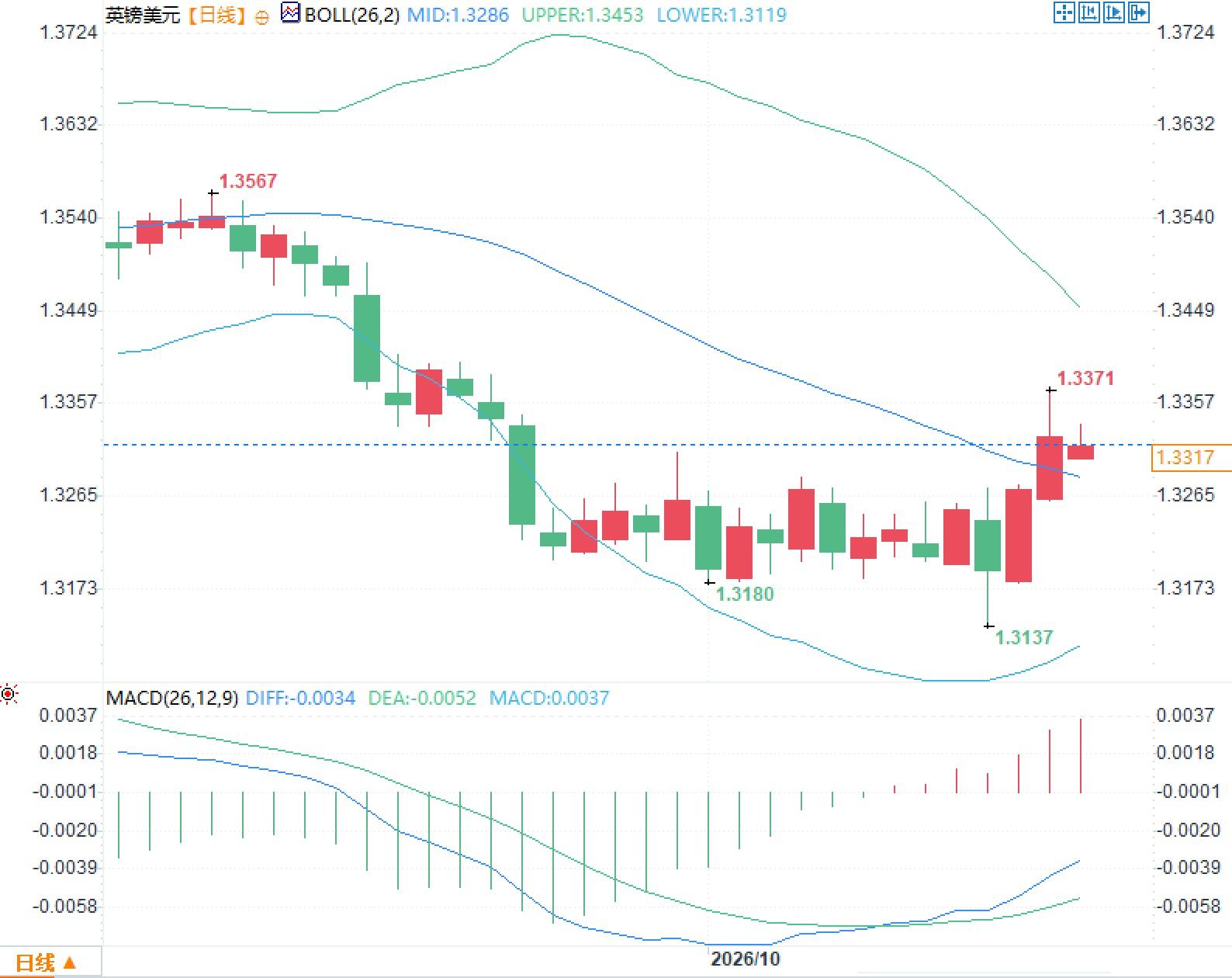
The current GBP/USD exchange rate is around 1.332. The daily chart shows the price is currently near the middle Bollinger Band, which is at 1.3286, with the upper band at 1.3453 and the lower band at 1.3119. The MACD indicator shows the DIFF at -0.0034, the DEA at -0.0052, and the histogram turning positive at 0.0037, indicating a shift in short-term momentum from negative to positive. Recent highs are marked at 1.3567, and lows at 1.3137 and 1.3180. Market volatility typically increases before and after data releases, with prices reacting more quickly to changes in interest rate expectations; however, the specific path depends on the magnitude of the data's deviation from expectations and subsequent statements from Bank of England officials.Frequently Asked Questions
Question 1: Why are the current employment and inflation data particularly crucial for the Bank of England's November decision? Answer: The Bank of England's current interest rate is 3.75%, and there is disagreement in the market regarding whether it will be raised to 4% in November. The unemployment rate and wage growth directly reflect the degree of slack in the labor market, while the September Consumer Price Index examines the strength of the transmission of energy and service prices. If the data shows that the second-degree effect is beginning to appear, the basis for the Policy Committee to maintain the current interest rate will be weakened. Question 2: What is Hugh Peel's attitude towards consecutive rate hikes? Answer: Peel stated that a single rate hike should not be interpreted as the starting point of a new round of step-by-step increases, and he is skeptical of the market's pricing in four rate hikes. He believes it is necessary to observe whether the second-degree effect has materialized, and emphasizes that restrictive policies may need to be maintained for a longer period to curb catch-up inflation dynamics.- Risk Warning and Disclaimer
- The market involves risk, and trading may not be suitable for all investors. This article is for reference only and does not constitute personal investment advice, nor does it take into account certain users’ specific investment objectives, financial situation, or other needs. Any investment decisions made based on this information are at your own risk.