Gold is caught in a tug-of-war between stagflation narratives and interest rate hike expectations.
2026-10-19 17:58:20
Currently, gold prices are caught in a tug-of-war between two powerful macroeconomic forces: interest rates and oil prices. One is economic growth, US Treasury credit, and the resulting US Treasury yields related to trading shocks; the other is energy prices, their impact on energy shocks, inflation changes, and the relative strength of the US dollar. Middle East geopolitical conflicts and refining bottlenecks are pushing up energy prices, with costs continuing to be passed down the supply chain. Food inflation is expected to accelerate again, and the stubbornness of inflation continues to exceed market expectations. However, persistently high inflation is forcing the Federal Reserve to maintain monetary tightening. The market expects the Fed to likely pause rate hikes in October, but there is still a possibility of resuming rate hikes in December. As a non-interest-bearing asset, gold is supported by both its anti-inflation and safe-haven logic while being suppressed by high real interest rates. In the short term, gold prices are likely to maintain a wide range of fluctuations, and the marginal changes in these two forces will determine the future direction of gold prices. 
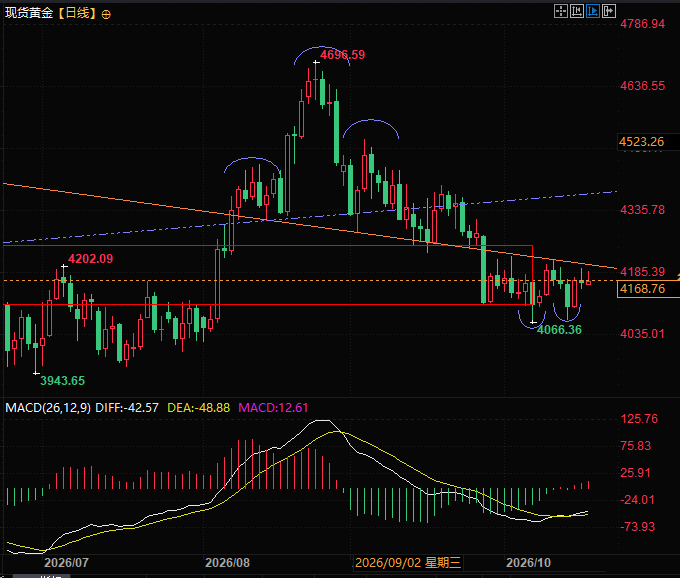 (Spot gold daily chart, source: EasyTrade) At 17:55 Beijing time, spot gold is currently trading at $4168 per ounce.
Federal Reserve policy expectations: the core pricing driver for gold.
Federal Reserve policy expectations remain the most crucial pricing variable determining gold price movements. Latest data shows that the US CPI rose 3.7% year-on-year in September, a further increase from 3.4% in August, while the core CPI, excluding food and energy, rose 2.6% year-on-year; the PPI surged 1.3% month-on-month, marking the largest monthly increase in four years, indicating a risk that upstream wholesale cost pressures will continue to be passed on to end consumers. US inflation has been above the Fed's 2% policy target for five consecutive years. Faced with unexpected inflation, Fed officials have shown significant differences of opinion. Market pricing indicates an 83% probability of maintaining the current interest rate at the October meeting, with most officials preferring to wait and see, awaiting more economic data; however, Cleveland Fed President Hammark issued a hawkish warning, pointing out that inflation is spreading broadly, businesses have already incorporated high costs into their pricing plans, and if inflation expectations worsen, there is even an option for a 50 basis point rate hike by the end of the year. Currently, the market's focus has shifted beyond October, centering on the possibility of a December rate hike, with institutions also predicting further rate hikes in 2027. From the perspective of gold pricing logic, rising expectations of interest rate hikes will push up nominal yields on US Treasury bonds, leading to an increase in real interest rates, which is bearish for gold prices. However, persistently higher-than-target inflation data strengthens gold's inflation-hedging properties, creating a tug-of-war between the two forces. The Federal Reserve's Beige Book also indicates that economic slowdowns and weakening hiring in some parts of the US are causing low-income groups to cut back on consumption. The safe-haven demand resulting from a weakening economy provides additional support for gold prices.Energy bottlenecks + Middle East geopolitics: sources of inflation, influencing gold prices in two ways.
Energy supply bottlenecks coupled with Middle East geopolitical risks have become the root cause of this round of inflationary pressures, simultaneously impacting gold in two ways. The conflict in Iran and disturbances in the Strait of Hormuz have driven oil prices sharply higher, with Brent crude briefly reaching $110 per barrel and WTI crude surging to $101 per barrel. The core market contradiction is not the disruption of oil transportation, but rather the limited global refining capacity and significantly lower refined product inventories compared to the five-year seasonal average. Even if the US reaches a diesel supply agreement with Russia, it will be difficult to significantly lower refined product prices in the short term. High oil prices directly increase the cost of living, with the Michigan Consumer Sentiment Index falling to its second-lowest level in history, and the energy shock will continue to spread to downstream industries such as food. High energy costs are dragging down US economic growth, and the market is beginning to trade on the stagflation narrative, a historically favorable macroeconomic scenario for gold. The Middle East conflict remains unresolved, and the escalating tail risks continue to provide a safe-haven premium for gold. On the other hand, oil prices pushing up overall inflation will strengthen the Federal Reserve's tightening motivation, increasing expectations of interest rate hikes, which in turn will suppress gold prices.Food inflation continues to drive inflation stickiness, exacerbating policy dilemmas.
Food inflation is rising in waves, further confirming that inflation is not a short-term, one-off event, highlighting its stickiness. While the food CPI has appeared stable in recent months, this period of calm is about to end. Rising diesel prices are increasing transportation costs, tariffs on packaging materials persist, and the El Niño climate disaster threatens agricultural production in many countries; multiple factors will gradually release upward pressure on prices. Agricultural experts predict that US food inflation will rise to 3.5%-4% next year. September PPI data shows that wholesale food prices rebounded month-on-month after three consecutive months of decline, with fresh meat and fruits and vegetables showing signs of price increases first. The current corn planting season has already borne the energy and fertilizer costs brought about by the Iranian conflict, and the impact of rising corn prices may continue until early 2027; the price increase effect of the current strong El Niño on crops is expected to fully manifest only in mid-2027. For the Federal Reserve, food inflation cannot be ignored; a broad-based increase in food prices will force the central bank to maintain a tight monetary policy. For the gold market, food inflation provides strong evidence of inflation stickiness, weakening the market's optimistic expectation that "inflation will fall rapidly to 2%" and supporting the demand for gold as a safe haven. However, the stronger the inflation stickiness, the longer the Federal Reserve will maintain high interest rates, thus prolonging the high real interest rate cycle and continuously suppressing gold prices.Summary and Technical Analysis:
In summary, the continued supply-side shocks in energy and food are pushing up prices, providing a fundamental support for gold as an inflation hedge and safe haven. However, persistent inflation is forcing the Federal Reserve to retain the option of further interest rate hikes, and high real interest rates constitute the main downward pressure on gold prices. Going forward, the gold market will essentially be a race between real interest rates and inflation expectations. If inflation continues to spread, the Fed will be forced to implement more rate hikes, further increasing real interest rates and putting downward pressure on gold prices. Conversely, if the energy supply shock continues, the US economy weakens significantly, and the stagflation narrative dominates the market, gold prices have room to rise. Subsequent trading will require close monitoring of three key variables: the probability of a Fed rate hike in December, changes in crude oil and refined product inventories, US PCE inflation data, and the development of the Middle East situation. Technically, gold prices face resistance from the neckline of a head and shoulders pattern, while there is support from a double bottom pattern below. (Spot gold daily chart, source: EasyTrade) At 17:55 Beijing time, spot gold is currently trading at $4168 per ounce.
- Risk Warning and Disclaimer
- The market involves risk, and trading may not be suitable for all investors. This article is for reference only and does not constitute personal investment advice, nor does it take into account certain users’ specific investment objectives, financial situation, or other needs. Any investment decisions made based on this information are at your own risk.