US easing of restrictions on Russia and SPR reserve releases drive crude oil prices up before they fall back.
2026-10-19 16:50:20
The current international crude oil pricing is primarily driven by the protracted US-Iran rivalry combined with geopolitical disturbances in the Middle East and Russia-Ukraine. Last week's shipping crisis in the Strait of Hormuz pushed oil prices sharply higher, but prices fell back on Monday after the implementation of multiple price-cutting policies by the US, confirming the prediction made in last week's article that Trump would intervene at the current oil price level. 
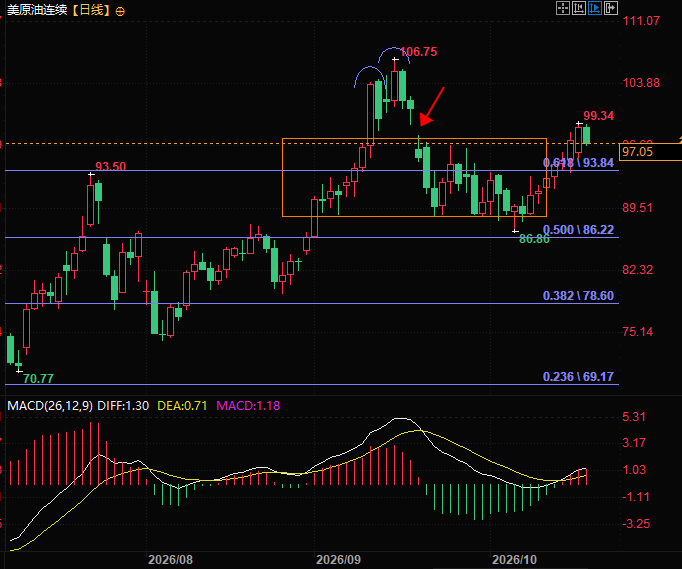 (WTI crude oil futures daily chart, source: FX678) At 16:48 Beijing time, WTI crude oil futures are currently trading at $97.28 per barrel.
The US introduced a series of measures to lower oil prices, triggering a pullback in oil prices from their highs on Monday.
First, some sanctions against Russia were waived. Trump signed an executive order exempting key sanctions and tariffs imposed on Russia under the Graham Act, and will use up to 60 days to assess the policy's impact on the global economy. The policy anticipates Russian diesel exports could reach 2.3 million barrels this month, potentially increasing to 7.6 million barrels per month later. The market anticipated a surge in Russian fuel exports, leading to profit-taking by long positions. Faced with inflationary pressures from high oil prices and election pressures, the US introduced two sets of control measures, directly triggering a drop in crude oil prices from a five-month high on Monday. Second, strategic petroleum reserves were released. The US Department of Energy launched a crude oil swap program, releasing up to 17 million barrels of crude oil between November this year and January next year. Finally, a withdrawal-with-forward-return model was adopted, requiring winning bidders to return crude oil of equivalent quality in 2028-2029, plus an additional 12.5% as compensation. This mechanism supplements market supply in the short term while maintaining the total reserve volume in the long term, achieving dynamic optimization of the SPR (Strategic Petroleum Reserve Flow). On Monday, WTI crude oil fell by a maximum of 2.06%, reaching a low of $96.7 per barrel. This market movement confirms previous predictions: after a sharp rise in oil prices, the US would inevitably intervene to lower them. Philip Nova's Director of Market Insights, Sahdwa, believes that Trump's sanctions waivers are more like a short-term tactic to lower oil prices before the midterm elections, and cannot solve the supply disruption problem in the Strait of Hormuz; the risk of tanker attacks remains. KCM Trade analyst Watler stated that while sanctions waivers could theoretically increase Russian fuel exports, the policy details and implementation timeline are unclear, making it difficult for the market to fully price in the increased supply until the terms are fully clarified.Oil prices surged last week: Risks in the Strait of Hormuz escalated, but Iranian production remained resilient.
The core driver of last week's oil price surge was the deteriorating shipping situation in the Strait of Hormuz. The Iranian Navy stated that the number of oil tankers damaged and on fire due to illegal entry into the strait's restricted area has been steadily increasing, with several tankers exploding after striking mines in the Gulf of Oman and at the strait's entrance. At least 10 merchant ships were confirmed to have been attacked last week. Kpler data shows that the average daily oil flow in the Gulf plummeted to 8.5 million barrels last week, far below the previous week's level of over 20 million barrels. Supply panic rapidly pushed up oil prices, with WTI reaching $99.34 per barrel on Friday, a new high since late May. The standoff between the US and Iran continues, with the US Central Command stating that the naval blockade has caused Iran to lose $25 billion in oil revenue. There have even been instances of salary and pension payments being suspended in Iran. However, this does not mean the US has the upper hand. Latest data shows that Iran's daily oil production rose to 3.715 million barrels in October, an increase of 285,000 barrels from September's 3.43 million barrels, representing an 8.3% increase. This data suggests that Iranian oil fields may not currently face significant inventory buildup or production shutdown pressures, indicating a degree of resilience in production. Meanwhile, Iran emphasizes that the Strait of Hormuz is not fully open, and ship passage requires coordination with Iranian armed forces. Satellite monitoring also shows strong Saudi crude oil loading activity, with 11 tankers loading on October 15th alone, totaling over 20 million barrels. Other Gulf producing countries are actively supporting exports. Barclays points out that the upward trend in oil shipping rates is likely to continue for at least several weeks; maintaining its 2026 Brent crude price forecast of $100/barrel and 2027 Brent crude price forecast of $85/barrel, the bank believes that the short-term upside risk for oil prices is high. The bank argues that the premium resulting from geopolitical conflict will not dissipate quickly, and even if the situation eases, infrastructure repairs will lag, making a rapid price reversal unlikely after the initial surge.Long-term costs of the strait obstruction: slow recovery of oil prices and delayed price reductions in refined oil products.
Calculations show that if the Strait of Hormuz gradually reopens in November, the conflict will increase US car owners' gasoline bills by $165 billion by 2027. Each month the strait is closed incurs an additional $35-40 billion in economic costs; if reopening is delayed until April next year, the total expenditure will reach at least $350 billion. Traders should note the asymmetric nature of refined oil price adjustments: gasoline and diesel prices rise faster when crude oil prices rise, and retail price reductions lag behind when crude oil prices fall. Even if the strait reopens, crude oil supply and refining capacity recovery will still take several months, with gasoline prices potentially returning to pre-war levels by June 2027 and diesel by August. Analysts warn that a short-term price drop after the strait reopens does not equate to a rapid return to pre-war levels; persistent geopolitical risks will support oil prices in the long term. Supply chain recovery will have a scarring effect, and the decline in refined oil prices will be significantly slower than that of crude oil futures.Geopolitical tensions between Russia and Ukraine are escalating, and the market is divided on the effectiveness of policies.
The sanctions waiver policy has also sparked a power struggle between the Russian and Ukrainian camps, with Ukrainian President Zelensky criticizing the US measures as harming Ukrainian interests. US Treasury Secretary Bessant responded immediately, pointing out that the UK had already granted sanctions waivers to diesel and jet fuel processed from Russian crude oil in May, and that Zelensky's criticism of the US while ignoring European partners constitutes a double standard. DBS Bank's head of energy research, Sakar, believes that the US reserve releases and Russian sanctions waivers are short-term remedial measures that can hardly change the fundamentals of crude oil supply. He anticipates that oil prices will likely remain in the $100-$110 range before the US midterm elections, with the shipping risks in the Strait of Hormuz created by Iran and its proxies continuing to make energy prices a core concern for voters.Summary of market trend logic:
Last week's oil price increase was primarily driven by frequent attacks on merchant ships in the Strait of Hormuz, which sharply reduced the flow of crude oil in the Gulf and led to market trading of a geopolitical risk premium due to supply disruptions in the Middle East. Barclays believes that short-term upside risks outweigh those of oil, with rising shipping costs continuing to support prices. However, some institutions caution that a strait blockade would result in long-term consumer costs, and the recovery period for refined oil products would be extremely long. Monday's price correction was primarily due to the US's combination of reserve releases and the easing of sanctions on Russian oil, prompting long positions to realize profits at higher levels. KCM Trade and Philip Nova Market Insights commented that the policies only provided short-term reassurance to market sentiment, and the core supply risks in the Middle East remained unresolved. DBS Bank stated that these policies are short-term tools and unlikely to reverse the current price range. In the medium to long term, the persistence of the US-Iran standoff remains the main theme for crude oil. Short-term prices will likely fluctuate between rising geopolitical risks in the Middle East and US policy intervention to lower prices, with news-driven volatility expected to remain high. Technical Analysis: After briefly breaking through the top of the trading range, WTI crude oil futures are currently undergoing a pullback due to resistance from the previous price gap. Support is currently around 93.84. The key focus is whether oil prices will show unexpected resilience. If oil prices rebound sharply during the European and American trading sessions, major asset classes such as gold will be suppressed. (WTI crude oil futures daily chart, source: FX678) At 16:48 Beijing time, WTI crude oil futures are currently trading at $97.28 per barrel.
- Risk Warning and Disclaimer
- The market involves risk, and trading may not be suitable for all investors. This article is for reference only and does not constitute personal investment advice, nor does it take into account certain users’ specific investment objectives, financial situation, or other needs. Any investment decisions made based on this information are at your own risk.