USD/JPY under pressure on October 19: Currency intervention risk exerts pressure.
2026-10-19 20:20:23
The USD/JPY exchange rate is fluctuating at low levels due to shifts in market expectations regarding the Federal Reserve's interest rate policy and the potential tightening of monetary policy by the Bank of Japan (BoJ). In other words, the policy prospects of the two major currencies, the US dollar and the Japanese yen, are changing inversely, resulting in a lack of clear directional drivers for the pair and forcing a continuous downward shift in trading focus. The current exchange rate is 158.237.  Fundamental Analysis The USD/JPY exchange rate rose slightly, but market trading remained subdued, with volatility narrowing significantly. This "price increase with decreasing volume" pattern typically indicates weak upward momentum, driven more by short covering and technical rebounds than by a genuine influx of new buying. After the US Consumer Price Index (CPI) data exceeded expectations, the market's probability of another Fed rate hike in October rose to 47% before falling back to 14%, putting pressure on the dollar. This sharp shift in expectations largely stemmed from the market reassessing the nature of the US inflation data—whether the high monthly readings represent a continuation of trend pressure or a temporary disturbance; the market currently leans towards the latter. This shift in investor expectations limited further upside potential for the dollar. Bank of Japan Governor Kazuo Ueda's remarks on Monday shifted market focus to the prospect of further rate hikes. He pointed out that against the backdrop of rising wages and prices, the Japanese economy continues to recover, and core inflation remains close to the 2% target level. This statement was interpreted by the market as the Bank of Japan maintaining its stance of gradually normalizing monetary policy, further tightening expectations of policy easing. This could strengthen market expectations of further monetary tightening, thus limiting the upside potential of the currency pair. It's worth noting that if the Bank of Japan subsequently releases more hawkish signals, the enthusiasm for buying the yen will further intensify, putting greater pressure on the dollar. Another factor suppressing USD/JPY buying is the risk of monetary intervention by the Japanese authorities. When the exchange rate approaches 159.00, market participants may be wary of new exchange rate checks (often seen as a precursor to intervention). A "exchange rate check" refers to a verbal or written request from Ministry of Finance officials to the market to inquire about quotes from major banks; essentially, it's a clear warning to speculative funds and a buffer before formal market intervention. This increases the risk of a sharp yen appreciation and makes traders unwilling to establish new long positions in the dollar. Under the shadow of intervention, the market's willingness to chase higher prices is significantly suppressed, thus structurally constraining the dollar's rebound potential. The USD/JPY forecast remains bearish on October 19, 2026. Technical Analysis (Based on 30-minute candlestick chart)
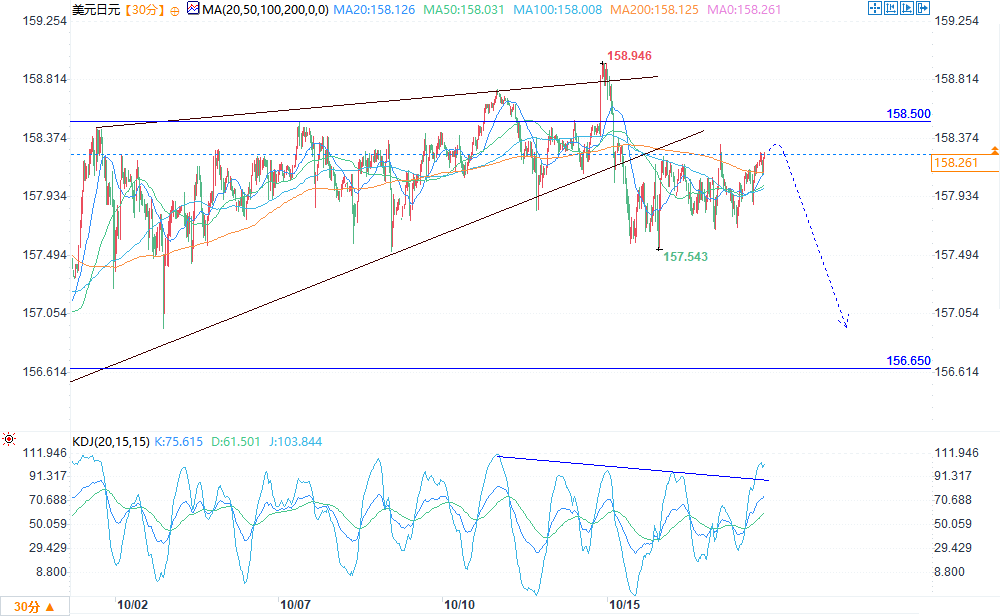 On the 30-minute chart, USD/JPY formed an upward trendline from a low of 156.375. After reaching a high of 158.946, this trendline was broken, and the pair is currently in a rebound phase after a pullback. However, this rebound is facing resistance from a downward trendline formed by previous highs, indicating continued selling pressure. Today's forecast is for the pair to decline again, with a potential target of 156.65. From a larger structural perspective, this rebound is a continuation of the downtrend rather than a trend reversal, and each rebound will face new selling pressure. Moving Average System: The 20-day, 50-day, 100-day, and 200-day moving averages are highly converged (MA20: 158.125, MA50: 158.030, MA100: 158.008, MA200: 158.125), indicating that short-term bullish and bearish costs are converging, leading to increased volatility and a more complex trading environment. The current price of 158.237 has briefly risen above all moving averages, but the moving average cluster has not formed a bullish alignment, suggesting weak support. KDJ Indicator: K=75.216, D=61.474, J=102.700. The J value has entered the overbought zone, and a bearish divergence has formed between the indicator's high and the price high (the price reached a new high of 158.946, while the KDJ peak is gradually decreasing), indicating that bullish momentum is continuously weakening. Even if a short-term rebound occurs, its sustainability is poor. A decisive break below the local support level of 157.75 would provide additional signals to the bears, confirming the start of a new downward wave. However, the possibility of a renewed upward momentum cannot be ruled out. A break above the resistance level and a sustained hold above 158.50 would overturn the current bearish scenario and indicate strengthening bullish momentum. In other words, 158.50 is the current watershed between bulls and bears; its hold will directly determine the direction of the subsequent price action. Key resistance levels: 158.30 and 158.85 (near the previous high of 158.946) Key support levels: 157.75 and 157.05, recent low of 157.543 Risk factors If the Fed's interest rate expectations change and the dollar stabilizes and rebounds, it could attract buyers back to the market. A sustained hold above the 158.50 resistance level would overturn the current bearish scenario and open up further upside potential for the dollar. Therefore, traders executing short-selling strategies should closely monitor this key resistance level. If a valid breakout occurs, stop-loss orders should be placed promptly to avoid holding losing positions against the trend. Furthermore, verbal intervention by the Japanese Ministry of Finance and news of currency checks are sudden risks. Once triggered, the exchange rate will decline rapidly, short-selling profits will be realized quickly, and the risk to long positions will increase dramatically. In summary , the USD/JPY 30-minute chart shows that the previous upward trend line has been broken, the KDJ indicator shows a bearish divergence, and bullish momentum is weakening. If it breaks below the 157.75 support level, the exchange rate is expected to test 156.65. Stabilizing below this level will confirm increased bearish momentum and increase the likelihood of further weakness in the currency pair. Considering both fundamentals and technicals, the divergence in policy expectations coupled with the risk of intervention constitutes multiple factors suppressing the US dollar, making it difficult to reverse the bearish dominance in the short term.
Fundamental Analysis The USD/JPY exchange rate rose slightly, but market trading remained subdued, with volatility narrowing significantly. This "price increase with decreasing volume" pattern typically indicates weak upward momentum, driven more by short covering and technical rebounds than by a genuine influx of new buying. After the US Consumer Price Index (CPI) data exceeded expectations, the market's probability of another Fed rate hike in October rose to 47% before falling back to 14%, putting pressure on the dollar. This sharp shift in expectations largely stemmed from the market reassessing the nature of the US inflation data—whether the high monthly readings represent a continuation of trend pressure or a temporary disturbance; the market currently leans towards the latter. This shift in investor expectations limited further upside potential for the dollar. Bank of Japan Governor Kazuo Ueda's remarks on Monday shifted market focus to the prospect of further rate hikes. He pointed out that against the backdrop of rising wages and prices, the Japanese economy continues to recover, and core inflation remains close to the 2% target level. This statement was interpreted by the market as the Bank of Japan maintaining its stance of gradually normalizing monetary policy, further tightening expectations of policy easing. This could strengthen market expectations of further monetary tightening, thus limiting the upside potential of the currency pair. It's worth noting that if the Bank of Japan subsequently releases more hawkish signals, the enthusiasm for buying the yen will further intensify, putting greater pressure on the dollar. Another factor suppressing USD/JPY buying is the risk of monetary intervention by the Japanese authorities. When the exchange rate approaches 159.00, market participants may be wary of new exchange rate checks (often seen as a precursor to intervention). A "exchange rate check" refers to a verbal or written request from Ministry of Finance officials to the market to inquire about quotes from major banks; essentially, it's a clear warning to speculative funds and a buffer before formal market intervention. This increases the risk of a sharp yen appreciation and makes traders unwilling to establish new long positions in the dollar. Under the shadow of intervention, the market's willingness to chase higher prices is significantly suppressed, thus structurally constraining the dollar's rebound potential. The USD/JPY forecast remains bearish on October 19, 2026. Technical Analysis (Based on 30-minute candlestick chart) On the 30-minute chart, USD/JPY formed an upward trendline from a low of 156.375. After reaching a high of 158.946, this trendline was broken, and the pair is currently in a rebound phase after a pullback. However, this rebound is facing resistance from a downward trendline formed by previous highs, indicating continued selling pressure. Today's forecast is for the pair to decline again, with a potential target of 156.65. From a larger structural perspective, this rebound is a continuation of the downtrend rather than a trend reversal, and each rebound will face new selling pressure. Moving Average System: The 20-day, 50-day, 100-day, and 200-day moving averages are highly converged (MA20: 158.125, MA50: 158.030, MA100: 158.008, MA200: 158.125), indicating that short-term bullish and bearish costs are converging, leading to increased volatility and a more complex trading environment. The current price of 158.237 has briefly risen above all moving averages, but the moving average cluster has not formed a bullish alignment, suggesting weak support. KDJ Indicator: K=75.216, D=61.474, J=102.700. The J value has entered the overbought zone, and a bearish divergence has formed between the indicator's high and the price high (the price reached a new high of 158.946, while the KDJ peak is gradually decreasing), indicating that bullish momentum is continuously weakening. Even if a short-term rebound occurs, its sustainability is poor. A decisive break below the local support level of 157.75 would provide additional signals to the bears, confirming the start of a new downward wave. However, the possibility of a renewed upward momentum cannot be ruled out. A break above the resistance level and a sustained hold above 158.50 would overturn the current bearish scenario and indicate strengthening bullish momentum. In other words, 158.50 is the current watershed between bulls and bears; its hold will directly determine the direction of the subsequent price action. Key resistance levels: 158.30 and 158.85 (near the previous high of 158.946) Key support levels: 157.75 and 157.05, recent low of 157.543 Risk factors If the Fed's interest rate expectations change and the dollar stabilizes and rebounds, it could attract buyers back to the market. A sustained hold above the 158.50 resistance level would overturn the current bearish scenario and open up further upside potential for the dollar. Therefore, traders executing short-selling strategies should closely monitor this key resistance level. If a valid breakout occurs, stop-loss orders should be placed promptly to avoid holding losing positions against the trend. Furthermore, verbal intervention by the Japanese Ministry of Finance and news of currency checks are sudden risks. Once triggered, the exchange rate will decline rapidly, short-selling profits will be realized quickly, and the risk to long positions will increase dramatically. In summary , the USD/JPY 30-minute chart shows that the previous upward trend line has been broken, the KDJ indicator shows a bearish divergence, and bullish momentum is weakening. If it breaks below the 157.75 support level, the exchange rate is expected to test 156.65. Stabilizing below this level will confirm increased bearish momentum and increase the likelihood of further weakness in the currency pair. Considering both fundamentals and technicals, the divergence in policy expectations coupled with the risk of intervention constitutes multiple factors suppressing the US dollar, making it difficult to reverse the bearish dominance in the short term.
- Risk Warning and Disclaimer
- The market involves risk, and trading may not be suitable for all investors. This article is for reference only and does not constitute personal investment advice, nor does it take into account certain users’ specific investment objectives, financial situation, or other needs. Any investment decisions made based on this information are at your own risk.