The market is overly pessimistic about the euro; the French budget agreement could be a catalyst for a rebound.
2026-10-20 07:34:20
On Tuesday (October 20) during the Asian session, the euro traded in a narrow range against the US dollar, currently hovering around 1.1210, almost unchanged for the day. UBS expects the euro to recover to 1.16 against the US dollar by the end of 2026, believing that the recent decline towards 1.11 has exceeded what can be explained by European economic fundamentals, and that market pessimism towards the region is excessive. 
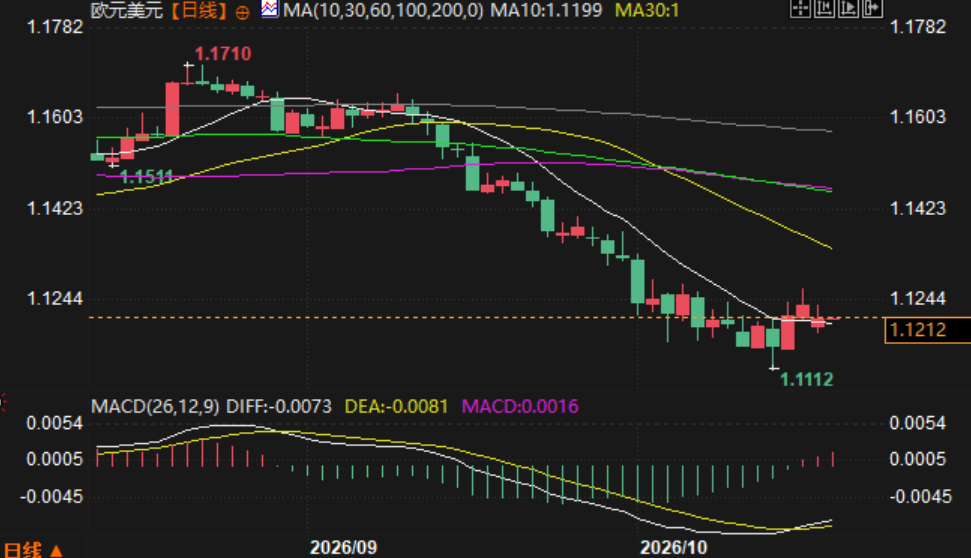 (Euro/USD daily chart, source: FX678) At 7:06 Beijing time, the euro was trading at 1.1210/11 against the US dollar.
The euro's decline against the dollar has exceeded fundamentals, and the market is overly pessimistic.
UBS believes that the euro's decline against the dollar from 1.17 to near 1.11 has exceeded what can be explained by European economic fundamentals. The bank attributes the euro's fall to strong US economic data, concerns about a potential US ban on diesel exports, rising global bond yields, and concerns about French public finances. The core of this assessment is that the euro's weakness is primarily driven by sentiment rather than fundamentals, leaving room for a rebound once the risks to the French budget ease.US Factors: The October Rate Hike Price Has Almost Completely Faded
In the US, UBS noted that stronger-than-expected inflation data initially pushed up US Treasury yields and the dollar, but this trend subsequently reversed, with yields falling and the dollar weakening on the day. The market has now almost entirely priced in the possibility of a Fed rate hike in October, which UBS stated makes it increasingly unlikely that the euro will continue to fall below 1.10. This assessment implies that one of the dollar's main supports—the expectation of an October rate hike—has faded, weakening the dollar's upward momentum and creating conditions for a euro rebound.French Factors: A budget agreement is expected, and narrowing interest rate differentials will support the euro.
France has been a particular source of pressure, with the spread between French and German government bond yields widening significantly in recent weeks. However, UBS does not anticipate a broader European debt crisis and believes a French budget agreement is likely. This could be achieved through Article 49.3 of the French constitution, which allows the government to pass legislation without a parliamentary vote, but faces the risk of a no-confidence motion. UBS states that an agreement should help narrow spreads and support the euro. French bond spreads are a key indicator to watch, as narrowing spreads would support a recovery scenario, while further widening would weaken it.Trading Strategy and Target: Buy below 1.12, target 1.16, stop loss below 1.10.
UBS indicates a preference for buying the euro below 1.12, targeting 1.16, with an exit point slightly below 1.10 to limit losses. The bank also believes that selling downside protection in currency pairs to capture gains is valuable given increased volatility. UBS identifies support levels at 1.10 and 1.08, with resistance at 1.13, followed by 1.17 near the August high. Looking further ahead, UBS expects the euro to reach 1.18 in March 2027, and 1.20 in June and September 2027, following the French presidential elections in April and May. The bank also anticipates a slowdown in energy prices next year, with Brent crude approaching $80/barrel by summer.Risk factors: US data, European growth and French fiscal policy
UBS identifies several key risks, including further strengthening of US data, a substantial deterioration in European growth, or a significant escalation of fiscal concerns in France. The US midterm elections are an unpriced-in risk; UBS states that a Democratic sweep of the House and Senate could have a mild negative impact on the dollar, but this is primarily a 2027 story, as the new Congress will take office in January. Upside catalysts include weaker US data, easing geopolitical tensions, lower energy prices, and a more stable outlook for France.Summarize
UBS expects the euro to recover to 1.16 against the dollar by the end of 2026, believing the recent decline towards 1.11 has exceeded what European economic fundamentals can explain. The bank attributes the euro's decline to strong US data, concerns about a diesel export ban, rising global yields, and French fiscal concerns, but believes the market is overly pessimistic. The pricing in a US October rate hike has almost completely faded, weakening key support for the dollar. A French budget agreement is expected, likely through Article 49.3, which should help narrow interest rate differentials and support the euro. UBS favors buying below 1.12, targeting 1.16, with a stop-loss below 1.10, and expects it to reach 1.18 by March 2027 and 1.20 by mid-year. Easing energy prices and a stable French outlook are catalysts for the upside, while strong US data, deteriorating European growth, and French fiscal concerns are the main risks. The US midterm elections are an unpriced-in risk, but primarily a story for 2027. (Euro/USD daily chart, source: FX678) At 7:06 Beijing time, the euro was trading at 1.1210/11 against the US dollar.
- Risk Warning and Disclaimer
- The market involves risk, and trading may not be suitable for all investors. This article is for reference only and does not constitute personal investment advice, nor does it take into account certain users’ specific investment objectives, financial situation, or other needs. Any investment decisions made based on this information are at your own risk.