The euro faces dual pressures from oil prices and fiscal policy; can it hold the 1.12 level?
2026-10-20 18:58:20
On Tuesday, October 20th, the euro gave up all its gains against the dollar after a brief rise in early trading, essentially flat around 1.1210. The dollar index rebounded from a daily low of 101.74 to near 101.90, but still recorded a 0.12% decline. West Texas Intermediate crude oil prices rose to $100.70, the highest level in over a month. The ongoing conflict in the Middle East significantly boosted the risk premium for oil prices. Further increases in oil prices, re-anchoring global inflation expectations, increased the probability of major central banks further tightening policy rates. Meanwhile, the dollar underperformed over the past week, mainly due to fluctuations in AI-related optimism. Stalled fiscal consolidation in France and rising political uncertainty, which has already spread to other Eurozone countries, further weakened the euro's appeal. 
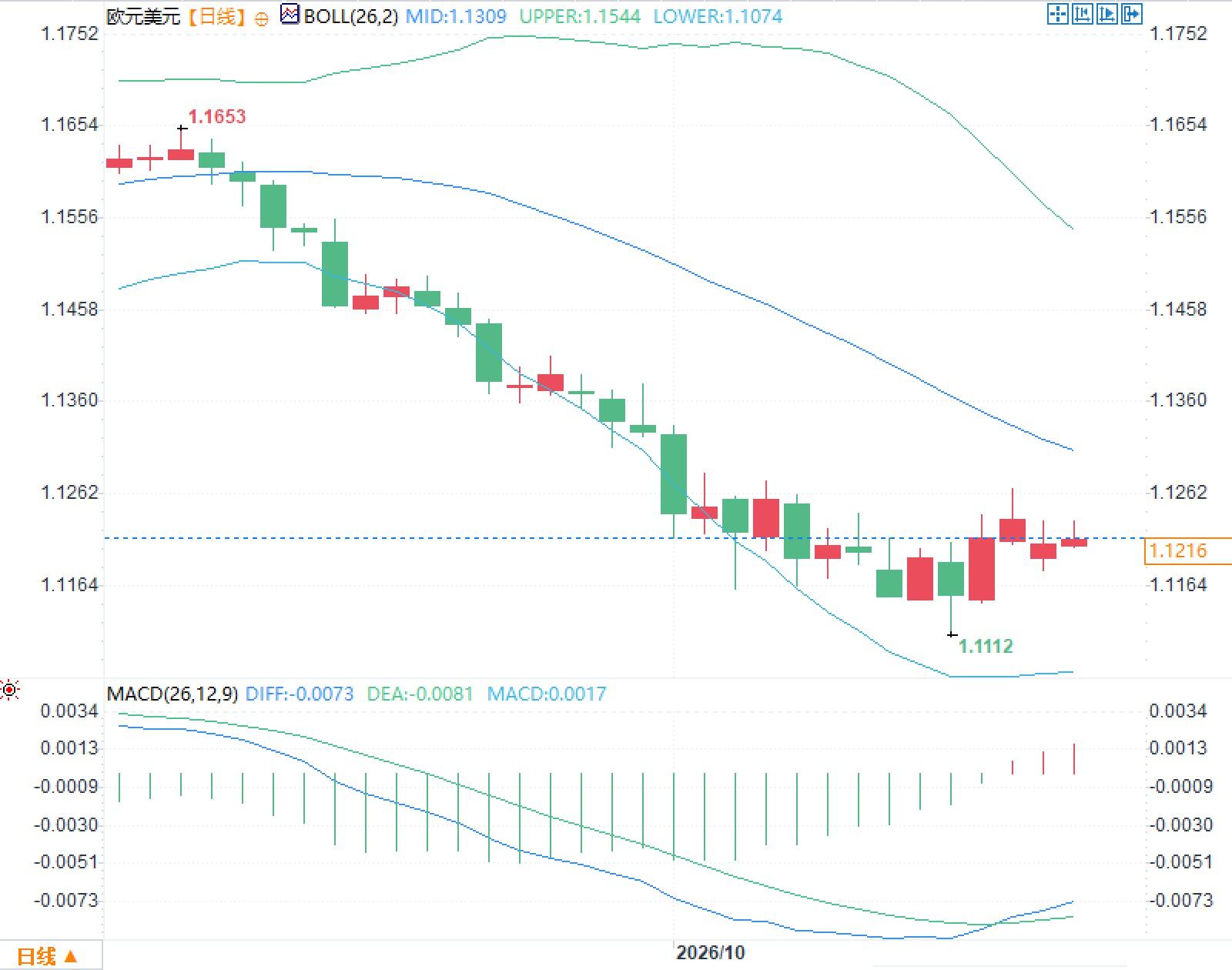 This pattern reflects a recent narrowing of the trading range, with prices fluctuating between the lower and middle Bollinger Bands. The narrowing Bollinger Bands indicate relatively low volatility, making prices more sensitive to external fundamental shocks. The relative positions of the DIFF and DEA lines in the MACD indicator show the difference between short-term momentum and the medium-term trend, while the histogram slightly above zero reflects marginal changes in short-term momentum. Overall, the technical pattern suggests that prices are trading within an existing trading range.
How soaring oil prices are reshaping inflation expectations and central bank policy paths
The core mechanism behind the continued rise in oil prices lies in the repricing of risk premiums. The ongoing conflict in the Middle East poses a persistent threat to key shipping routes, and Iran's statements regarding expanding its control have directly increased market concerns about supply disruptions. Currently, oil prices have surpassed the $100 mark, a level that affects a wide range of goods and services prices through cost transmission chains, causing global inflation expectations to re-anchor. As a significant component of core inflation, high energy prices typically make a noticeable contribution to overall inflation in the following months. Historical data shows that every 10% increase in oil prices tends to push up subsequent inflation by 0.2 to 0.4 percentage points. This change is forcing the market to reassess the policy paths of major central banks. The Federal Reserve and the European Central Bank had previously entered a period of observation, but the rise in oil price risk premiums has increased the probability of further policy tightening.The Evolution of AI-Related Funding and the Structural Characteristics of the US Dollar
Analysts at MUFG Financial Group pointed out that in the twelve months ending in July, foreign investors purchased $942 billion in US stocks, while purchases of US corporate bonds increased to $452 billion during the same period. The analysts also emphasized that this dynamic makes the US dollar more vulnerable to capital reversals when AI sentiment deteriorates. The dollar's underperformance over the past week is closely related to fluctuations in AI-related optimism. The shift in capital inflows from traditional safe-haven demand to yield-seeking signifies a structural change in the dollar's support base. Once expectations for returns in AI-related sectors are lowered, foreign capital may reallocate, depriving the dollar of this incremental support. This characteristic reduces the dollar's resilience in the face of sentiment reversals, and correspondingly increases market sensitivity to related capital flows.French fiscal turmoil spreads to other sovereign markets in the Eurozone
Deutsche Bank analysts point out that the latest round of political turmoil in France has spread to other European markets. Market concerns surrounding French debt are not only affecting French assets but also spreading to other countries and asset classes. The spread between Italian 10-year bonds and German bonds rose 4.7 basis points to 111 basis points that day, while the corresponding spread for Spain rose 1.2 basis points to 62 basis points. The stalled fiscal consolidation process in France and increased political uncertainty have led to a repricing of risk premiums within the Eurozone. The widening spreads reflect investors' reassessment of sovereign credit risk, and the changes in spreads in Italy and Spain, as important economies in the Eurozone, have regional indicative significance. This transmission effect weakens the overall attractiveness of the euro, leaving it lacking sufficient internal support in the face of external shocks. The widening fiscal divide within the Eurozone has led to a marginal adjustment in market pricing of regional integration, thereby affecting the euro's relative performance in the foreign exchange market.Current state of daily technical indicators for EUR/USD
The daily chart shows the Bollinger Bands with the middle band at 1.1309, the upper band at 1.1544, and the lower band at 1.1074. The current price is trading below the middle band, near the lower band, with a recent low marked at 1.1112. The MACD indicator shows a DIFF value of -0.0073, a DEA value of -0.0081, and a MACD histogram value of 0.0017. The price is fluctuating near the lower band, and the momentum indicator shows that both the DIFF and DEA are negative, but the histogram is slightly above zero. This pattern reflects a recent narrowing of the trading range, with prices fluctuating between the lower and middle Bollinger Bands. The narrowing Bollinger Bands indicate relatively low volatility, making prices more sensitive to external fundamental shocks. The relative positions of the DIFF and DEA lines in the MACD indicator show the difference between short-term momentum and the medium-term trend, while the histogram slightly above zero reflects marginal changes in short-term momentum. Overall, the technical pattern suggests that prices are trading within an existing trading range.Frequently Asked Questions
Question 1: Why do rising oil prices affect both the US dollar and the euro? Answer: Rising oil prices push up global inflation expectations, increasing the probability of major central banks further tightening policies. The US dollar typically benefits first from changes in interest rate expectations, while the euro comes under pressure due to fiscal divergence within the Eurozone and limited growth prospects. Question 2: How do France's fiscal problems spread to Italy and Spain? Answer: Market concerns about the sustainability of French debt lead to a reassessment of sovereign risk across the entire Eurozone, causing a simultaneous widening of the spread between Italian and Spanish government bonds and German government bonds, reflecting a regional increase in risk premiums.- Risk Warning and Disclaimer
- The market involves risk, and trading may not be suitable for all investors. This article is for reference only and does not constitute personal investment advice, nor does it take into account certain users’ specific investment objectives, financial situation, or other needs. Any investment decisions made based on this information are at your own risk.