Why did Trump fail to suppress oil prices before the midterm elections, pushing them back above $100?
2026-10-20 19:38:20
On Tuesday (October 20), WTI crude oil broke through $100 per barrel during the European trading session, while Brent crude oil approached $111. With less than two weeks until the US midterm elections, the Trump administration is facing increasing pressure on energy prices, but the oil market is not betting on an imminent end to the conflict. Washington currently hopes to control the conflict; when will oil supplies return to normal?  This is the most noteworthy contradiction in the current oil price trend. Trump has ample domestic political reasons to avoid further increases in oil prices. For the crude oil market, the determining factor may not be whether the US wants to end the conflict, but whether it can persuade Iran to accept an arrangement that would restore shipping without making significant concessions. Reports indicate that Iran intends to use the political pressure ahead of the US midterm elections to gain leverage in negotiations, and significant differences remain between the two sides on negotiating terms. The US wants to include Iran's nuclear program in the negotiations, while Iran demands that the US first address issues such as the maritime blockade, sanctions, and frozen assets. Both sides face pressure to reach an agreement but may not be willing to make concessions first. This means that the most likely variables affecting oil prices in the next two weeks are not only whether military action will escalate, but also how long the negotiation stalemate will last, and whether the market will continue to pay a premium for supply disruptions. Election pressure is unlikely to translate into supply recovery . For Trump, rising oil prices are not only an energy market issue but also a political risk ahead of the midterm elections. Gasoline prices directly affect voters' perception of the cost of living, and a continued energy shock could also push up transportation and production costs, further weakening the government's performance on economic issues. The US Consumer Price Index rose 3.7% year-on-year in September, with rising gasoline prices being a significant factor in the accelerated inflation. Against this backdrop, the White House has reason to avoid further escalation of the conflict and seek diplomatic solutions to alleviate energy price pressures. However, the market cannot simply interpret this political motive as an imminent drop in oil prices. Trump needs more than just a halt to new military action; he needs an arrangement that can be seen as a successful outcome. If lifting the blockade or easing sanctions is perceived as a concession to Iran, and negotiations fail to resolve the nuclear issue and regional security disputes, the political cost of a swift resolution could be equally high. Iran, in turn, may use this constraint to increase its bargaining power. If Iran believes that maintaining shipping pressure will exacerbate domestic energy cost problems in the US, the approaching midterm elections may not automatically de-escalate the situation; instead, they may make both sides more cautious in negotiations. Therefore, the US's willingness to launch a large-scale new attack may be lower than the market's worst fears, but this is not enough to eliminate the risk of a prolonged conflict. For oil prices, both sides' unwillingness to escalate fully and their inability to reach an agreement can coexist. Supply Losses Are More Important Than Political Statements The crude oil market hasn't turned bearish due to the US's cooling-off motives because supply tightness is no longer just a potential future risk. A report on October 19th stated that the seven-day average of crude oil shipments through the Strait of Hormuz had fallen to approximately 8.5 million barrels per day, compared to over 20 million barrels per day the previous week. Attacks on commercial vessels and shipping security risks have raised market concerns that the supply recovery process may be hindered again. For the global crude oil market, changes in Strait of Hormuz shipments have a more direct impact on the amount of oil available for delivery than mere diplomatic statements. The International Energy Agency's monthly report released on October 14th showed that global observable oil inventories decreased by approximately 10 million barrels in September, with onshore inventories declining by approximately 113 million barrels. As of the end of September, global observable inventories were approximately 509 million barrels lower than at the end of February. The continued depletion of inventory buffers means that if supply is disrupted again, the market may find it more difficult to absorb the shock through existing inventories. However, supply is not entirely without recovery. IEA data shows that global oil supply increased by 2.5 million barrels per day in September, reaching 102.3 million barrels per day. This change indicates that the current market is not facing a supply gap that is bound to worsen, but rather oscillates between supply recovery and the risk of new disruptions. This also explains why oil prices may react differently to the same diplomatic news. If negotiations progress but ships are still unwilling to resume passage, the market may not significantly lower prices; if the two sides have not reached a comprehensive agreement, but crude oil exports and strait traffic continue to improve, oil prices may fall earlier. Demand poses another constraint. The IEA predicts that global oil demand will decline by approximately 2.6 million barrels per day year-on-year in 2026, with high oil prices and supply constraints weakening consumption. As fuel costs rise, some businesses and consumers will reduce consumption, and economic activity may also be dragged down. This means that while supply disruptions can push up oil prices, sustained high prices themselves can also damage demand, limiting the duration of the price increase. The current market therefore faces two opposing forces: declining inventories and transportation disruptions support near-term prices, while weakening demand and potential supply recovery limit further increases. In the next two weeks, which force dominates will be more helpful in determining the direction of oil prices than simply judging whether the situation in the Middle East is tense. Oil prices still face upside risks, and the $100 level is worth watching . A break above $100 for WTI is noteworthy, but the price differences between different delivery months remind the market that the rise in near-month contracts should not be directly interpreted as a shift in the overall market price center. On October 19th, the settlement price of the WTI November contract was $103.66 per barrel, while the more actively traded December contract settled at $98.54 per barrel. The difference of $5.12 indicates that near-month prices are influenced by contract expiration and short-term supply conditions. To determine whether the upward trend can continue, it is necessary to observe whether the December contract can consistently stay above $100, rather than just looking at the near-month contract that is about to expire. In the next two weeks, the baseline scenario remains that oil prices will fluctuate at high levels, slightly bullish. As long as there is no substantial breakthrough in the US-Iran negotiations, and shipping through the Strait of Hormuz remains vulnerable, supply risks may continue to support prices. Using the December WTI contract as a reference, $98 to $105 per barrel can be considered a scenario range for observation; for Brent, $107 to $113 per barrel is worth watching. These ranges are for analytical reference only, not precise price predictions. If strait navigation continues to improve, exports recover, and diplomatic arrangements begin to address substantive issues such as blockades and sanctions, the risk premium could quickly fall back, and it wouldn't be surprising if WTI retraces below $100. Conversely, if ship attacks increase, key energy facilities suffer significant damage, or strait shipping declines significantly again, WTI could test the $105 to $115 per barrel range, while Brent could test the $115 to $125 per barrel range.
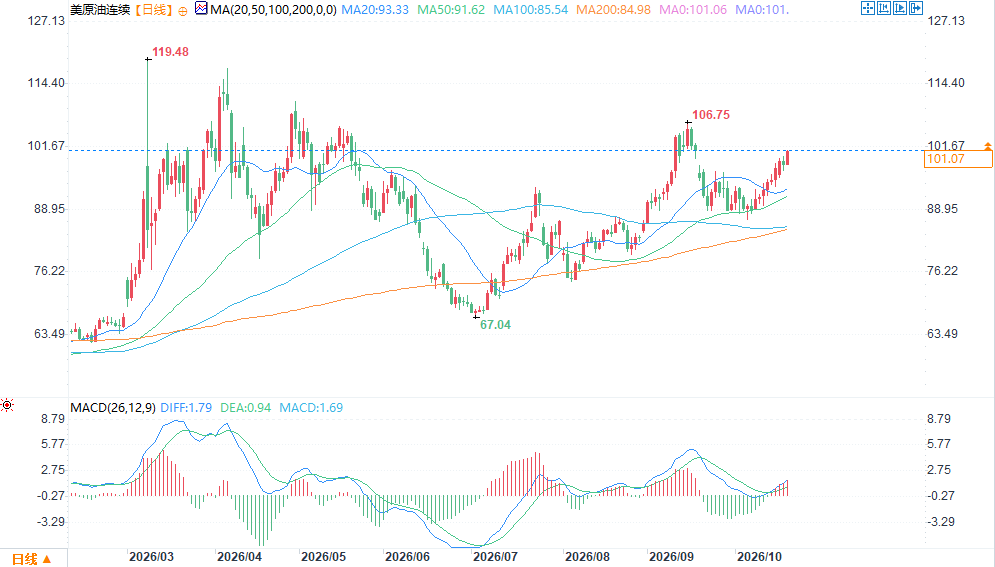 (WTI crude oil daily chart source: FX678) The key to determining the next direction of oil prices lies in distinguishing between supply losses and risk premiums. The former needs to be verified through actual shipping volumes, exports, and inventory data, while the latter depends more on the market's assessment of the duration of the conflict and the probability of further escalation. If oil prices no longer rise significantly after news of new attacks, it may mean that the risk has been fully priced in; if prices continue to rise while Straits traffic continues to decline, it indicates that supply tensions are deepening. The US has an incentive to control the conflict before the election, but this motivation alone is insufficient to justify a bearish outlook on oil prices. As long as diplomatic de-escalation has not translated into actual supply recovery, the crude oil market is likely to remain high and sensitive to new supply shocks. For the next two weeks, what truly matters to observe is not whether Trump wants to end the conflict, but whether he can push through an arrangement sufficient to restore oil shipping without being seen as a strategic retreat.
This is the most noteworthy contradiction in the current oil price trend. Trump has ample domestic political reasons to avoid further increases in oil prices. For the crude oil market, the determining factor may not be whether the US wants to end the conflict, but whether it can persuade Iran to accept an arrangement that would restore shipping without making significant concessions. Reports indicate that Iran intends to use the political pressure ahead of the US midterm elections to gain leverage in negotiations, and significant differences remain between the two sides on negotiating terms. The US wants to include Iran's nuclear program in the negotiations, while Iran demands that the US first address issues such as the maritime blockade, sanctions, and frozen assets. Both sides face pressure to reach an agreement but may not be willing to make concessions first. This means that the most likely variables affecting oil prices in the next two weeks are not only whether military action will escalate, but also how long the negotiation stalemate will last, and whether the market will continue to pay a premium for supply disruptions. Election pressure is unlikely to translate into supply recovery . For Trump, rising oil prices are not only an energy market issue but also a political risk ahead of the midterm elections. Gasoline prices directly affect voters' perception of the cost of living, and a continued energy shock could also push up transportation and production costs, further weakening the government's performance on economic issues. The US Consumer Price Index rose 3.7% year-on-year in September, with rising gasoline prices being a significant factor in the accelerated inflation. Against this backdrop, the White House has reason to avoid further escalation of the conflict and seek diplomatic solutions to alleviate energy price pressures. However, the market cannot simply interpret this political motive as an imminent drop in oil prices. Trump needs more than just a halt to new military action; he needs an arrangement that can be seen as a successful outcome. If lifting the blockade or easing sanctions is perceived as a concession to Iran, and negotiations fail to resolve the nuclear issue and regional security disputes, the political cost of a swift resolution could be equally high. Iran, in turn, may use this constraint to increase its bargaining power. If Iran believes that maintaining shipping pressure will exacerbate domestic energy cost problems in the US, the approaching midterm elections may not automatically de-escalate the situation; instead, they may make both sides more cautious in negotiations. Therefore, the US's willingness to launch a large-scale new attack may be lower than the market's worst fears, but this is not enough to eliminate the risk of a prolonged conflict. For oil prices, both sides' unwillingness to escalate fully and their inability to reach an agreement can coexist. Supply Losses Are More Important Than Political Statements The crude oil market hasn't turned bearish due to the US's cooling-off motives because supply tightness is no longer just a potential future risk. A report on October 19th stated that the seven-day average of crude oil shipments through the Strait of Hormuz had fallen to approximately 8.5 million barrels per day, compared to over 20 million barrels per day the previous week. Attacks on commercial vessels and shipping security risks have raised market concerns that the supply recovery process may be hindered again. For the global crude oil market, changes in Strait of Hormuz shipments have a more direct impact on the amount of oil available for delivery than mere diplomatic statements. The International Energy Agency's monthly report released on October 14th showed that global observable oil inventories decreased by approximately 10 million barrels in September, with onshore inventories declining by approximately 113 million barrels. As of the end of September, global observable inventories were approximately 509 million barrels lower than at the end of February. The continued depletion of inventory buffers means that if supply is disrupted again, the market may find it more difficult to absorb the shock through existing inventories. However, supply is not entirely without recovery. IEA data shows that global oil supply increased by 2.5 million barrels per day in September, reaching 102.3 million barrels per day. This change indicates that the current market is not facing a supply gap that is bound to worsen, but rather oscillates between supply recovery and the risk of new disruptions. This also explains why oil prices may react differently to the same diplomatic news. If negotiations progress but ships are still unwilling to resume passage, the market may not significantly lower prices; if the two sides have not reached a comprehensive agreement, but crude oil exports and strait traffic continue to improve, oil prices may fall earlier. Demand poses another constraint. The IEA predicts that global oil demand will decline by approximately 2.6 million barrels per day year-on-year in 2026, with high oil prices and supply constraints weakening consumption. As fuel costs rise, some businesses and consumers will reduce consumption, and economic activity may also be dragged down. This means that while supply disruptions can push up oil prices, sustained high prices themselves can also damage demand, limiting the duration of the price increase. The current market therefore faces two opposing forces: declining inventories and transportation disruptions support near-term prices, while weakening demand and potential supply recovery limit further increases. In the next two weeks, which force dominates will be more helpful in determining the direction of oil prices than simply judging whether the situation in the Middle East is tense. Oil prices still face upside risks, and the $100 level is worth watching . A break above $100 for WTI is noteworthy, but the price differences between different delivery months remind the market that the rise in near-month contracts should not be directly interpreted as a shift in the overall market price center. On October 19th, the settlement price of the WTI November contract was $103.66 per barrel, while the more actively traded December contract settled at $98.54 per barrel. The difference of $5.12 indicates that near-month prices are influenced by contract expiration and short-term supply conditions. To determine whether the upward trend can continue, it is necessary to observe whether the December contract can consistently stay above $100, rather than just looking at the near-month contract that is about to expire. In the next two weeks, the baseline scenario remains that oil prices will fluctuate at high levels, slightly bullish. As long as there is no substantial breakthrough in the US-Iran negotiations, and shipping through the Strait of Hormuz remains vulnerable, supply risks may continue to support prices. Using the December WTI contract as a reference, $98 to $105 per barrel can be considered a scenario range for observation; for Brent, $107 to $113 per barrel is worth watching. These ranges are for analytical reference only, not precise price predictions. If strait navigation continues to improve, exports recover, and diplomatic arrangements begin to address substantive issues such as blockades and sanctions, the risk premium could quickly fall back, and it wouldn't be surprising if WTI retraces below $100. Conversely, if ship attacks increase, key energy facilities suffer significant damage, or strait shipping declines significantly again, WTI could test the $105 to $115 per barrel range, while Brent could test the $115 to $125 per barrel range. (WTI crude oil daily chart source: FX678) The key to determining the next direction of oil prices lies in distinguishing between supply losses and risk premiums. The former needs to be verified through actual shipping volumes, exports, and inventory data, while the latter depends more on the market's assessment of the duration of the conflict and the probability of further escalation. If oil prices no longer rise significantly after news of new attacks, it may mean that the risk has been fully priced in; if prices continue to rise while Straits traffic continues to decline, it indicates that supply tensions are deepening. The US has an incentive to control the conflict before the election, but this motivation alone is insufficient to justify a bearish outlook on oil prices. As long as diplomatic de-escalation has not translated into actual supply recovery, the crude oil market is likely to remain high and sensitive to new supply shocks. For the next two weeks, what truly matters to observe is not whether Trump wants to end the conflict, but whether he can push through an arrangement sufficient to restore oil shipping without being seen as a strategic retreat.
- Risk Warning and Disclaimer
- The market involves risk, and trading may not be suitable for all investors. This article is for reference only and does not constitute personal investment advice, nor does it take into account certain users’ specific investment objectives, financial situation, or other needs. Any investment decisions made based on this information are at your own risk.