One chart: Baltic Dry Index rises, Capesize sector strengthens.
2026-10-20 23:10:20
Latest data shows that the Baltic Dry Index (BDI) reached 2593 points on October 20, 2026, a four-day high, up 1.85% month-on-month (compared to the previous value), marking the largest increase since September 4, 2026, and the second consecutive day of increase (including zero growth). Looking at the short-term charts, the recent 11 BDI data points show: positive growth twice, negative growth nine times, and zero growth. Specifically, the Panamax Freight Index (BPI) was 2247 points, down 1.71% from the previous value; the Capesize Freight Index (BCI) was 3522 points, up 4.67%; and the Supramax Freight Index (BSI) was 1868 points, unchanged. For detailed 720-day and 10-year trend charts of the Baltic Dry Index and its three main sub-indices, please refer to the charts specially created by FX678. 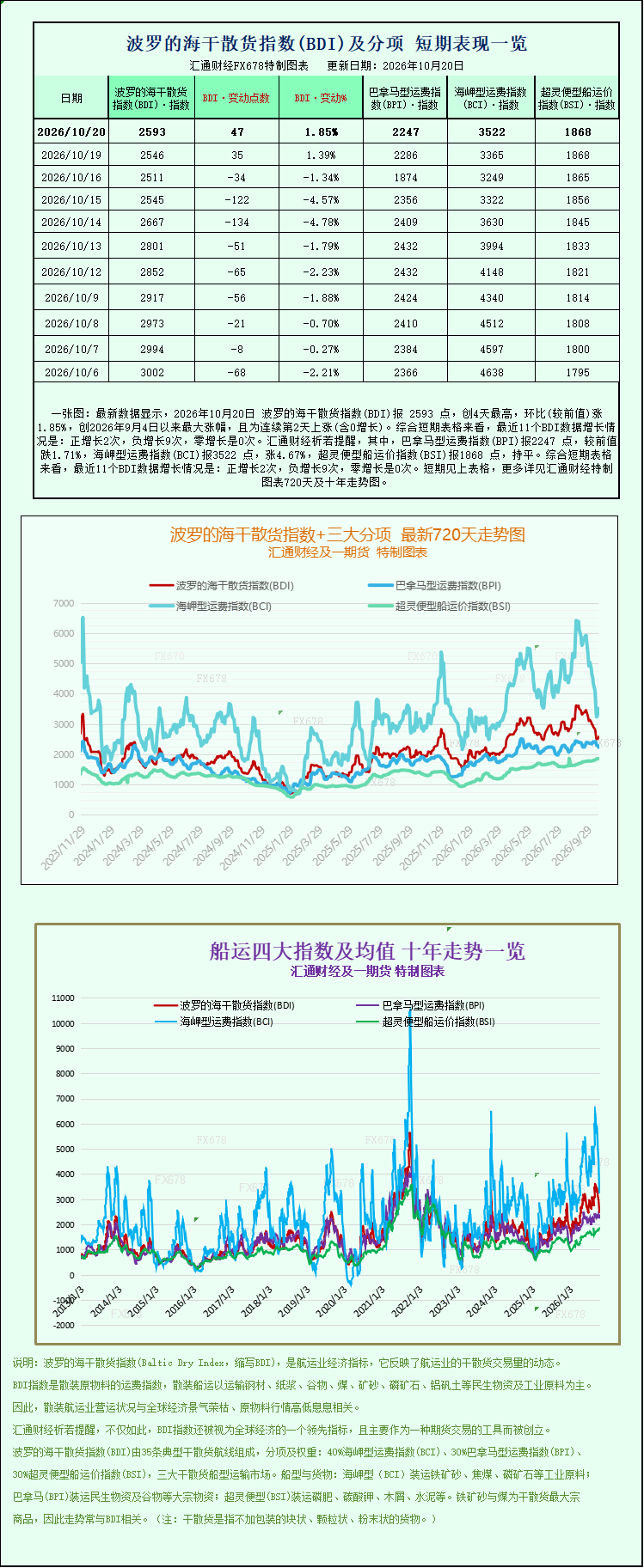 Boosted by stronger Capesize vessel freight rates, the Baltic Dry Index, the main shipping index tracking dry bulk freight rates, closed higher on Tuesday, ending a previous downward trend. Major Index Performance: Mixed Results The Baltic Dry Index (BDI), which reflects freight rates for Capesize, Panamax, and Supramax vessels, rose 47 points, or 1.85%, to close at 2593 points. This increase was mainly driven by the Capesize sector: the Capesize Index (BCI) surged 157 points, or 4.67%, to 3522 points. In contrast to the strong performance of Capesize vessels, the Panamax sector weakened. The Panamax Index (BPNI) fell 39 points, or 1.71%, to close at 2247 points. For smaller vessel types, the Supramax Index (BSIS) remained largely unchanged at 1868 points. Capesize Vessels: Freight Rates and Supply & Demand Behind the Rise Capesize bulk carriers are the largest vessel type in the dry bulk market, typically with a deadweight tonnage of 150,000 tons. They primarily handle the ocean transport of bulk industrial raw materials such as iron ore and thermal coal, and have the highest weighting in the Baltic Dry Index (BDI). Their charter rate fluctuations often have a decisive impact on the overall index. On Tuesday, the average daily earnings of Capesize bulk carriers carrying this type of cargo increased by $1,427 to $28,442, a significant increase. While freight rates strengthened, the fundamentals showed a robust supply and demand situation. Iron ore futures prices fell on Tuesday, while global shipments surged and arrivals at Chinese ports increased, highlighting ample market supply. On the one hand, high iron ore shipments provided sustained demand for Capesize vessels; on the other hand, ample arrivals meant that the rise in freight rates reflected more the activity in the transportation sector than a shortage of upstream resources. Panamax Vessels: Weak Demand Dragging Down the Market In contrast to Capesize vessels, Panamax vessels also showed a divergence. These vessels typically carry 60,000 to 70,000 tons of consumer goods and industrial raw materials such as coal or grain. Their size must be compatible with the Panama Canal's navigation requirements, combining route flexibility with cargo capacity advantages. On Tuesday, the average daily revenue for Panamax vessels fell by $350 to $20,223, reflecting relatively weak demand in this segment, with limited support for freight rates from grain and coal trade volumes. Background and Recent Trends The Baltic Dry Index (BDI) is a leading indicator of the international dry bulk shipping market, and its fluctuations are widely considered a leading indicator of global commodity trade activity. Previously, the BDI was generally in a downward trend—weak Capesize freight rates had dragged the index down for several consecutive weeks. The recent significant rebound in the Capesize sector has raised market concerns about whether it can drive a stabilization and recovery in the overall index. Market Outlook: Coexisting Bullish and Bearish Factors Based on current information, the future market trend remains highly uncertain, with bullish and bearish factors intertwined. Positive factors supporting freight rates include: high shipment volumes of bulk dry bulk commodities such as iron ore and coal; and China, as the world's largest importer of iron ore, will continue to be a key variable influencing freight rates due to port arrivals and clearance schedules. However, negative factors are equally significant – lower iron ore futures prices and ample port cargo reflect a loose supply situation, which may limit the sustainability of freight rate increases to some extent. Furthermore, the performance of freight rates for medium and small vessel types such as Panamax and Supramax will also constrain the trend of the composite index. Overall, the recent strength in Capesize freight rates, which has driven a rebound in the BDI, reflects the structural differentiation among different segments of the dry bulk market. Whether freight rates can continue to rise will depend on the pace of iron ore shipments, the strength of Chinese demand, and marginal changes in the supply and demand of cargoes for various vessel types.
- Risk Warning and Disclaimer
- The market involves risk, and trading may not be suitable for all investors. This article is for reference only and does not constitute personal investment advice, nor does it take into account certain users’ specific investment objectives, financial situation, or other needs. Any investment decisions made based on this information are at your own risk.