Why does France have a systemic risk position?
2026-10-21 00:30:20
A common view holds that France is too small to have a substantial impact on the global financial landscape, but this view is clearly flawed. This assessment ignores the deep-rooted financial interconnectedness within the Eurozone and the current intertwined nature of global macroeconomic risks.  There are three main reasons why France poses a systemic risk to global markets. First, the current situation largely stems from the cost of living crisis triggered by high oil prices. This is a global issue, but France's fiscal situation makes it a leading indicator of the crisis; France is essentially the canary in the coal mine. The continued rise in energy prices squeezes residents' real income, and coupled with the government's heavy debt burden, it amplifies social contradictions. This pressure is not limited to France. Second, the political centrist has crumbled, with voters increasingly turning to the far left or far right. Similarly, this is not a problem unique to France. The rise of the Alternative for Germany (AfD) is essentially a similar phenomenon, and a major trigger for this phenomenon—the immigration issue—is prevalent in most parts of Europe. The continued decline in the credibility of traditional mainstream parties and policy instability will further undermine investors' confidence in the fiscal stability of Europe. Third, the risk spillover effect. The Eurozone has a long list of highly indebted countries, making them extremely vulnerable to any external shocks, and France itself could become a major source of such shocks. Under the Eurozone's single currency framework, national debt markets are closely interconnected; once a country's debt risk escalates, it can easily spread rapidly across borders.
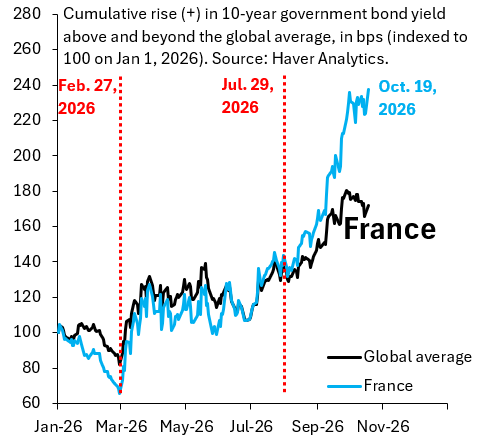 (Chart 1: Year-to-Date Increase in French 10-Year Bond Yield (Blue) vs. Equal-Weighted Average of 10-Year Bond Yields in Other G10 Countries (Black)) The chart above shows the year-to-date increase in the yield of French 10-year bonds (blue line), compared to the equal-weighted average yield of 10-year bonds in other G10 countries (black line). The yield on French 10-year bonds has now climbed to its highest point this year, for a straightforward reason: the market believes the French government will resort to spending to solve the problem, essentially appeasing protesters through policy compromises, which will further worsen the already dire fiscal situation. Simultaneously, whenever the blue line rises sharply, the black line also rises accordingly, indicating that the situation in France will spill over into the global bond market, driven by the three reasons mentioned above. The global bond market is highly interconnected; risk pricing fluctuations in European government bonds quickly transmit to US Treasuries and bonds from other developed economies, influencing safe-haven trading behavior among global funds.
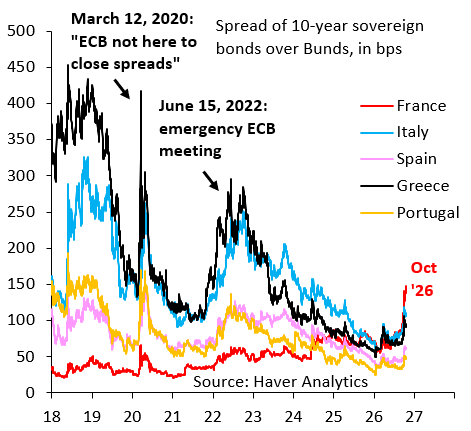 (Chart 2: Yield Spreads of 10-Year Government Bonds Relative to German Bonds) France faces systemic risk primarily because this risk can spread to other highly indebted European countries. The chart above shows the yield spreads of 10-year government bonds relative to German bonds across various countries, and some of this risk transmission is already evident. Recently, the French bond yield spread has risen (red line), leading to a general increase in yield spreads for peripheral Eurozone countries. As analyzed in another article, the European Central Bank (ECB) initially attempted to isolate the risks in peripheral Eurozone countries (especially Italy) by intervening to lower government bond yields. However, this approach is destined to fail: as long as the situation in France continues to spiral out of control, yields cannot be suppressed. Ultimately, the ECB will have to impose caps on government bond yields for all countries, which will further distort the incentive mechanisms of national fiscal policies. Once the central bank indiscriminately supports national debt, it will weaken the incentive for governments to proactively control fiscal deficits, creating long-term hidden dangers. In short, France faces systemic risk, and the situation will likely worsen before it improves. The superposition of multiple macroeconomic, social, and fiscal risks means that it is difficult to see signs of rapid recovery in the short term.
There are three main reasons why France poses a systemic risk to global markets. First, the current situation largely stems from the cost of living crisis triggered by high oil prices. This is a global issue, but France's fiscal situation makes it a leading indicator of the crisis; France is essentially the canary in the coal mine. The continued rise in energy prices squeezes residents' real income, and coupled with the government's heavy debt burden, it amplifies social contradictions. This pressure is not limited to France. Second, the political centrist has crumbled, with voters increasingly turning to the far left or far right. Similarly, this is not a problem unique to France. The rise of the Alternative for Germany (AfD) is essentially a similar phenomenon, and a major trigger for this phenomenon—the immigration issue—is prevalent in most parts of Europe. The continued decline in the credibility of traditional mainstream parties and policy instability will further undermine investors' confidence in the fiscal stability of Europe. Third, the risk spillover effect. The Eurozone has a long list of highly indebted countries, making them extremely vulnerable to any external shocks, and France itself could become a major source of such shocks. Under the Eurozone's single currency framework, national debt markets are closely interconnected; once a country's debt risk escalates, it can easily spread rapidly across borders. (Chart 1: Year-to-Date Increase in French 10-Year Bond Yield (Blue) vs. Equal-Weighted Average of 10-Year Bond Yields in Other G10 Countries (Black)) The chart above shows the year-to-date increase in the yield of French 10-year bonds (blue line), compared to the equal-weighted average yield of 10-year bonds in other G10 countries (black line). The yield on French 10-year bonds has now climbed to its highest point this year, for a straightforward reason: the market believes the French government will resort to spending to solve the problem, essentially appeasing protesters through policy compromises, which will further worsen the already dire fiscal situation. Simultaneously, whenever the blue line rises sharply, the black line also rises accordingly, indicating that the situation in France will spill over into the global bond market, driven by the three reasons mentioned above. The global bond market is highly interconnected; risk pricing fluctuations in European government bonds quickly transmit to US Treasuries and bonds from other developed economies, influencing safe-haven trading behavior among global funds. (Chart 2: Yield Spreads of 10-Year Government Bonds Relative to German Bonds) France faces systemic risk primarily because this risk can spread to other highly indebted European countries. The chart above shows the yield spreads of 10-year government bonds relative to German bonds across various countries, and some of this risk transmission is already evident. Recently, the French bond yield spread has risen (red line), leading to a general increase in yield spreads for peripheral Eurozone countries. As analyzed in another article, the European Central Bank (ECB) initially attempted to isolate the risks in peripheral Eurozone countries (especially Italy) by intervening to lower government bond yields. However, this approach is destined to fail: as long as the situation in France continues to spiral out of control, yields cannot be suppressed. Ultimately, the ECB will have to impose caps on government bond yields for all countries, which will further distort the incentive mechanisms of national fiscal policies. Once the central bank indiscriminately supports national debt, it will weaken the incentive for governments to proactively control fiscal deficits, creating long-term hidden dangers. In short, France faces systemic risk, and the situation will likely worsen before it improves. The superposition of multiple macroeconomic, social, and fiscal risks means that it is difficult to see signs of rapid recovery in the short term.
- Risk Warning and Disclaimer
- The market involves risk, and trading may not be suitable for all investors. This article is for reference only and does not constitute personal investment advice, nor does it take into account certain users’ specific investment objectives, financial situation, or other needs. Any investment decisions made based on this information are at your own risk.