Gold prices fluctuated around $4,100, and although institutions lowered their forecasts, they remained bullish on gold in the long term.
2026-10-21 11:24:22
Gold prices are currently consolidating sideways, seeking support around $4,100 per ounce. Rising inflation pushing up US Treasury yields and a stronger dollar continue to weigh on gold's short-term performance. CIBC Capital Markets updated its precious metals outlook, significantly lowering its gold price forecasts until the end of this decade, but remains optimistic about gold's long-term investment value.
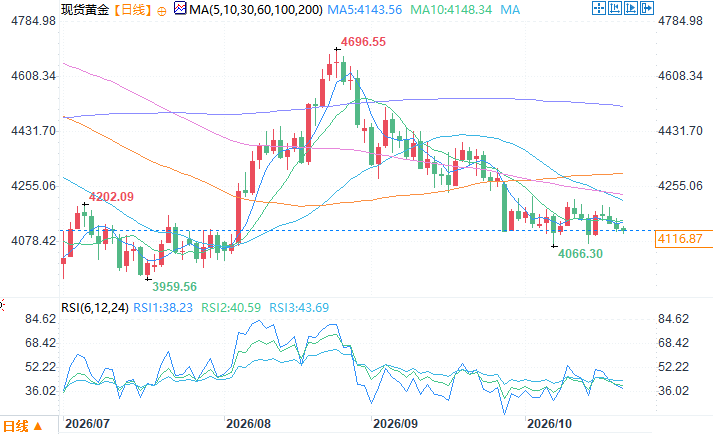 Spot gold daily chart source: FX678. At 11:22 AM Beijing time on October 21, spot gold was trading at $4119.87 per ounce.
Gold price expectations have been significantly lowered, but the long-term bullish outlook remains unchanged.
A team of commodity analysts led by Anita Soni and Cosmos Chiu released their latest forecast, lowering their gold price expectation for the fourth quarter of this year to $4,500 per ounce, a 31% reduction from the initial estimate of $6,500. The bank adjusted its average gold price forecast for 2027 to $5,200 and for 2028 to $5,500, down from previous forecasts of $6,500 and $6,000 respectively. Looking further ahead, the average gold price is expected to be $4,800 in 2029, $4,500 in 2030, and $4,200 in 2031. Analysts stated that although the monetary policy environment is increasingly unfavorable for gold, the underlying logic supporting last year's historic surge in gold prices has not disappeared. Persistent inflation, coupled with the US-Iran tensions and high energy prices, is forcing the Federal Reserve Chairman to adopt a tighter policy stance, while geopolitical risks, government debt pressures, and the need for central banks to diversify their foreign exchange reserves will continue to provide long-term support for gold.Short-term negative factors are suppressing gold prices, while US Treasury yields are having a two-way impact.
Gold prices have fluctuated wildly this year. According to the bank's statistics, gold prices have fallen nearly 24% from their year-to-date high of around $5,600, briefly dipping to around $4,000 at the end of June before rebounding to around $4,400 during the summer. The Federal Reserve's 25 basis point rate hike in September, coupled with signals of further tightening, triggered another sell-off in gold. Analysts say that rising real interest rates and a stronger dollar are the biggest obstacles for gold at present. Since gold does not generate interest, these factors increase the opportunity cost of holding it. With the 10-year US Treasury yield exceeding 5%, market competition has intensified: high yields make bonds more attractive than gold, but rising financing costs have also raised concerns about the sustainability of US fiscal policy, and sovereign debt risk has actually strengthened gold's safe-haven appeal. The bank also predicts that if the economy weakens or inflation cools, and the Federal Reserve begins cutting interest rates, the monetary policy environment will be favorable for gold prices. Historically, gold has tended to perform well when real interest rates are below 2%.Demand structure diverges, with physical gold purchases and central bank gold buying providing a solid foundation.
The gold market demand is showing a clear divergence. In the third quarter, global gold ETFs saw a net inflow of $30.7 billion, corresponding to a demand for 211 tons of physical gold, reversing the outflow of 45 tons in the second quarter. European funds showed strong buying enthusiasm, while funds from the UK and US returned to the market in August and September. Asian spot investment will also be an important support for the remainder of the year. Global gold bar and coin purchases reached 784 tons in the first half of the year, a historical high, with investors in Asia's two largest economies continuing to allocate physical gold for hedging. In contrast, speculative funds in the futures market continued to reduce their long positions. Analysts believe that the contrast between short selling in futures and the resilience of physical investment is expected to drive a recovery in gold prices next year. Central bank gold purchases are also a long-term positive pillar. In the first half of 2026, central banks worldwide purchased a total of 345 tons of gold, with 289 tons purchased in the second quarter, a five-fold increase compared to the first quarter. Central banks are continuing to diversify their dollar asset holdings, and gold purchases are a long-term strategic allocation behavior.Weak growth in mineral supply provides a floor for gold prices.
Limited increases in mining supply are also supporting gold prices. While higher gold prices are encouraging mining companies to extend the mining cycles of older mines and promote new projects, global annual gold production growth is expected to remain at only around 1%. Disruptions in mine production, declining ore grades, and lengthy approval processes are constraining rapid expansion in the industry, making it difficult to match the strong demand for gold as an investment.Conclusion
In the short term, the US dollar and US Treasury yields remain the core factors suppressing gold prices, and CIBC's downward revision of its gold price forecast is a response to the tightening environment. However, long-term positive factors such as continued central bank gold purchases, resilience of physical investment, and debt and geopolitical risks remain, and gold's safe-haven and reserve value has not changed. Spot gold daily chart source: FX678. At 11:22 AM Beijing time on October 21, spot gold was trading at $4119.87 per ounce.
- Risk Warning and Disclaimer
- The market involves risk, and trading may not be suitable for all investors. This article is for reference only and does not constitute personal investment advice, nor does it take into account certain users’ specific investment objectives, financial situation, or other needs. Any investment decisions made based on this information are at your own risk.