With wage-driven inflation looming, has the Bank of Japan opened its window for interest rate hikes?
2026-10-21 12:28:20
On Wednesday (October 21), the USD/JPY pair traded in a narrow range during Asian trading hours, currently hovering around 158.15, virtually unchanged for the day. Japanese Finance Minister Satsuki Katayama stated on Wednesday (October 21) that the economy is on the verge of transitioning to sustained inflation driven by wage increases, and she believes there is no disagreement between the government and the Bank of Japan. Speaking in parliament, Katayama stated that Japan's current price increases are primarily driven by rising import costs. 
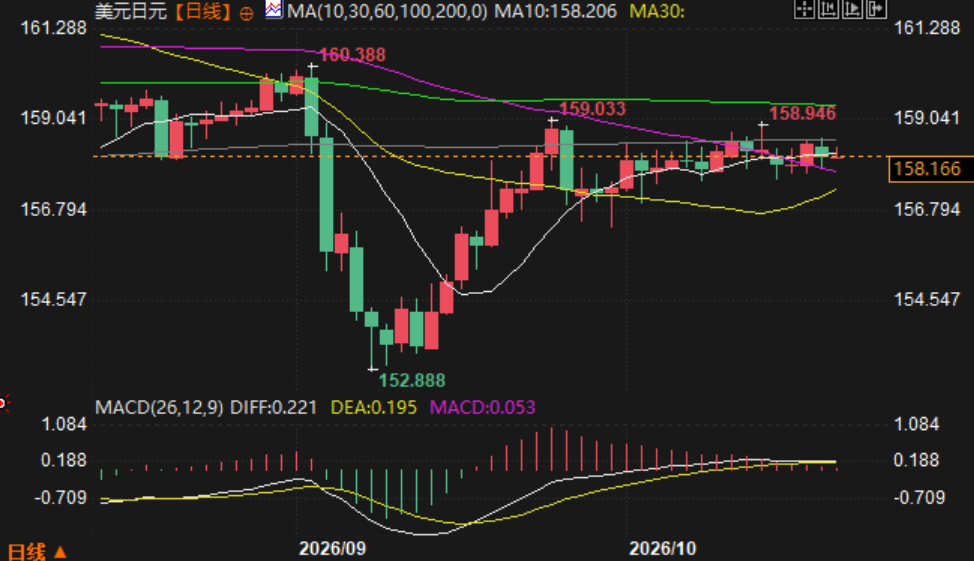 (USD/JPY daily chart, source: FX678) At 12:26 Beijing time, USD/JPY was trading at 158.12/13.
Key statement: The economy is approaching sustained wage-driven inflation.
She stated that the economy is nearing a period where wage growth supports inflation, a shift that the Bank of Japan has long described as a condition for monetary policy normalization. The key point of this statement is that Katayama characterizes current inflation as a transition from "import cost-driven" to "wage-driven" inflation. This assessment supports the rationale for further tightening, as wage-driven inflation is more sustainable and better suited to the Bank of Japan's interest rate hikes.There is no disagreement between the government and the Bank of Japan.
When asked whether tax cuts might conflict with the central bank's interest rate hikes, Katayama stated that the government and the Bank of Japan were exchanging views on multiple levels, and she believed there was no disagreement between their positions. Katayama was attempting to signal to the market that fiscal support and monetary tightening could coexist. However, this claim of "no disagreement" faces scrutiny—fiscal measures supporting household spending could increase demand when the central bank tightens, and the tension between the two has not been eliminated.Political Risk: Dissent briefly weakened the yen in September.
This Q&A reflects the tensions closely watched by the market. In September, two board members nominated by Prime Minister Sanae Takaichi's government voted against raising the interest rate to 1.25%, briefly weakening the yen. A survey released Wednesday showed that most economists expect the Bank of Japan to raise the policy rate to 1.50% in December, maintaining its quarterly rate hike pace. Nearly three-quarters of respondents said that further dissenting votes at the next rate hike could weigh on the yen, which is currently only slightly above its 2026 lows. Katayama's remarks may help reassure the market, indicating that the government is not resisting tightening, although she did not explicitly support further rate hikes.Oil prices and import costs: key drivers of inflation
Import costs, including energy prices related to the Middle East conflict, which Katayama mentioned, remain a key driver of the inflation she described. Oil prices remain a direct input variable to Japan's inflation outlook. If the situation in the Middle East pushes up oil prices, Japan's import costs will rise, and inflationary pressures will intensify, which could prompt the Bank of Japan to tighten policy more quickly, providing support for the yen.Policy Path: October 30th Meeting, December Voting – Divergence is Key
The Bank of Japan's next policy meeting will conclude on October 30, at which time it will release its latest growth and inflation forecasts. Attention will then turn to December, where voting disagreements may prove just as important as the decision itself. The key to this policy path is that the October meeting will likely remain unchanged, but may send signals through forecast adjustments; the December voting disagreements will test whether Katayama's claim of "no disagreement" holds true, and if the government-nominated board members vote against the policy again, it could trigger a new round of yen selling.Political risks have eased, but interest rate differentials and voting divisions remain key factors.
Katayama's statement that "there is no disagreement between the government and the Bank of Japan" has a marginal positive effect on the USD/JPY exchange rate. The logic is that if the market believes the government will not obstruct further interest rate hikes by the central bank, the expectation of a December rate hike to 1.50% will be solidified, and the yen's interest rate disadvantage is expected to gradually narrow. Katayama characterized the economy as approaching "wage-driven sustained inflation," a statement that supports the rationale for further tightening, thus supporting the yen and pushing up short-term Japanese government bond yields. However, the strength of this support is limited by two factors. First, Katayama did not explicitly support further rate hikes; his statement was more of a reassurance than a policy commitment. Second, surveys show that nearly three-quarters of economists believe that if the government-nominated committee members vote against the next rate hike, it could drag down the yen. This means that the December vote will test whether Katayama's claim of "no disagreement" holds true. Furthermore, the US-Japan interest rate differential remains a dominant short-term factor—the US 10-year Treasury yield remains around 5.30%, and the significant interest rate differential remains unchanged. In summary, Katayama's remarks provided marginal support for the yen, but the USD/JPY pair is likely to remain range-bound between 157 and 159 in the short term. The voting differences at the December Bank of Japan meeting and the Federal Reserve's policy path are the core variables determining the medium-term direction.Summarize
Japanese Finance Minister Katayama stated that the economy is on the verge of transitioning to sustained wage-driven inflation, and she believes there is no disagreement between the government and the Bank of Japan. This statement may help alleviate the political risks flagged in surveys—most economists warn that another dissenting vote from government-nominated board members could weigh on the yen. Katayama's description of the economy nearing wage-driven inflation supports the rationale for further tightening, which typically supports the yen and pushes up short-term Japanese government bond yields. Her mention of import-driven price increases keeps oil prices in focus, and energy costs related to the Middle East conflict are a direct driver of Japanese inflation. Tension remains between consumption tax cuts and central bank tightening, and the market may test her "no disagreement" statement with the vote at the next rate hike. The Bank of Japan will release its latest forecasts at its October 30 meeting, and the December vote could prove as significant as the decision itself. (USD/JPY daily chart, source: FX678) At 12:26 Beijing time, USD/JPY was trading at 158.12/13.
- Risk Warning and Disclaimer
- The market involves risk, and trading may not be suitable for all investors. This article is for reference only and does not constitute personal investment advice, nor does it take into account certain users’ specific investment objectives, financial situation, or other needs. Any investment decisions made based on this information are at your own risk.