What are the conditions for buying gold at the bottom when US Treasury yields fall but gold doesn't rise?
2026-10-21 18:12:21
On Tuesday, spot gold briefly dipped to around 4106, hitting a four-day low. A noteworthy divergence emerged in the precious metals market: while US Treasury yields declined marginally, gold failed to rebound as expected, indicating a temporary failure of the traditional geopolitical safe-haven narrative. Bas Kooijman, CEO of DHF Capital, commented that rising oil prices have increased inflation stickiness, strengthening expectations of hawkish monetary policy and putting continued pressure on gold prices. 
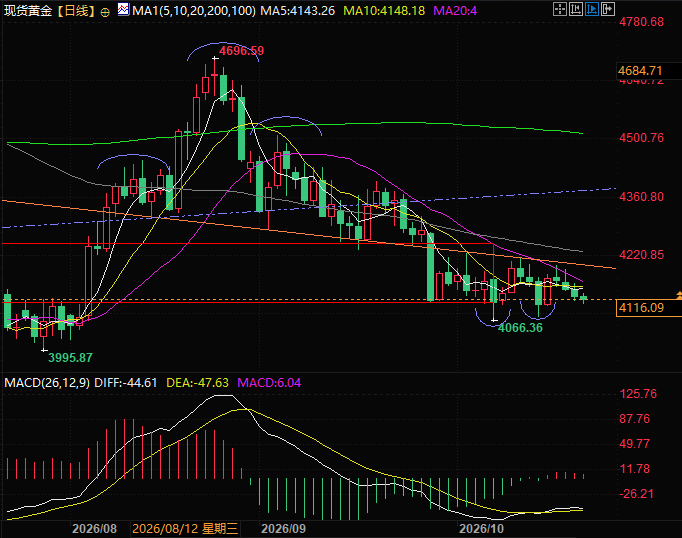 (Spot gold daily chart, source: EasyTrade) At 18:05 Beijing time, spot gold is currently trading at $4117 per ounce.
Market divergence: Interest rates are falling, but gold is struggling to strengthen.
The previous rise in gold prices was not driven by expectations of interest rate cuts, but rather by betting on the risk of dollar credit dilution due to US debt pressure and fiscal easing. Institutions point out that the previous market trend was primarily driven by hedging against a weakening dollar; however, the current demand for petrodollar settlements has increased, shifting the dollar's pricing logic, and a strong dollar is directly suppressing gold prices. The market focus has shifted. European instability, coupled with the US's continued expansion of South American oil supply, has solidified global forward demand for the dollar, keeping the dollar index resilient. ING also noted that in an environment of energy supply disruptions, the traditional logic of "geopolitical benefits for gold" is prone to failure, with the market prioritizing pricing the negative impact of high oil prices pushing up inflation and a stronger dollar.Key marginal changes: Oil control policies fell short of expectations, and refined oil inflation limited the scope for further easing.
The market had initially expected the US to use the midterm election window to introduce measures to stabilize oil prices and open up room for easing, but price stabilization policies have been slow to materialize, and the blockade of Iran has been less effective than expected. Crude oil and refined product inventories continue to weaken, and imported inflation caused by a diesel shortage has blocked the Fed's path to easing. Institutions believe that the resilience of inflation caused by the tight balance of refined products is the core constraint; persistently high inflation expectations limit a significant decline in nominal interest rates, and real interest rates are unlikely to fall significantly. CME Group's FedWatch data shows a low probability of an October rate hike, but the market is still heavily pricing in a December rate hike; Bank of Japan Governor Kazuo Ueda signaled that domestic inflation is close to the 2% target, leaving room for rate hikes, making a global monetary easing unlikely. MUFG warned that energy-driven inflation would directly negate expectations of rate cuts, making it difficult for gold to find support; CITIC Securities Futures added that this round of inflation stems from a shortage of refined products on the supply side, leaving the Fed in a dilemma and unlikely to release easing signals.Energy Reshapes Exchange Rate Landscape: Energy Dependence in Europe and Japan, Conversely Supporting the US Dollar
The value of the US dollar is deeply intertwined with energy trade. European and Japanese economies are highly dependent on crude oil imports, and high oil prices continue to erode the fundamentals of the euro and yen, passively weakening non-US currencies and indirectly supporting the dollar. Futures institutions have identified a clear transmission path: rising oil prices support the dollar through two paths: firstly, by pushing up inflation and extending the high-interest-rate cycle; and secondly, by creating sustained demand for dollar reserves through global crude oil trade. This forms a complete negative feedback loop: Straits risk pushes up oil prices → pent-up demand for oil boosts the dollar → a strong dollar raises the holding cost of interest-free gold, continuously suppressing gold prices. Foreign exchange investment researchers point out that the current market is not trading on safe havens, but rather on the bearish theme of "high oil prices → high inflation → strong dollar." In other words, increased uncertainty in Middle Eastern supply is gradually shifting the market's supply anchor to US shale oil and South American production areas; global crude oil trade is increasingly reliant on US supply, and crude oil trade, capital expenditure, and long-term contract settlements remain primarily in US dollars. The underlying link of the petrodollar has changed, but the bond has actually strengthened.Underlying constraints on gold prices: A breakout in gold prices requires a cooling of energy inflation.
A decline in interest rates alone is insufficient to drive a trend in gold prices. As long as the US-Iran tensions persist, the shipping risks in the Strait of Hormuz remain, and the tight balance in refined oil prices continues, energy inflation will continue to constrain the Federal Reserve's policy space. Against this backdrop, gold prices will struggle to escape the dual constraints of the dollar and real interest rate expectations, and the traditional safe-haven logic is unlikely to return in the short term. In other words, gold prices must first fall to absorb the previous bets on a weaker dollar and the portion related to the US debt crisis before they can return to the stage of betting on US Treasury yields. The World Gold Council advises that a new trend in gold prices hinges on easing energy supply risks and a decline in inflation expectations; a slight decrease in interest rates alone cannot constitute a reversal signal. In terms of trading, key factors to monitor include the progress of Middle East negotiations, diesel crack prices, the release of European diesel reserves, and the Russia-Ukraine conflict. Technically, the 5-day moving average for spot gold turned upwards today, presenting a good rebound opportunity. If gold prices do not rebound during the New York session, the 5-day moving average will likely turn sharply downwards tomorrow after deducting the candlestick pattern, exerting significant downward pressure on gold prices. (Spot gold daily chart, source: EasyTrade) At 18:05 Beijing time, spot gold is currently trading at $4117 per ounce.
- Risk Warning and Disclaimer
- The market involves risk, and trading may not be suitable for all investors. This article is for reference only and does not constitute personal investment advice, nor does it take into account certain users’ specific investment objectives, financial situation, or other needs. Any investment decisions made based on this information are at your own risk.