Why should the New Zealand dollar's support depend on next week's guidance, given that inflation data fell short of expectations?
2026-10-22 07:52:21
The New Zealand dollar traded in a narrow range against the US dollar during Asian trading hours on Thursday (October 22), currently hovering around 0.5700. While New Zealand's third-quarter inflation data was slightly below expectations, it failed to shake market expectations that the Reserve Bank of New Zealand (RBNZ) would raise interest rates next week. Official data released on Thursday showed that New Zealand's annual inflation slowed to 3.7% in the third quarter, lower than economists' expectations, but still above the upper limit of the RBNZ's target range. This result did little to change market expectations for a rate hike by the RBNZ next week. 
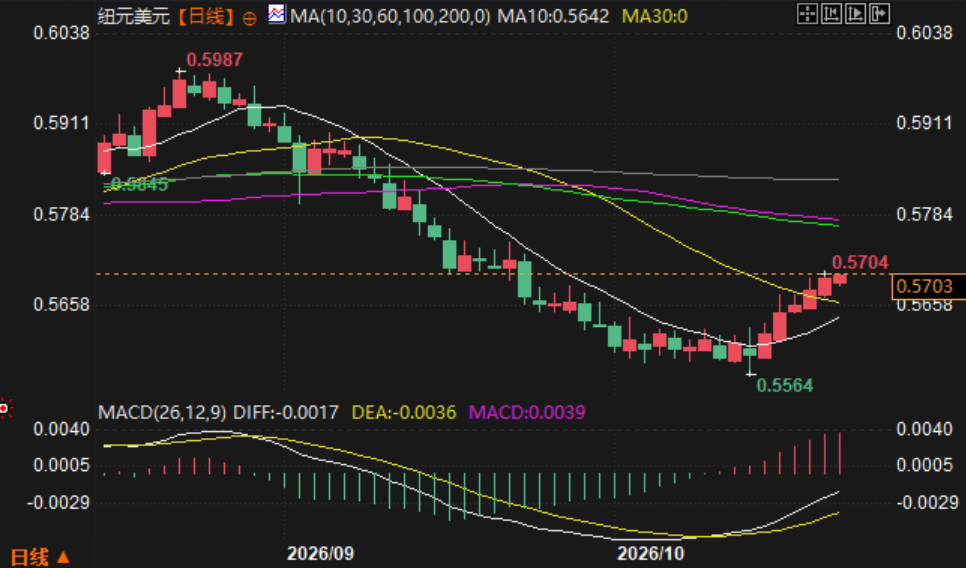 (NZD/USD daily chart, source: EasyForex) At 7:45 Beijing time, the NZD/USD exchange rate was 0.5702/03.
Key data: Annual inflation was 3.7%, lower than expected but still above the target range.
New Zealand's annual inflation slowed to 3.7% in the third quarter, below economists' expectations of 3.8% and the Reserve Bank of New Zealand's own forecast of 3.9%, but still above the upper limit of the central bank's 1% to 3% target range. Quarterly CPI rose 0.7% quarter-on-quarter, lower than the expected 0.8%. The slower-than-expected slowdown in inflation, remaining outside the target range, provides justification for the Reserve Bank of New Zealand to maintain a tightening stance. Petrol prices were the biggest contributor to inflation, although they had fallen since the second quarter; housing construction costs also rose.Market pricing: 98% probability of a rate hike next week, accumulating to 50 basis points by the end of February.
The New Zealand dollar dipped slightly after the data release before rebounding, as the market continued to price in a 98% probability of a rate hike during next week's monetary policy assessment, and fully priced in a cumulative tightening of 50 basis points by the end of February. The Reserve Bank of New Zealand has already raised the official cash rate twice this year to 2.75%. The slightly weaker-than-expected inflation data was insufficient to change the policy outlook, and the market still considers a rate hike next week almost certain.Core inflation remains firm: policymakers still have reason to worry.
Westpac New Zealand senior economist Satish Ranchode said that although the results were below the Reserve Bank of New Zealand's forecast, strong core inflation will give policymakers pause for thought. He stated that a rate hike next week now appears to be the least resisted path, with market pricing and economists' views converging. The key point of this statement is that while overall inflation data was lower than expected, strong core inflation means policymakers still have reason to maintain tightening. A rate hike next week has become the market consensus, and the slightly weaker-than-expected inflation data has not changed this consensus.Oil prices are a key oscillating factor: Middle East conflicts drive up fuel, fertilizer, and transportation costs.
Economists expect inflation to rise again in the fourth quarter due to renewed increases in fuel prices. The ASB forecasts inflation to reach 4.5% by year-end and says its 2027 inflation profile looks significantly stronger than the Reserve Bank of New Zealand's September forecast. The Middle East conflict is exacerbating global stagflation risks by disrupting energy supplies and shipping, pushing up fuel, fertilizer, and transportation costs. Oil prices are a key swing factor in New Zealand's inflation outlook. Gasoline is already the largest contributor to inflation, and further increases in crude oil prices will directly translate into an expected fourth-quarter inflation rebound, tilting the risks toward a longer period of tightening.Political Context: Inflation becomes a core issue in the November 7th election.
This data is the last major economic report before the Reserve Bank of New Zealand's decision-making process. Its release comes as inflation becomes a central issue ahead of the fiercely contested November 7th election. Inflation data not only affects monetary policy but could also influence the election outcome. If inflation remains above the target range, the ruling party may face pressure, while the opposition could use this issue to garner voter support.Summarize
New Zealand's annual inflation slowed to 3.7% in the third quarter, below economists' expectations of 3.8% and the Reserve Bank of New Zealand's own forecast of 3.9%, but still above the target range of 1% to 3%. Quarterly CPI rose 0.7% quarter-on-quarter, below the expected 0.8%. Petrol prices were the biggest contributor to inflation, while housing construction costs also increased. The market continues to price in a 98% probability of a rate hike next week and fully prices in a cumulative 50 basis point tightening by the end of February. Strong core inflation gives policymakers reason to remain concerned, and a rate hike next week appears to be the least obstructed path. Oil prices are a key swing factor, with the Middle East conflict pushing up fuel, fertilizer, and transportation costs. The ASB predicts inflation will reach 4.5% by year-end. This data is the last major economic report before the Reserve Bank of New Zealand's decision, and inflation is becoming a central issue in the November 7th general election. Support for the New Zealand dollar will depend on the hawkishness of the Reserve Bank of New Zealand's guidance next week, rather than today's data. (NZD/USD daily chart, source: EasyForex) At 7:45 Beijing time, the NZD/USD exchange rate was 0.5702/03.
- Risk Warning and Disclaimer
- The market involves risk, and trading may not be suitable for all investors. This article is for reference only and does not constitute personal investment advice, nor does it take into account certain users’ specific investment objectives, financial situation, or other needs. Any investment decisions made based on this information are at your own risk.