Crude oil trading alert: Supply-side concerns support oil prices; US crude oil remains volatile at high levels.
2026-10-22 09:44:22
On Thursday during Asian trading hours, WTI crude oil rebounded after three consecutive days of decline, trading around $97.70 per barrel, while Brent crude oil remained near the $110 mark. The direct trigger for this round of gains was the renewed escalation of geopolitical conflicts, but hedging signals released from the supply side simultaneously resulted in a tug-of-war pattern in oil prices, where they "can fall but cannot rise."  The attacks have once again brought the fragility of the Middle East's energy supply chain to the forefront. Houthi rebels launched an attack on Saudi Aramco's Shaybaek oil field. In response, the United States ordered the evacuation of some personnel and their families from its embassies and consulates in Saudi Arabia—a move often interpreted by the market as a signal of an upgraded security risk assessment, its symbolic significance outweighing its actual supply impact. Meanwhile, Ukraine launched a large-scale attack this week on key Russian oil infrastructure, a move clearly aimed at disrupting Moscow's ability to expand diesel exports under the recently reached agreement. This simultaneous pressure from two fronts makes it difficult for the risk premium in the global crude oil market to systematically recede in the short term. As market analysts have pointed out, "the end of the full Pax Americana signals more instability in the Middle East," a judgment that reinforces expectations that geopolitical risk premiums will persist longer in oil and gas assets. However, supply-side data is offsetting these concerns. Export flows from the Middle East are approaching pre-war levels, with Saudi Arabia's crude oil exports increasing by 7.9% month-on-month in August, the highest level since March; furthermore, Russia is expected to ship its first diesel cargo to the United States on Thursday, meaning a further increase in global market supply. This pattern of "escalating conflict and restored flow" constitutes the core pricing contradiction in current oil prices: the attack brings a pulse-like premium, while export data reflects structural supply capacity. Historically, only when actual shipments experience a sustained disruption will the premium transform into a trend of increase; before that, any surge triggered by news of a single attack is more likely to encounter profit-taking by hedging and speculative long positions. Macroeconomic and cross-asset levels are also releasing two-way signals. Bond yields rose slightly, while risk assets continued their recovery; the European situation is particularly noteworthy, with the premium of French 10-year bonds relative to German bonds approaching a 24-year high. In the currency market, the dollar index is showing mixed signals above yesterday's low, with interest rate differentials still providing support for the currency. The combination of rising yields and stock market recovery suggests that risk appetite has not contracted across the board, which to some extent weakens the safe-haven buying momentum for crude oil; however, the support of interest rate differentials for the dollar is putting downward pressure on oil prices through pricing channels. For crude oil, this environment of "demand expectations not collapsing, but pricing not aligned" suggests that oil prices are more likely to absorb geopolitical premiums through range-bound fluctuations rather than experiencing a smooth, one-sided rise. From a global market perspective, the current high-level fluctuations in oil prices are spilling over to other assets through cost channels. Persistently high energy prices will directly push up inflation readings in various countries, strengthening the rationale for central banks to maintain high interest rates, thereby suppressing the valuations of precious metals and growth stocks through the real interest rate channel. Simultaneously, rising freight and insurance costs caused by shipping disruptions will exacerbate global trade concerns. Therefore, crude oil is no longer just a single commodity, but a key starting point in this round of macroeconomic pricing chains, and its increased volatility will inevitably lead to a synchronous increase in cross-asset correlations. When assessing oil prices, investors need to pay attention to its feedback effects on inflation paths and risk appetite, rather than viewing geopolitical events in isolation. On the daily chart, WTI crude oil rebounded from its three-day low and has climbed back above the 20-day exponential moving average. Short-term moving averages are flattening and converging, indicating that the previous pullback structure has not yet evolved into a trend reversal. The RSI is around 52, back above the 50 neutral line and not yet in overbought territory, showing a moderate release of upward momentum, a typical "stabilizing and awaiting direction" pattern. Resistance levels to watch are $98.80, $99.50, and the psychological level of $100. $100 is both a psychological level and a previous area of dense trading; only a decisive break above this level on the daily chart can confirm the opening of medium-term upside potential. Support levels to watch are first the previous support at $96.70, followed by $95.80 and $95.00. $96.70 is a key support level in the near term; a break below this level could lead to a pullback to $95 or even lower. On the 4-hour chart, oil prices rebounded from around $96.50 and then slowly moved upwards along the short-term moving average. The MACD histogram is expanding above the zero line, and the fast and slow lines are diverging upwards, indicating that the bulls are in control in the short term. Currently, the price is consolidating in a narrow range between $97.30 and $98.20. If it retraces to $97.20-$97.50 and finds support, there is still a chance to retest the resistance zone of $98.80-$99.50. If it breaks below $97 with significant volume, it may seek support at $96.70 or even $95.80. An upward breakout requires the coordination of the recovery progress of the Shebay oil field and the frequency of attacks on Russian and Ukrainian energy facilities. Until then, it is advisable to treat the price within a range and avoid chasing highs and lows.
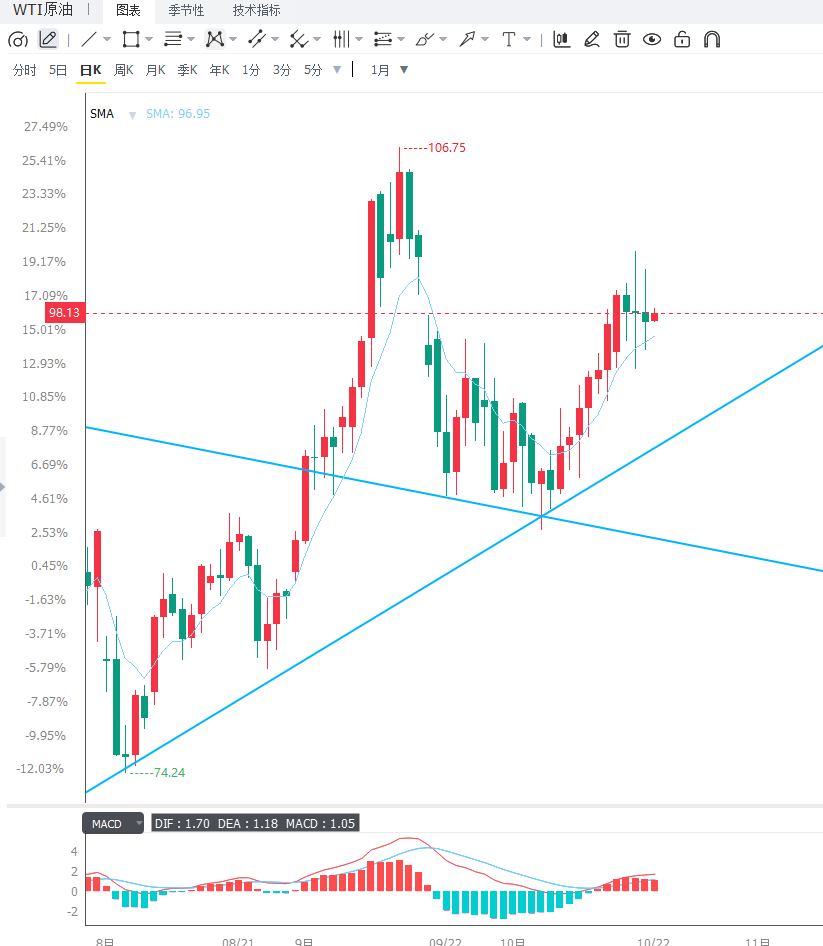 Editor's Summary: The core contradiction in the short term for crude oil lies in the impulsive premium provided by geopolitical attacks, while the recovery of Middle Eastern exports and increased Russian diesel cargoes constitute a substantial supply offset. The resonance of these two factors suggests that oil prices are more likely to fluctuate repeatedly within the $96.70-$99.50 range. Going forward, three variables need to be closely monitored: first, the extent of damage to the Shebay oil field and the progress of its recovery, which directly determines whether the attack is a temporary disruption or a substantial production reduction; second, the navigation conditions in the Strait of Hormuz and the frequency of Ukrainian attacks on Russian energy facilities, which are key to whether the risk premium can be sustained; and third, whether Saudi Arabian and Russian export data can continue to improve, which is the core evidence to verify whether it is "expectation-driven" or "substantial shortage." In the medium term, before a valid breakout from the range, oil prices will maintain a high-level oscillating pattern. Confirmation of the trend direction still requires the final clarification of the geopolitical situation and global demand expectations.
The attacks have once again brought the fragility of the Middle East's energy supply chain to the forefront. Houthi rebels launched an attack on Saudi Aramco's Shaybaek oil field. In response, the United States ordered the evacuation of some personnel and their families from its embassies and consulates in Saudi Arabia—a move often interpreted by the market as a signal of an upgraded security risk assessment, its symbolic significance outweighing its actual supply impact. Meanwhile, Ukraine launched a large-scale attack this week on key Russian oil infrastructure, a move clearly aimed at disrupting Moscow's ability to expand diesel exports under the recently reached agreement. This simultaneous pressure from two fronts makes it difficult for the risk premium in the global crude oil market to systematically recede in the short term. As market analysts have pointed out, "the end of the full Pax Americana signals more instability in the Middle East," a judgment that reinforces expectations that geopolitical risk premiums will persist longer in oil and gas assets. However, supply-side data is offsetting these concerns. Export flows from the Middle East are approaching pre-war levels, with Saudi Arabia's crude oil exports increasing by 7.9% month-on-month in August, the highest level since March; furthermore, Russia is expected to ship its first diesel cargo to the United States on Thursday, meaning a further increase in global market supply. This pattern of "escalating conflict and restored flow" constitutes the core pricing contradiction in current oil prices: the attack brings a pulse-like premium, while export data reflects structural supply capacity. Historically, only when actual shipments experience a sustained disruption will the premium transform into a trend of increase; before that, any surge triggered by news of a single attack is more likely to encounter profit-taking by hedging and speculative long positions. Macroeconomic and cross-asset levels are also releasing two-way signals. Bond yields rose slightly, while risk assets continued their recovery; the European situation is particularly noteworthy, with the premium of French 10-year bonds relative to German bonds approaching a 24-year high. In the currency market, the dollar index is showing mixed signals above yesterday's low, with interest rate differentials still providing support for the currency. The combination of rising yields and stock market recovery suggests that risk appetite has not contracted across the board, which to some extent weakens the safe-haven buying momentum for crude oil; however, the support of interest rate differentials for the dollar is putting downward pressure on oil prices through pricing channels. For crude oil, this environment of "demand expectations not collapsing, but pricing not aligned" suggests that oil prices are more likely to absorb geopolitical premiums through range-bound fluctuations rather than experiencing a smooth, one-sided rise. From a global market perspective, the current high-level fluctuations in oil prices are spilling over to other assets through cost channels. Persistently high energy prices will directly push up inflation readings in various countries, strengthening the rationale for central banks to maintain high interest rates, thereby suppressing the valuations of precious metals and growth stocks through the real interest rate channel. Simultaneously, rising freight and insurance costs caused by shipping disruptions will exacerbate global trade concerns. Therefore, crude oil is no longer just a single commodity, but a key starting point in this round of macroeconomic pricing chains, and its increased volatility will inevitably lead to a synchronous increase in cross-asset correlations. When assessing oil prices, investors need to pay attention to its feedback effects on inflation paths and risk appetite, rather than viewing geopolitical events in isolation. On the daily chart, WTI crude oil rebounded from its three-day low and has climbed back above the 20-day exponential moving average. Short-term moving averages are flattening and converging, indicating that the previous pullback structure has not yet evolved into a trend reversal. The RSI is around 52, back above the 50 neutral line and not yet in overbought territory, showing a moderate release of upward momentum, a typical "stabilizing and awaiting direction" pattern. Resistance levels to watch are $98.80, $99.50, and the psychological level of $100. $100 is both a psychological level and a previous area of dense trading; only a decisive break above this level on the daily chart can confirm the opening of medium-term upside potential. Support levels to watch are first the previous support at $96.70, followed by $95.80 and $95.00. $96.70 is a key support level in the near term; a break below this level could lead to a pullback to $95 or even lower. On the 4-hour chart, oil prices rebounded from around $96.50 and then slowly moved upwards along the short-term moving average. The MACD histogram is expanding above the zero line, and the fast and slow lines are diverging upwards, indicating that the bulls are in control in the short term. Currently, the price is consolidating in a narrow range between $97.30 and $98.20. If it retraces to $97.20-$97.50 and finds support, there is still a chance to retest the resistance zone of $98.80-$99.50. If it breaks below $97 with significant volume, it may seek support at $96.70 or even $95.80. An upward breakout requires the coordination of the recovery progress of the Shebay oil field and the frequency of attacks on Russian and Ukrainian energy facilities. Until then, it is advisable to treat the price within a range and avoid chasing highs and lows. Editor's Summary: The core contradiction in the short term for crude oil lies in the impulsive premium provided by geopolitical attacks, while the recovery of Middle Eastern exports and increased Russian diesel cargoes constitute a substantial supply offset. The resonance of these two factors suggests that oil prices are more likely to fluctuate repeatedly within the $96.70-$99.50 range. Going forward, three variables need to be closely monitored: first, the extent of damage to the Shebay oil field and the progress of its recovery, which directly determines whether the attack is a temporary disruption or a substantial production reduction; second, the navigation conditions in the Strait of Hormuz and the frequency of Ukrainian attacks on Russian energy facilities, which are key to whether the risk premium can be sustained; and third, whether Saudi Arabian and Russian export data can continue to improve, which is the core evidence to verify whether it is "expectation-driven" or "substantial shortage." In the medium term, before a valid breakout from the range, oil prices will maintain a high-level oscillating pattern. Confirmation of the trend direction still requires the final clarification of the geopolitical situation and global demand expectations.- Risk Warning and Disclaimer
- The market involves risk, and trading may not be suitable for all investors. This article is for reference only and does not constitute personal investment advice, nor does it take into account certain users’ specific investment objectives, financial situation, or other needs. Any investment decisions made based on this information are at your own risk.