Gold Trading Alert: Gold Prices stage a dramatic rebound! With the Fed's interest rate hike looming large, how many cards do the bulls have left?
2026-10-22 08:00:21
The gold market is currently in a classic tug-of-war between bulls and bears. On one hand, the decline in US Treasury yields has lowered the opportunity cost of holding gold, a non-interest-bearing asset, providing a short-term rebound for gold prices. On the other hand, high expectations for a December rate hike by the Federal Reserve, a weak dollar, rotation of funds in risk assets, and sporadic geopolitical disturbances are all suppressing the upside potential of gold. On Wednesday (October 21), spot gold rebounded from a near one-week low of $4,104.85 per ounce, closing at $4,141.10 per ounce, up 0.39%, while US gold futures for December delivery closed at $4,150 per ounce, up 0.2%. However, in early Asian trading on Thursday (October 22), spot gold weakened again, giving back Wednesday's gains and trading around $4,125 per ounce, down about 0.4%. This rise and fall perfectly reflects the market's cautious sentiment ahead of the Fed's decision. 
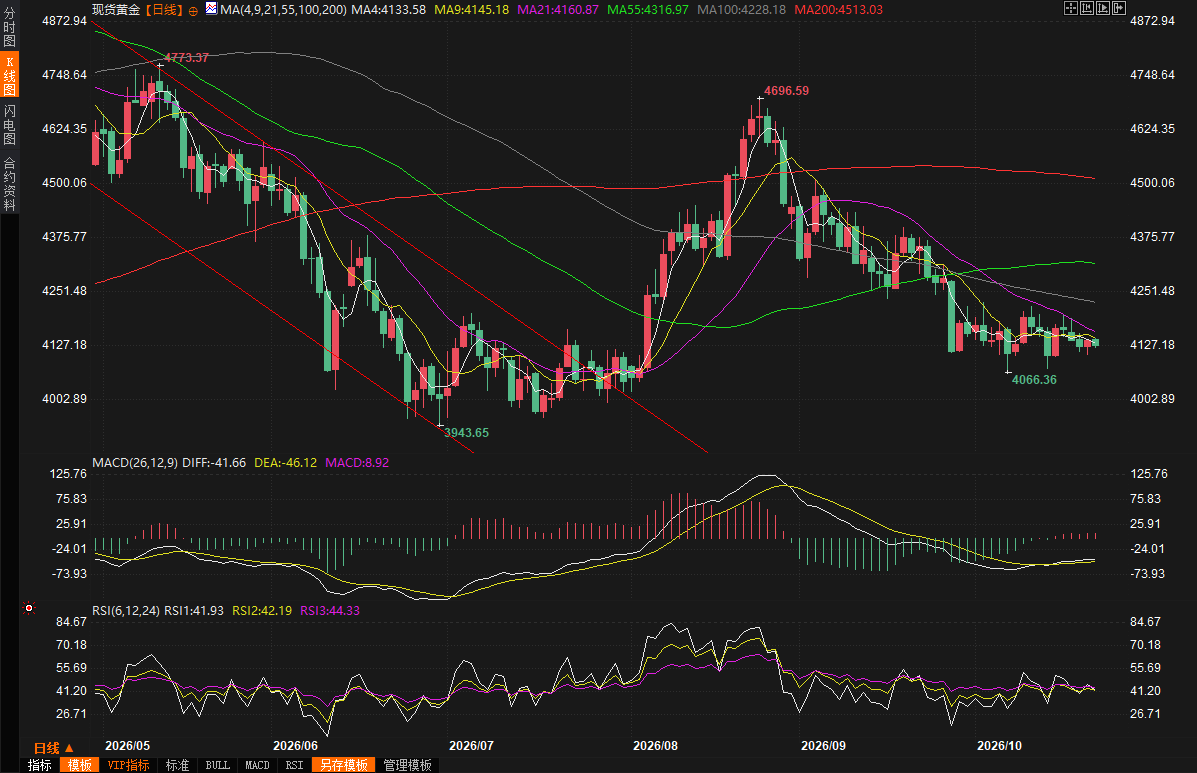 (Spot gold daily chart, source: FX678) At 07:56 Beijing time, spot gold is currently trading at $4125.85 per ounce.
Gold prices rebounded, barely holding above the $4,100 mark.
From a technical perspective, Wednesday's gold price movement was quite dramatic. Spot gold briefly touched $4104.85 per ounce, its lowest point since October 15th, just shy of the psychologically important $4100 mark. Subsequently, gold prices found support and rebounded, ultimately closing at $4141.10 per ounce, a gain of 0.39%. US gold futures also closed slightly higher, with the December contract rising 0.2% to $4150 per ounce. This rebound indicates that after continuous adjustments, the market is unwilling to overly bet on a one-sided decline before the Fed meeting, with some short sellers choosing to take profits, and short-term buying taking advantage of the decline in US Treasury yields. However, the rebound was not sustained. Gold prices gave back Wednesday's gains in early Asian trading on Thursday, indicating that bullish sentiment remains fragile, and the market prefers to remain cautious ahead of key data and policy meetings. Therefore, the $4100 level has become an important psychological level to watch in the short term, while the $4150 level serves as a near-term upside reference.Falling Treasury yields: a short-term lifeline for gold.
Gold's rebound from its lows on Wednesday was primarily driven by lower U.S. Treasury yields. The yield on the 10-year U.S. Treasury note fell for the second consecutive trading day, dropping 0.6 basis points to 5.111% on Wednesday, after hitting a low of 5.081% during the session. The yield on the 30-year Treasury note fell 1.3 basis points to 5.412%. Last week, the 10-year Treasury yield fell 14.6 basis points in a single week, marking its largest weekly drop in eight months, indicating that market concerns about rising financing costs for AI-related stocks had dampened risk appetite, leading to a shift of funds towards U.S. Treasuries as a safe haven, thus lowering yields. For gold, lower nominal yields mean a lower opportunity cost of holding non-interest-bearing assets, naturally increasing its attractiveness. However, the situation within the bond market is not entirely positive. Following the auction of $13 billion in 20-year Treasury bonds, yields rebounded from intraday lows. Analysts considered the results mixed; the winning yield of 5.469% was higher than pre-auction market expectations, but the bid-to-cover ratio of 2.73 was above average. On Thursday, the U.S. Treasury will also auction $26 billion in five-year Treasury Inflation-Protected Securities (TIPS), and the increased supply of Treasury bonds could again disrupt the yield curve. More noteworthy is the latest breakeven inflation rate for five-year TIPS at 2.41%, compared to 2.399% on Tuesday, the highest closing level in five weeks; the latest breakeven yield for 10-year TIPS was 2.365%, indicating that the market expects an average inflation rate of approximately 2.4% over the next 10 years. Rising inflation expectations mean that even if nominal yields decline in the short term, real interest rates may remain relatively high, which is not a long-term reliable bullish factor for gold.On the eve of the Fed decision: Rate hike expectations are the biggest drag.
The Federal Reserve remains the true driving force behind medium-term sentiment in the gold market. Investors are closely watching the policy meeting on October 27-28 and next week's US Personal Consumption Expenditures (PCE) report for clues about future interest rate trends. Peter Grant, Vice President and Senior Precious Metals Strategist at Zaner Metals, stated that the market currently expects a 25 basis point rate hike this year, but it may not be implemented until December, and the probability of an October rate hike has significantly decreased. He believes that gold prices will remain range-bound in the short term, but the overall trend is still biased towards the downside. According to the CME FedWatch tool, the market currently rates a 90% probability of a Fed rate hike in December. Almost all economists expect the Fed to keep interest rates unchanged this month and raise rates in December, as policymakers have chosen to remain patient despite persistently high inflation—which should normally prompt policymakers to take a tougher stance. Bond market data also confirms this shift in expectations: the market expects a 14.9% probability of a 25 basis point rate hike at the Fed's October 28 meeting, down from 33.2% a week ago and far below 57.6% a month ago. The yield on the two-year U.S. Treasury note, most closely correlated with Federal Reserve interest rate expectations, rose slightly by 0.2 basis points to 4.789%. This means the market has almost accepted the scenario of "no rate hike in October, but a possible rate hike in December." For gold, the lack of a rate hike in October provides a short-term respite, but the 90% probability of a rate hike in December hangs like a sword of Damocles, limiting the potential for a gold price rebound. Fed Chairman Warsh is also unlikely to provide clear signals on future policy directions; the market can only look for clues in the meeting's wording and PCE data. This uncertainty itself will deter gold bulls from launching a major offensive.The US Dollar and Capital Rotation: A "Musical Chairs" Game Within Safe-Haven Assets
The dollar's performance is also noteworthy. On Wednesday, the dollar index hovered near a three-week low, ultimately falling 0.01% to 101.69, while the euro rose 0.01% to $1.1237. The dollar's lack of significant strength should theoretically provide some support for gold, but the limited rebound in gold prices suggests that current funds are not simply flowing into gold, but rather rotating rapidly between different assets. Bill Northey, senior investment director at Bank of America Wealth Management, pointed out that the capital markets are currently experiencing very clear fund rotation, with investors constantly switching between risky and safe-haven assets. When the stock market declines, funds tend to flow into the US Treasury market, and when the stock market strengthens, funds flow out of the Treasury market. The 10-year US Treasury yield, around 5.1%, has begun to compete with the continuously strengthening stock market for funds, and attractive alternatives can be found in the fixed-income market and even in spread products other than US Treasuries. Meanwhile, the AI boom continues to attract funds to the US, boosting economic growth and inflation expectations, thus providing long-term support for the dollar. Noah Buffam, a foreign exchange strategist at CIBC Capital Markets, stated that US economic growth has been largely driven by the entire AI sector, keeping US inflation consistently above target levels and having a far greater impact on the US economy than on other countries. US stocks rose on Wednesday, with the Nasdaq index gaining over 1%, partly boosted by a roughly 7% surge in SpaceX shares. The company's quarterly results eased some market concerns about the AI sector; AI server maker AMD also predicted its quarterly revenue and profit margins would exceed Wall Street expectations. The recovery in risk appetite will weaken gold's safe-haven appeal, while the still attractive yields on US Treasury bonds mean that gold does not have a clear advantage in the "internal competition among safe-haven assets." Shaun Osborne, chief foreign exchange strategist at Scotiabank, said that the market currently lacks a dominant theme, a situation that will likely continue at least until next week's FOMC meeting, as the market needs to understand the Fed's thinking. This lack of a dominant theme is precisely the breeding ground for short-term range-bound trading in gold.Geopolitical Risk: A Double-Edged Sword of Safe-Haven Pulses and Inflation Transmission
Geopolitically, the materials indicate numerous risks. On November 21, the U.S. Treasury Department issued a notice adding several individuals and entities to its "Specially Designated Nationals List" for allegedly helping to conceal and transport Iranian commodities. The sanctions target a law firm operating in Panama and Greece, three shipping or shipping agency companies located in Panama, Singapore, and the UAE, as well as nine vessels flying Panamanian and UAE flags and five related individuals. The Treasury Department also issued two general authorizations, requiring the relevant transactions to be completed by November 20 (Eastern Time). The U.S. previously launched a new round of sanctions against Iran on August 24, expanding the scope of economic sanctions to five sectors: aviation, digital assets, gold, shipping, and technology. On the Israeli front, according to Israel's Channel 12 television, dozens of Israeli fighter jets and aerial refueling tankers flew over Syrian and Iraqi airspace earlier this week, approaching the Iranian border before turning back. The operation occurred between the evening of the 19th and the early morning of the 20th. The Israeli warplanes flew in formations and along routes similar to those used in attacks against Iran. Israel informed the United States beforehand and described the operation as an exercise aimed at deterring Iran and demonstrating military capabilities. Tensions between Israel and Iran continue to escalate. With only six days left until Israel's parliamentary elections on October 27th, Netanyahu has stated that only the overthrow of the Iranian regime can completely eliminate the so-called Iranian threat to Israel. The US mission in Saudi Arabia also issued a security alert, stating that the Houthi rebels in Yemen continue to carry out hostile actions against Saudi Arabia, attacking civilian airports and other critical infrastructure. These hostile actions could escalate rapidly and spread. Regarding Russia and Ukraine, Russia has stated its readiness to restart trilateral talks between Russia, the US, and Ukraine in November. Zelenskyy supports the early start of a new round of trilateral talks. Trump stated that the end of the Russia-Ukraine conflict has never been "closer," but analysts believe that the US envoy's mediation is largely exploratory and that formal peace talks are still some distance away. These geopolitical risks typically generate a safe-haven premium for gold, but the current market pricing is still primarily driven by interest rate paths. More subtly, the escalating conflict between the US and Iran has heightened market concerns that rising oil prices could drive up inflation and impact Federal Reserve policy. Rising oil prices, transmitted through inflation expectations, may strengthen rather than weaken expectations of interest rate hikes, thus indirectly suppressing gold prices. Sanctions affect the gold industry and could impact regional trade flows and sentiment, but the data does not provide quantifiable supply and demand shocks. Therefore, it's inappropriate to exaggerate geopolitical factors as a trend-driven bullish factor; a more reasonable interpretation is a pulse-like safe-haven disturbance.Market Outlook: With interest rates as the anchor and geopolitics as the impetus, gold is still searching for direction in a precarious situation.
In conclusion, gold is not currently lacking in compelling narratives, but rather these narratives are intertwined and mutually constraining. The decline in US Treasury yields serves as a short-term support level, with the recovery of the $4100 level indicating some support below. However, the high probability of a December rate hike (90%), the likelihood of the Fed holding rates steady this month while retaining the possibility of action in December, and the upcoming PCE report are all preventing bulls from aggressively chasing higher prices. The US dollar index has hovered near three-week lows without providing a strong rally for gold, suggesting that funds are more inclined to rotate rapidly between US Treasuries, stocks, and gold. Geopolitical risks, from Iranian sanctions and tensions between Iran and Israel to the Houthi attacks on Saudi Arabia, could indeed ignite safe-haven demand at any time. However, the inflationary transmission from rising oil prices could strengthen expectations of rate hikes, creating a complex situation for gold where "safe-haven demand is bullish" and "interest rate is bearish" coexist. Peter Grant's assessment is quite representative: gold prices will maintain range-bound trading in the short term, but the overall trend remains downward. Spot gold gave back Wednesday's gains in early Asian trading on Thursday, trading around $4125 per ounce, already reflecting market apprehension about a December rate hike. Going forward, the FOMC meeting's wording, US PCE data, whether US Treasury yields can continue to decline, whether the dollar index will fall below its near three-week low, whether there will be a breakthrough in the Russia-Ukraine peace talks, and whether the situation in the Middle East will escalate substantially, will all determine whether gold holds the support around $4100 and tests $4150, or whether it will come under renewed pressure due to rate hike expectations. For gold bulls, they do have some options, but right now every move depends on the Fed's stance; for bears, geopolitical risks and declining yields are equally important to consider. (Spot gold daily chart, source: FX678) At 07:56 Beijing time, spot gold is currently trading at $4125.85 per ounce.
- Risk Warning and Disclaimer
- The market involves risk, and trading may not be suitable for all investors. This article is for reference only and does not constitute personal investment advice, nor does it take into account certain users’ specific investment objectives, financial situation, or other needs. Any investment decisions made based on this information are at your own risk.