Gold prices consolidated weakly at the lower edge of their trading range, pressured by both expectations of a Fed rate hike and high oil prices.
2026-10-22 10:28:27
On Thursday morning in Asia, spot gold traded in a narrow range around $4,115 per ounce, continuing the weakness from the previous day. The core contradiction in gold prices at present lies in the offsetting effect between safe-haven demand from geopolitical conflicts and opportunity cost pressures under a high-interest-rate environment. This makes it difficult for precious metals to fall sharply or form a smooth rebound, exhibiting a typical tug-of-war pattern with a "ceiling" and a "floor".  Geopolitical risk premiums continue to accumulate. Iranian Foreign Minister Araqchi stated on Wednesday that while Iran remains firmly committed to seeking a dignified and peaceful solution, it is also fully prepared for self-defense. President Peschizian pointed out that the US should not expect dialogue with Iran while imposing blockades and threats. These statements extend the potential disruption risk from a single choke point to the entire Eurasian energy and shipping corridor, escalating market concerns about the logistics chain. However, this risk aversion is weakening the actual boost to gold prices from another logic: high oil prices have pushed up US inflation readings through cost channels, thus reinforcing the rationale for the Federal Reserve to further adjust monetary policy to curb price pressures. When inflation is driven by supply shocks, gold's anti-inflation narrative is often suppressed by tightening expectations, which is the fundamental reason why gold prices have weakened despite geopolitical tensions. At the monetary policy level, market pricing is undergoing a subtle shift. Federal Reserve Chairman Warsh avoided signaling the outcome of this month's policy meeting last week, but emphasized that higher-than-expected inflation has not changed his assessment of the US economy. According to the CME FedWatch tool, the probability of keeping interest rates unchanged at the October meeting is currently around 84%. While a rate hold next week is widely expected, the market is still pricing in another rate hike in December, keeping the policy outlook skewed towards tightening. Higher interest rates typically put downward pressure on gold, as precious metals do not pay interest, increasing their relative attractiveness as interest-bearing assets. Furthermore, high energy costs increase the likelihood that the Federal Reserve will need to further adjust its policy to control price pressures. For gold, this is a combination of "lack of dovish catalysts in the short term and unresolved interest rate pressures in the medium term": as long as the year-end tightening path is not disproven, every rebound in gold prices is likely to be met with profit-taking. Cross-asset correlations also release two-way signals. European risk assets fell due to political turmoil in France, while US Treasury yields rose due to reduced safe-haven demand; against this backdrop, the dollar strengthened slightly, and commodity prices weakened in tandem. This combination indicates that risk appetite has not contracted across the board, which to some extent weakens the safe-haven buying momentum for gold; while the interest rate differential's support for the dollar exerts additional downward pressure on gold prices through pricing channels. For gold, this is an environment where "safe-haven demand hasn't collapsed, but pricing isn't cooperating," meaning gold prices are more likely to digest geopolitical premiums through range-bound trading rather than a smooth, one-sided rise. Warsh's recent speeches scored 5.6/10, slightly below the historical average of 6.1/10, indicating a more moderate communication style than usual, but the overall tone remains constructive. He acknowledged that he was "deeply traumatized by the global financial crisis," highlighting a cautious approach to financial stability while emphasizing structural growth, surging investment, and artificial intelligence as short-term demand-side drivers and tools to strengthen confidence in data and monetary policy; meanwhile, he declined to predict decisions in October and December. The FXS Fed Sentiment Index remained unchanged at a high of 127.51, well above the neutral benchmark. This means that despite the lack of incremental signals in his speeches, the overall policy narrative remains firmly in the hawkish range. For gold, this constitutes a persistent headwind: as long as the index remains above 127 and the year-end tightening path is not disproven, the central level of real interest rates will be difficult to systematically decline, thus limiting the upside potential for gold prices. From a global market perspective, the current fluctuations in gold prices are essentially a superposition of two independent logics: on one hand, the increased demand for safe-haven assets due to Middle East shipping disruptions and political turmoil in France (with the Franco-German interest rate differential approaching a 24-year high), coupled with central bank gold purchases and ETF holdings providing structural support for gold prices; on the other hand, if oil prices continue to rise, they will further push up global inflation readings through cost channels, forcing central banks to extend the high-interest-rate cycle, which in turn will negatively impact precious metal valuations through the real interest rate channel. Therefore, it is inappropriate to simply equate geopolitical tensions with a bullish outlook for gold, but rather to focus on the true direction of real interest rates and the US dollar—only when inflation expectations diverge from real interest rates, or when the US dollar weakens again due to reduced yield support, will the pricing power of gold truly materialize. On the daily chart, spot gold is trading below the 20-period Bollinger Band middle line and the 100-day moving average. Short-term moving averages are in a bearish alignment, and rebounds are continuously suppressed by the aforementioned resistance levels. The medium-term bearish structure has not yet been repaired. However, the price is still holding above the lower Bollinger Band, suggesting that the short-term trend is more inclined towards consolidation rather than a full breakout. The RSI (14) is around 42.60, which is in the neutral to weak zone, indicating that downward momentum is still being released but has not extended excessively, which is a typical weak consolidation pattern. The upper resistance levels to watch are the Bollinger Band middle line at around $4160, the 100-day moving average at around $4230, and the Bollinger Band upper line at around $4255. These three levels constitute a wide supply zone. Only if the daily body effectively stands above $4160 can the current bearish tendency be alleviated. The first support level to watch is the lower Bollinger Band at around $4070, a key support level in the near term. A break below this level could open up further downside potential, while holding above it would likely allow gold prices to maintain a slightly bearish consolidation within the $4070-$4160 range. On the 4-hour chart, gold prices have been consolidating slowly along short-term moving averages after falling from around $4140. The MACD histogram is close to the zero line, with the fast and slow lines repeatedly intertwined, indicating neutral momentum. Currently, the price is oscillating narrowly between $4100 and $4140. A break below $4110 with significant volume could lead to support at $4090 or even $4070. An upward breakout would require a decline in real interest rates or an escalation of geopolitical tensions. Until then, a range-bound trading strategy is advisable, avoiding chasing highs and lows.
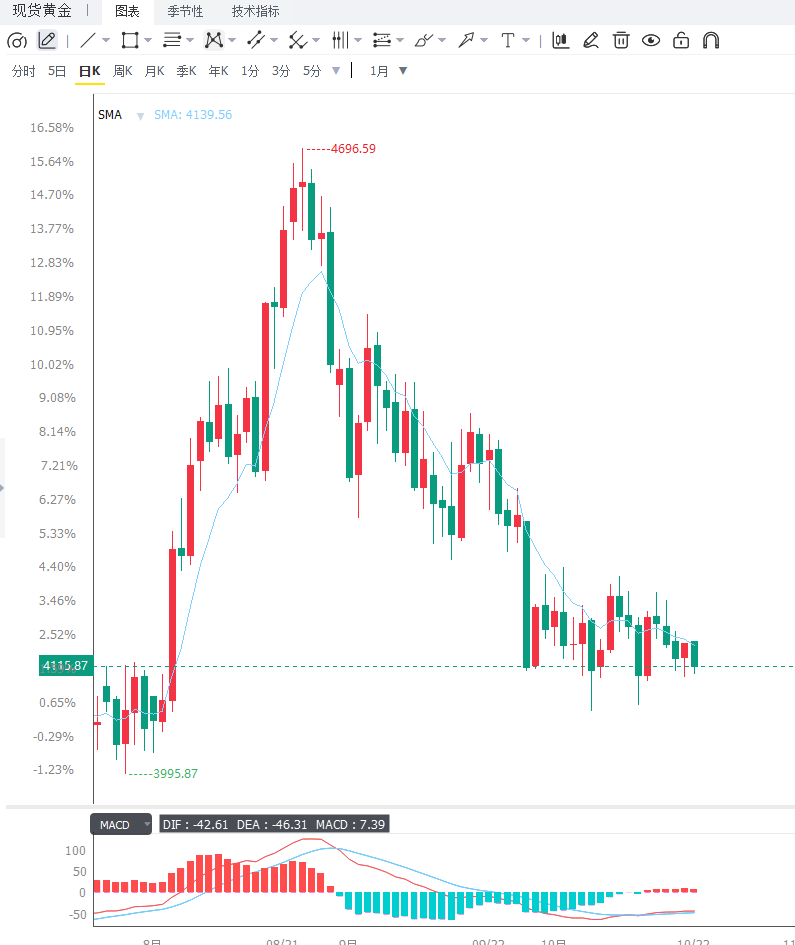 Editor's Summary: The core contradiction for gold in the short term lies in the support provided by geopolitical risk premiums, while the high-interest-rate environment and a strong dollar compress upside potential. The combined effect of these two factors suggests that gold prices are more likely to fluctuate within the $4070-$4160 range. Three key variables need to be monitored: first, the status of traffic in the Strait of Hormuz and the evolution of Iran's statements, which directly determine the duration of safe-haven demand; second, US inflation data and the Fed's year-end policy path. If expectations of a December rate hike continue to rise, real interest rate pressures will push gold prices to test the support below $4070; and third, the direction of the US dollar index. If the dollar weakens again due to reduced yield support, it will provide additional pricing support for gold. In the medium term, before a valid breakout from the current range, gold prices will maintain a weak and volatile pattern. Confirmation of the trend direction still requires the release of inflation data and the final clarification of central bank year-end policy paths.
Geopolitical risk premiums continue to accumulate. Iranian Foreign Minister Araqchi stated on Wednesday that while Iran remains firmly committed to seeking a dignified and peaceful solution, it is also fully prepared for self-defense. President Peschizian pointed out that the US should not expect dialogue with Iran while imposing blockades and threats. These statements extend the potential disruption risk from a single choke point to the entire Eurasian energy and shipping corridor, escalating market concerns about the logistics chain. However, this risk aversion is weakening the actual boost to gold prices from another logic: high oil prices have pushed up US inflation readings through cost channels, thus reinforcing the rationale for the Federal Reserve to further adjust monetary policy to curb price pressures. When inflation is driven by supply shocks, gold's anti-inflation narrative is often suppressed by tightening expectations, which is the fundamental reason why gold prices have weakened despite geopolitical tensions. At the monetary policy level, market pricing is undergoing a subtle shift. Federal Reserve Chairman Warsh avoided signaling the outcome of this month's policy meeting last week, but emphasized that higher-than-expected inflation has not changed his assessment of the US economy. According to the CME FedWatch tool, the probability of keeping interest rates unchanged at the October meeting is currently around 84%. While a rate hold next week is widely expected, the market is still pricing in another rate hike in December, keeping the policy outlook skewed towards tightening. Higher interest rates typically put downward pressure on gold, as precious metals do not pay interest, increasing their relative attractiveness as interest-bearing assets. Furthermore, high energy costs increase the likelihood that the Federal Reserve will need to further adjust its policy to control price pressures. For gold, this is a combination of "lack of dovish catalysts in the short term and unresolved interest rate pressures in the medium term": as long as the year-end tightening path is not disproven, every rebound in gold prices is likely to be met with profit-taking. Cross-asset correlations also release two-way signals. European risk assets fell due to political turmoil in France, while US Treasury yields rose due to reduced safe-haven demand; against this backdrop, the dollar strengthened slightly, and commodity prices weakened in tandem. This combination indicates that risk appetite has not contracted across the board, which to some extent weakens the safe-haven buying momentum for gold; while the interest rate differential's support for the dollar exerts additional downward pressure on gold prices through pricing channels. For gold, this is an environment where "safe-haven demand hasn't collapsed, but pricing isn't cooperating," meaning gold prices are more likely to digest geopolitical premiums through range-bound trading rather than a smooth, one-sided rise. Warsh's recent speeches scored 5.6/10, slightly below the historical average of 6.1/10, indicating a more moderate communication style than usual, but the overall tone remains constructive. He acknowledged that he was "deeply traumatized by the global financial crisis," highlighting a cautious approach to financial stability while emphasizing structural growth, surging investment, and artificial intelligence as short-term demand-side drivers and tools to strengthen confidence in data and monetary policy; meanwhile, he declined to predict decisions in October and December. The FXS Fed Sentiment Index remained unchanged at a high of 127.51, well above the neutral benchmark. This means that despite the lack of incremental signals in his speeches, the overall policy narrative remains firmly in the hawkish range. For gold, this constitutes a persistent headwind: as long as the index remains above 127 and the year-end tightening path is not disproven, the central level of real interest rates will be difficult to systematically decline, thus limiting the upside potential for gold prices. From a global market perspective, the current fluctuations in gold prices are essentially a superposition of two independent logics: on one hand, the increased demand for safe-haven assets due to Middle East shipping disruptions and political turmoil in France (with the Franco-German interest rate differential approaching a 24-year high), coupled with central bank gold purchases and ETF holdings providing structural support for gold prices; on the other hand, if oil prices continue to rise, they will further push up global inflation readings through cost channels, forcing central banks to extend the high-interest-rate cycle, which in turn will negatively impact precious metal valuations through the real interest rate channel. Therefore, it is inappropriate to simply equate geopolitical tensions with a bullish outlook for gold, but rather to focus on the true direction of real interest rates and the US dollar—only when inflation expectations diverge from real interest rates, or when the US dollar weakens again due to reduced yield support, will the pricing power of gold truly materialize. On the daily chart, spot gold is trading below the 20-period Bollinger Band middle line and the 100-day moving average. Short-term moving averages are in a bearish alignment, and rebounds are continuously suppressed by the aforementioned resistance levels. The medium-term bearish structure has not yet been repaired. However, the price is still holding above the lower Bollinger Band, suggesting that the short-term trend is more inclined towards consolidation rather than a full breakout. The RSI (14) is around 42.60, which is in the neutral to weak zone, indicating that downward momentum is still being released but has not extended excessively, which is a typical weak consolidation pattern. The upper resistance levels to watch are the Bollinger Band middle line at around $4160, the 100-day moving average at around $4230, and the Bollinger Band upper line at around $4255. These three levels constitute a wide supply zone. Only if the daily body effectively stands above $4160 can the current bearish tendency be alleviated. The first support level to watch is the lower Bollinger Band at around $4070, a key support level in the near term. A break below this level could open up further downside potential, while holding above it would likely allow gold prices to maintain a slightly bearish consolidation within the $4070-$4160 range. On the 4-hour chart, gold prices have been consolidating slowly along short-term moving averages after falling from around $4140. The MACD histogram is close to the zero line, with the fast and slow lines repeatedly intertwined, indicating neutral momentum. Currently, the price is oscillating narrowly between $4100 and $4140. A break below $4110 with significant volume could lead to support at $4090 or even $4070. An upward breakout would require a decline in real interest rates or an escalation of geopolitical tensions. Until then, a range-bound trading strategy is advisable, avoiding chasing highs and lows. Editor's Summary: The core contradiction for gold in the short term lies in the support provided by geopolitical risk premiums, while the high-interest-rate environment and a strong dollar compress upside potential. The combined effect of these two factors suggests that gold prices are more likely to fluctuate within the $4070-$4160 range. Three key variables need to be monitored: first, the status of traffic in the Strait of Hormuz and the evolution of Iran's statements, which directly determine the duration of safe-haven demand; second, US inflation data and the Fed's year-end policy path. If expectations of a December rate hike continue to rise, real interest rate pressures will push gold prices to test the support below $4070; and third, the direction of the US dollar index. If the dollar weakens again due to reduced yield support, it will provide additional pricing support for gold. In the medium term, before a valid breakout from the current range, gold prices will maintain a weak and volatile pattern. Confirmation of the trend direction still requires the release of inflation data and the final clarification of central bank year-end policy paths.
- Risk Warning and Disclaimer
- The market involves risk, and trading may not be suitable for all investors. This article is for reference only and does not constitute personal investment advice, nor does it take into account certain users’ specific investment objectives, financial situation, or other needs. Any investment decisions made based on this information are at your own risk.