Gold prices faced a sell-off, with key support levels testing buyer confidence.
2026-10-22 20:12:21
Gold showed upward potential last week, but the precious metal fell sharply in early trading today. Global market risk aversion intensified, leading to volatile and unpredictable price swings, with significant short-term speculative fluctuations. Day traders who expected a smooth upward trend are likely to have suffered losses, with speculative positions betting on higher gold prices particularly under pressure. This market action serves as a reminder to traders that short-term gold trading is always prone to sharp fluctuations.  Early morning sell-off tests short-term support for gold While gold has gradually risen over the past few weeks, multiple negative factors have continued to weigh on prices, making it difficult for them to break through resistance levels effectively. This morning's decline has not yet shown a widespread market-wide correlation, with only some Asian stock markets declining in tandem. The dollar's relatively small fluctuations this morning may indicate that this round of gold selling is a speculative move triggered by large funds taking profits recently. Support levels deserve close attention, and the next few hours will be crucial. If gold prices show solid support here, some aggressive speculators may re-enter the market to go long. High US Treasury yields continue to suppress gold prices . Gold is trading around $4058 during the session. The break below the $4100 mark has sounded alarm bells for major institutional trading rooms, which are analyzing the market movements in the coming hours. When gold prices began their rapid decline this morning, they were still around $4120. Yesterday, gold already showed signs of pressure at the end of the session, encountering strong resistance around $4140 before prices began to fall. Gold prices briefly tested $4,200 late last week, releasing some bullish signals and seemingly indicating upward potential. However, this rally has now turned into a sell signal. The core issue lies in the underlying drivers: while inflation concerns due to rising energy prices are undeniable, is the persistently high US Treasury yield still strongly dragging down gold? Traders bullish on gold should not be overly optimistic and should not expect an immediate and strong price surge. The sharp drop tests the willingness to buy on dips. After a rapid decline in just a few hours, gold traders hoping to profit from a rebound are now facing a dilemma. Theoretically, various risk events should benefit gold, but currently, they are continuously generating selling pressure. Gold is currently testing support around $4,050, presenting a significant temptation to buy on dips; however, gold also tested the $4,000 level at the end of July this year. All assets require attention to time cycles, and this is especially true for gold. Although the market generally believes that gold has value-preserving properties, it still occasionally faces selling pressure from speculative funds. The idea of being bullish in the short term is not inherently wrong, but if you choose to enter the market, you must make good risk control arrangements for quick entry and exit.
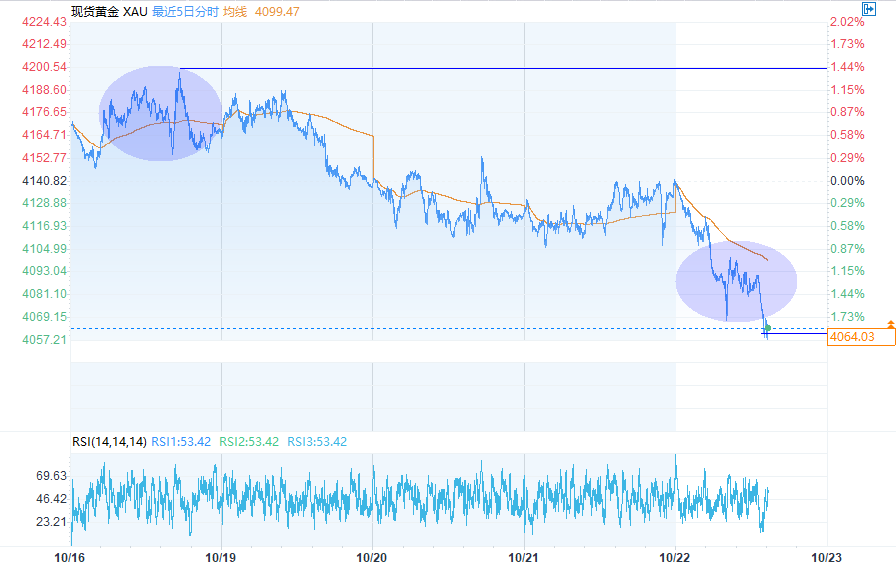 (Spot Gold 5-day chart source: EasyForex) Oversold Doesn't Mean a Stop to the Decline If US Treasury yields remain high or even continue to rise, gold prices have room to fall further. While the current strength of the US dollar has eased somewhat, it is likely to strengthen again if global stock markets continue to weaken and intensify selling. This means gold prices may continue to decline, even though many believe the market has entered oversold territory. If gold prices continue to fall further, traders inclined to go long need to remember: the current market price is the true market sentiment. Don't blindly buy simply because the market is considered oversold; this doesn't mean gold prices will reverse upwards in the short term. In a highly volatile market, reversals are uncertain. Yesterday and today's rapid decline in gold prices indicates that the precious metals market remains in a highly volatile environment. A cautious atmosphere in global markets has led to sudden changes in market sentiment, and gold traders must be constantly vigilant. While the decline in gold prices may seem excessive, traders looking to profit from a rebound should understand that short-term prices may not necessarily reverse upwards. Gold Short-Term Outlook After breaking below $4100, gold is currently trading around $4060, with the $4050 support level becoming a key target. If gold prices regain above $4095, short-term selling pressure will ease, potentially leading to a rebound to $4135; however, high US Treasury yields will continue to limit upside. A decisive break below $4050 would target $4030, indicating that buyers have not yet regained control of the market. Price reactions near support levels will determine whether this decline is gradually stabilizing or attracting more selling pressure.
Early morning sell-off tests short-term support for gold While gold has gradually risen over the past few weeks, multiple negative factors have continued to weigh on prices, making it difficult for them to break through resistance levels effectively. This morning's decline has not yet shown a widespread market-wide correlation, with only some Asian stock markets declining in tandem. The dollar's relatively small fluctuations this morning may indicate that this round of gold selling is a speculative move triggered by large funds taking profits recently. Support levels deserve close attention, and the next few hours will be crucial. If gold prices show solid support here, some aggressive speculators may re-enter the market to go long. High US Treasury yields continue to suppress gold prices . Gold is trading around $4058 during the session. The break below the $4100 mark has sounded alarm bells for major institutional trading rooms, which are analyzing the market movements in the coming hours. When gold prices began their rapid decline this morning, they were still around $4120. Yesterday, gold already showed signs of pressure at the end of the session, encountering strong resistance around $4140 before prices began to fall. Gold prices briefly tested $4,200 late last week, releasing some bullish signals and seemingly indicating upward potential. However, this rally has now turned into a sell signal. The core issue lies in the underlying drivers: while inflation concerns due to rising energy prices are undeniable, is the persistently high US Treasury yield still strongly dragging down gold? Traders bullish on gold should not be overly optimistic and should not expect an immediate and strong price surge. The sharp drop tests the willingness to buy on dips. After a rapid decline in just a few hours, gold traders hoping to profit from a rebound are now facing a dilemma. Theoretically, various risk events should benefit gold, but currently, they are continuously generating selling pressure. Gold is currently testing support around $4,050, presenting a significant temptation to buy on dips; however, gold also tested the $4,000 level at the end of July this year. All assets require attention to time cycles, and this is especially true for gold. Although the market generally believes that gold has value-preserving properties, it still occasionally faces selling pressure from speculative funds. The idea of being bullish in the short term is not inherently wrong, but if you choose to enter the market, you must make good risk control arrangements for quick entry and exit. (Spot Gold 5-day chart source: EasyForex) Oversold Doesn't Mean a Stop to the Decline If US Treasury yields remain high or even continue to rise, gold prices have room to fall further. While the current strength of the US dollar has eased somewhat, it is likely to strengthen again if global stock markets continue to weaken and intensify selling. This means gold prices may continue to decline, even though many believe the market has entered oversold territory. If gold prices continue to fall further, traders inclined to go long need to remember: the current market price is the true market sentiment. Don't blindly buy simply because the market is considered oversold; this doesn't mean gold prices will reverse upwards in the short term. In a highly volatile market, reversals are uncertain. Yesterday and today's rapid decline in gold prices indicates that the precious metals market remains in a highly volatile environment. A cautious atmosphere in global markets has led to sudden changes in market sentiment, and gold traders must be constantly vigilant. While the decline in gold prices may seem excessive, traders looking to profit from a rebound should understand that short-term prices may not necessarily reverse upwards. Gold Short-Term Outlook After breaking below $4100, gold is currently trading around $4060, with the $4050 support level becoming a key target. If gold prices regain above $4095, short-term selling pressure will ease, potentially leading to a rebound to $4135; however, high US Treasury yields will continue to limit upside. A decisive break below $4050 would target $4030, indicating that buyers have not yet regained control of the market. Price reactions near support levels will determine whether this decline is gradually stabilizing or attracting more selling pressure.
- Risk Warning and Disclaimer
- The market involves risk, and trading may not be suitable for all investors. This article is for reference only and does not constitute personal investment advice, nor does it take into account certain users’ specific investment objectives, financial situation, or other needs. Any investment decisions made based on this information are at your own risk.