Both bulls and bears are waiting: This UK budget may contain five major surprises.
2026-10-22 20:14:22
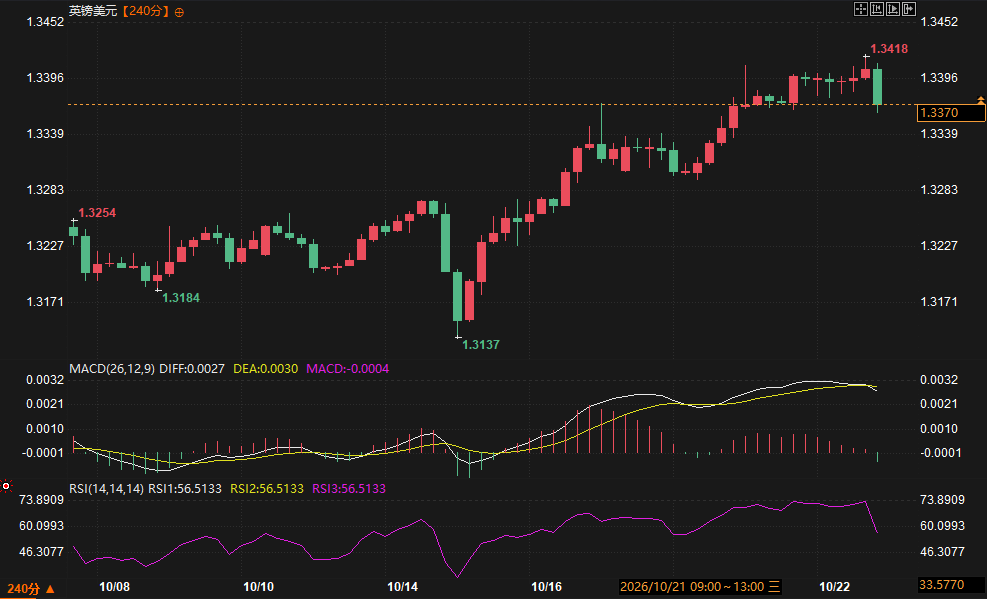
On Thursday (October 22), the British pound saw a significant recovery against the US dollar, rising from a low of 1.3137 on October 14 to around 1.34 on the 4-hour chart. Although the MACD histogram is converging and the RSI has retreated from overbought territory, the overall trend remains intact. However, data suggests that the true determinant of the pound's next move may lie not in the technical charts, but in the red box containing the UK's autumn budget on October 28.
With fiscal space shrinking, the market has already priced it in.
ING estimates that due to rising interest rate expectations and a roughly 70 basis point increase in 10-year government bond yields, UK debt interest payments will increase by approximately £11 billion annually by fiscal year 2029/30, potentially squeezing fiscal space from the £24 billion forecast in March to around £10 billion. Logically, Chancellor Healey will likely need a £5-6 billion tax increase to close the fiscal rule gap – explaining the pound's recent unusual sensitivity to fiscal news. However, ING also cautions that the Treasury has a history of initially projecting pessimism before delivering a surprise, as happened last year. If the OBR raises its wage growth forecast, even a mere 0.6 percentage point adjustment could bring in approximately £10 billion in liquidity, almost completely offsetting the increase in interest costs. This discrepancy between expectations and reality is precisely what fuels the pound's volatility.
Five unexpected events, each one pointing directly at the British pound.
ING listed five scenarios that could shock the market: First, fiscal space could increase rather than decrease, easing the pressure of tax increases and benefiting the pound; second, spending could exceed expectations, and if the OBR assessment shows substantial stimulus, the market would further bet on a UK interest rate hike, thus boosting the pound; third, a "tax shift" in income tax—simultaneously raising the basic income tax and lowering the National Insurance contribution rate by 2 percentage points, which could raise £6 billion annually—would signal to investors that Prime Minister Burnham is willing to touch sensitive tax systems; fourth, a minimum wage increase of close to 5% would strengthen the rationale for the Bank of England to raise interest rates in November or even take a more hawkish path; fifth, bond issuance could increase from £308 billion to approximately £325 billion, and if medium-term lending forecasts worsen, the gilt-edged bond market may not be so lenient.
The Bank of England is the main character; the budget is merely the scriptwriter.
It's worth noting that ING's benchmark assessment is that this budget will not bring substantial stimulus and will have a limited impact on the central bank—a November rate hike is already a market consensus. However, the real risks lie in the details: if the minimum wage increase exceeds 4.5%, and if energy subsidies are only nominally "temporary," these will alter the pricing of the inflation path. The consensus among mainstream overseas institutions is that the current strength of the pound is essentially supported by interest rate differentials, and the budget may very well rewrite the slope of this logic.
Is this the calm before the storm, or the beginning of a new trend?
From a technical perspective, the 1.3370 level represents the upper edge of a previous densely traded area, and the price has repeatedly confirmed its position above this level, indicating that the bulls have not exited. However, before October 28th, any rumors regarding fiscal space, minimum wage, or bond issuance plans could amplify volatility. A question worth considering is: if the budget is truly "unremarkable," will the pound, driven by expectations, lose its upward momentum? In event-driven markets, the most expensive element is often the expectation itself.
Further Reading
Q: What is "fiscal space"?
A: This refers to the buffer amount remaining after the government meets fiscal rules (the current budget must achieve a surplus within three years). The smaller the buffer, the greater the pressure to increase taxes or cut spending.
Q: Why would the budget affect the pound?
A: Fiscal expansion could boost inflation and interest rate expectations, attracting capital inflows; however, if bond issuance gets out of control, it could put downward pressure on the pound.
Q: What is "tax type switching"?
A: Simultaneously raising income tax and lowering national insurance is neutral to employees, but it can increase revenue due to a broader tax base. It is a politically sensitive and innovative solution.
Q: Why is the minimum wage important?
A: A significant increase would push up business costs and service inflation, directly impacting the Bank of England's assessment of its interest rate path.
Q: Will the central bank raise interest rates in November?
A: The market has generally priced in the interest rate hike. If the budget unexpectedly stimulates the economy, it may reinforce a more hawkish pricing strategy.
- Risk Warning and Disclaimer
- The market involves risk, and trading may not be suitable for all investors. This article is for reference only and does not constitute personal investment advice, nor does it take into account certain users’ specific investment objectives, financial situation, or other needs. Any investment decisions made based on this information are at your own risk.