Institutions: Leveraged liquidation renders gold ineffective as a safe haven, but its long-term strategic value remains.
2026-10-23 07:40:21
On Friday (October 23) during Asian trading hours, spot gold traded in a narrow range, currently hovering around $4028 per ounce. On Thursday, spot gold fell sharply by 2.8%, closing at $4025.23 per ounce, having touched $4020.95 during the session, its lowest level since August 3. HSBC Asset Management strategists stated that gold's strong rally earlier this year had pushed prices well above $5000 per ounce, but that rally has stalled, with prices falling and volatility increasing. They noted that gold failed to protect portfolios during the recent stock market decline as leveraged positions were sold to meet margin calls. HSBC still believes gold has strategic allocation value, citing factors including currency devaluation trades, central bank reserve diversification, and geopolitical fragmentation. 
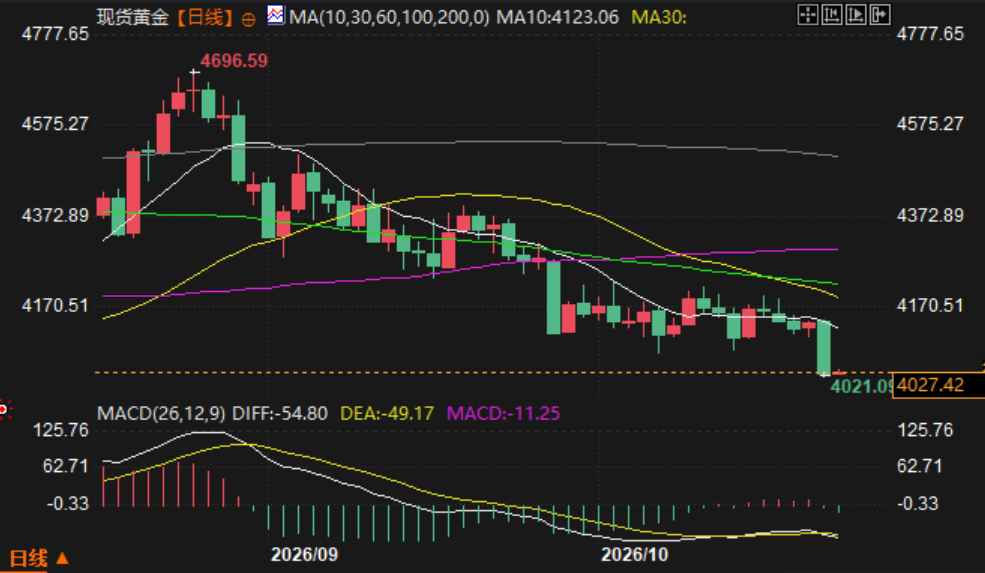 (Spot gold daily chart, source: FX678) At 7:28 Beijing time, spot gold was trading at $4,027.62 per ounce.
Key takeaway: Gold's short-term hedging effect has failed, but its long-term strategic value remains.
HSBC Asset Management strategists stated that gold's strong rally earlier this year has stalled, with prices falling and volatility increasing. Gold failed to protect portfolios during the recent stock market downturn as leveraged positions were sold to meet margin calls. However, HSBC still believes gold has strategic allocation value, citing factors such as currency devaluation trades, central bank reserve diversification, and geopolitical fragmentation. Gold's short-term performance is constrained by forced liquidations of leveraged funds, but its long-term strategic value is supported by structural factors. Investors should not rely on gold to cushion short-term stock market declines, but can retain it in their long-term portfolios.Leveraged Funds and Margin Calls: Gold Becomes a Source of Cash During Stock Market Declines
HSBC's more pointed message concerns gold's performance during stock market sell-offs. As large amounts of leveraged funds flowed into gold, sharp stock market declines triggered margin calls, prompting investors to sell gold to raise cash. HSBC concluded that gold may be a good hedge against systemic risk in a multipolar world, but it cannot be expected to reduce short-term volatility. Strategists stated that no single asset can withstand all types of stress, which is why investors should diversify their portfolios. The core of this logic is that gold's safe-haven function may fail in leveraged markets, as investors need cash during stressful periods, and gold is one of the most liquid assets. This doesn't mean gold's safe-haven properties have disappeared, but rather that its performance during short-term stress may be less than expected.Thursday's market confirmed this: gold and the Nasdaq both fell.
Thursday's trading confirmed this description. Spot gold fell to around $4,020 per ounce, its lowest level since August, while the Nasdaq fell more than 2.5% on the same day due to a broad sell-off in chip stocks. The simultaneous decline in gold along with risk assets suggests that gold has failed to provide safe-haven protection in the current market structure. This phenomenon aligns with HSBC's assessment—forced liquidation of leveraged funds overwhelmed gold's safe-haven properties.Comparison with July report: From range trading to no price target
It's worth noting that the latest report did not provide a price target. This contrasts with HSBC's more confident tone in July, when Global Chief Investment Officer Willem Sels and Global Head of Wealth Insights Lucia Ku stated that US Treasury yields had become the main driver of gold prices. They noted at the time that gold had not risen during the Middle East conflict and had largely moved in tandem with stocks. They expected gold prices to remain range-bound in the short term due to high real yields and a strong dollar, but still anticipated further gains by year-end driven by diversification demand, central bank purchases, and stable ETF inflows. Now, with gold prices about a quarter below their January peak, the latest report's lack of a target indicates a more cautious stance. HSBC's short-term view on gold has shifted from "range-bound trading, year-end rise" to "no price target, more cautious," reflecting the impact of falling gold prices and increased volatility on its judgment.Structural Support: Asian Demand and Institutional Allocation
In a May interview, HSBC's chief precious metals analyst, James Steel, offered a different interpretation of the same pattern. He refuted the claim that gold's decline after the Iranian attack indicated a failure of its safe-haven function. With rising oil prices, renewed inflation concerns, climbing bond yields and the dollar, and falling stock markets, investors needed cash, and gold provided that cash. In his view, the liquidation was a reaction to broader financial market pressures: investors were cashing out their insurance policies, not abandoning them. Steel also noted that the old positive correlation between gold and oil had broken down, becoming weak and sometimes negative. He pointed to structural support in Asia, where regulatory changes now allow large insurance companies in major Asian countries and Indian asset managers to hold gold. This has shifted demand from major Asian countries towards large institutional gold bars, away from jewelry and coins. He stated that more asset managers who had never held gold before are beginning to add it as an alternative asset due to its combination of hardness and high liquidity. At the heart of this structural support is that regulatory changes and institutional allocation demand in Asia provide a long-term floor for gold, potentially limiting the downside for prices.Summarize
HSBC believes gold is not a short-term hedge against stocks, as leveraged funds are forced to liquidate during stock market declines, making gold a source of cash rather than a protective tool. However, HSBC still believes gold has long-term strategic value, citing factors such as currency devaluation trading, central bank reserve diversification, and geopolitical fragmentation. Spot gold fell sharply on Thursday to its lowest level since August, coinciding with a sharp drop in the Nasdaq index, confirming the phenomenon of gold falling in tandem with risk assets. The main pressure on gold prices is transmitted through oil: Brent crude above $110/barrel exacerbates inflation concerns, pushing up yields and the dollar, increasing the cost of holding gold. The latest report did not provide a price target, contrasting with the confident tone of "range trading, year-end rise" in July, indicating a more cautious stance. Regulatory changes in Asia and institutional allocation demand provide long-term structural support for gold, potentially limiting downside. Near-term direction depends on whether the stock market can stabilize, whether margin pressures can ease, and whether yields can fall from their highs. Short-term pressures are likely to continue to dominate gold prices until yields fall or stock market volatility subsides. (Spot gold daily chart, source: FX678) At 7:28 Beijing time, spot gold was trading at $4,027.62 per ounce.- Risk Warning and Disclaimer
- The market involves risk, and trading may not be suitable for all investors. This article is for reference only and does not constitute personal investment advice, nor does it take into account certain users’ specific investment objectives, financial situation, or other needs. Any investment decisions made based on this information are at your own risk.